
TheOldGuy @TheOldGuy@qoto.org
I am a Democrat who supports Ukraine in their battle against The Russian fascist invaders.
I am a 73 year old Covid hermit who
lives on 10 acres in a sparsely populated area of the Ozarks. I heat with wood that is leftover by the lumber industry. When cutting oak for lumber only the trunk is used.
The largest town is population 2993. The county is 13k people scattered over 713 square miles.
Joined Dec 2022
🟣 This can demonstrate how Plaestinians create their alternative universe, where they always emerge victorious, through use of language to reinterpret factual events.
To most of us, this photo may signify a symbolic defeat for Hamas, with the IDF soldier standing tall while the Hamas fighter sits, restrained and stripped of uniform.
Despite instances of Palestinian defeat in wars with Israel, they manage to present themselves as victorious by framing the outcomes differently: "We demonstrated resilience against Israel," or "Israel engaged in talks with our leadership, acknowledging our legitimacy."
And here too. Palestinians look at this photo, and see victory, as the captured Hamas fighter maintains direct eye contact with the soldier. This moment in time the interaction is taken out of context and can be interpreted in so many different ways. But for them, if they can convince themselves that it symbolises victory, this is all they need.
In this war, we will crush Hamas, and will turn Gaza into a wasteland.
But I assure you, they will declare victory the day after the end of the war.
@AliaDiok
🇮🇱 @israel_report
🔴 IDF: Footage of close-quarters combat with armed terrorist in civilian clothing in Khan Yunis
In Khan Yunis, where Hamas has deliberately embedded its military infrastructure within densely-populated, urban areas, the IDF Paratroopers Brigade has been fighting terrorist operatives in close-quarters combat situations over the last few weeks.
During operations next to the residence of the commander of Hamas' Khan Yunis Brigade, paratroopers identified a terrorist operative - who was dressed in civilian clothing - armed with grenades and a knife. After the terrorist advanced toward them and threw a grenade in their direction, the soldiers immediately identified the threat, returned fire, and killed him at close range without sustaining any casualties.
This is a further example of the Hamas terror organization's strategy of terrorists operating under the guise of civilians during military activities.
Attached is footage from the battle and the elimination of the terrorist in civilian clothing: https://bit.ly/4bmOh7z
Attached is an image of the eliminated terrorist: https://IDFANC.activetrail.biz/ANC050220248475
🇮🇱 @israel_report
⚫ Nakba explained:
With rare exceptions, the Arabs that fled the fighting or were ‘expelled’ in ‘48 were fleeing from retribution from their own invading Arab armies. The understanding was that any Arab that remained in the areas under attack was a traitor that was cooperating with the local Jews.
The Arabs nakba’d themselves! Which also explains the initial reluctance to settle Nakba Arabs within the surrounding states - absorbing these populations would have involved an admission of culpability for their plight, and scapegoating the Jews became an irresistible option…
On the last day of November 1947, three days before hostilities broke out, the Higher Arab Committee reiterated its established policy on ties with Jews:
“The Arab nation is called on to remain steadfast in an absolute boycott of the Jews and to consider any connection with them a severe crime and great betrayal of religion and the homeland.”
It called on the Arabs of Palestine to enlist in the struggle… It quickly became clear, however, that Arabs were in no hurry to heed the Committee’s call. Only a few thousand enlisted in the combat forces… Nor was severing ties with the Jews accepted by the public at large. What the Higher Arab Committee called “a great betrayal” did not appear that way to many Arabs. Furthermore, not only were they passive, but some resisted (at various levels) the fighters and military activities.
This unwillingness to do battle pervaded the country. In December 1947 the inhabitants of Tulkarem refused to attack Jewish towns to their west, to the chagrin of the local Holy Jihad commander, Hasan Salameh. Sources in Ramallah reported at the same time that many were refusing to enlist, and reports from Beit Jibrin indicated that ‘Abd al-Rahman al-‘Azzi was doing all he could to keep his region quiet. The villagers of the Bani-Hasan nahiya southwest of Jerusalem decided not to carry out military actions within their territory, and the people of al-Maliha refused a request from ‘Abd al-Qader al-Husseini to attack the Jewish neighborhoods of Mekor Hayyim and Bayyit va-Gan. That same month, at the end of January, the inhabitants of ‘Ayn Ghazal, on the coast below Mt. Carmel, refused to blow up Jewish-owned lime kilns adjacent to the village. Three weeks later the residents of Ramla and Lydda were told to take part in an attack on Jews; they ignored the order. At the end of March men under the command of Hussein Hassouna of Lydda disarmed mines near the Jewish agricultural school of Ben Shemen laid by volunteers from the Arab Liberation Army. Similar incidents occurred in villages in the Lower Galilee.
(…)
The fighters from Arab countries were, of course, witnesses to this conduct, which became the origin of the charge that the Palestinians were traitors to the Arab cause. The foreign volunteers could not but be cognizant that, while they had come from afar to save Palestine and fight for its Arabs, some of the Palestinian Arabs themselves were making alliances and maintaining social and economic ties with Jews. Some were even seeking to negotiate a peace agreement (1)
Old Palestine was a traditional society where—though the Arabs might not have liked the Jews on a communal level—peace was valued more than modern ideas of national glory or the pan-Arab state.
@FissileFinance
🇮🇱 @israel_report
🔴 IDF: Terrorist cell identified operating near IDF troops thwarted in joint ground, aerial, and naval operation
In the central Gaza Strip, a five-man terrorist cell operating near IDF troops was identified and promptly thwarted through a joint operation involving ground forces, the brigade's fire control center, aircraft, naval vessels, and tanks.
IDF troops are continuing to conduct targeted raids on Hamas terrorist targets in the central and northern Gaza Strip. Over the past day, the 401st and the Nahal brigades killed dozens of terrorists.
During IDF activity in Khan Yunis, an IAF fighter jet struck a Hamas terrorist cell operating inside terrorist infrastructure, where the terrorists were preparing to attack IDF troops in a nearby structure with explosives.
In western Khan Yunis, IDF troops continue to kill terror operatives in battles and conduct targeted raids on terrorist targets. Over the past day, the troops killed dozens of terrorists who ambushed the troops throughout the city.
In another IDF activity, a terrorist carrying explosive devices near IDF troops was identified and struck by an aircraft. Secondary explosions were seen, which indicated explosive devices in his possession.
In a separate IDF activity directed by intelligence in Khan Yunis, IDF troops conducted targeted raids on terrorist targets and located weapons including AK-47 rifles, sniper rifles, grenades, and ammunition. The troops also killed 10 terrorists using close-range fire and aerial support.
Furthermore, IDF missile boats struck terrorist infrastructure used by terrorist organizations in the Gaza Strip.
Attached is a video of the terrorist cell thwarted by joint ground, air, and navy forces: https://bit.ly/3SMsMFO
Attached are photos of IDF activity in the Gaza Strip: https://IDFANC.activetrail.biz/anc0502202465841135426541234
Attached is a video of IDF strikes in the Gaza Strip: https://bit.ly/3OudG5v
Attached is a video of IDF activity in the Gaza Strip: https://bit.ly/3OuCj1Q
🇮🇱 @israel_report
🟠 Did you know that before becoming America’s jihad capital, Dearborn, Michigan, was a thriving center of Middle Eastern Christian culture?
Not a lot of people know, but Dearborn was initially settled in the early 20th century by Lebanese Christians and Assyrians/Chaldeans fleeing Islamic persecution in the Middle East.
Middle Eastern Christians were the majority of Dearborn’s population until the 1980s, when they gradually started being replaced by Hezbollah-supporting Muslims from Southern Lebanon, Yemen, Iraq and Bangladesh.
These Christians no longer felt welcomed in the city they helped build. Fearing the same persecution they faced back home, they had no other option but flee Dearborn too.
Dearborn became unlivable. Islamic extremism runs the city now. Maronite, Chaldean and Orthodox churches were converted into mosques. Dearborn’s Eastern Christian heritage is forever lost.
@realmaalouf
🇮🇱 @israel_report
Two Russian army T-72 tanks collided during a botched assault in eastern Ukraine last week.
It’s a sign that Russian training standards continue to slip as the Kremlin struggles to make good the more than 300,000 casualties its forces have suffered in their 23-month wider war on Ukraine.
“Complete stupidity and incompetence,” is how one Russian blogger described the recent assault in a missive translated by wartranslated.
The tanks were part a company-size element that attacked the Ukrainian garrison in Novomykhailivka, 10 miles west of Donetsk in eastern Ukraine on Jan. 30.
The grouping included three T-72s, seven MT-LB armored tractors and a single BMP-2 fighting vehicle.
The assault got off to a bad start, when—a couple of miles from the front line—two of the T-72s collided, disabling one of the tanks.
The rest of the vehicles proceeded with their attack, only to come under fire from Ukrainian artillery, anti-tank missiles and explosive FPV's
Source Forbes.
🇺🇦@ukraine_report🇺🇦🔱Liz
Russia Will Block VPN Services in March, Says Safe Internet League Chief Mizulina.
Downloads of VPNs, which help users access blocked websites, surged in Russia after authorities started blocking Western social media platforms and scores of Russian independent news outlets amid the invasion of Ukraine.
At a meeting with Russian schoolchildren in Yekaterinburg, Mizulina admitted that it will not be possible to block all VPNs.
Mizulina is head of the "Safe Internet League" in Russia, avid supporter of war. In her speech on May 26, 2022 to the International News Agency “Russia Today”, she called the citizens who left Russia and disagree with Russia’s invasion of Ukraine “crowing roosters”, and their departure from the country was a cleansing of unwanted citizens. Another threat was made against Google and Wikipedia: “First, we will clean Ukraine from the Nazis and Bandera, and then we will get to Google and Wikipedia,” Mizulina said.
🇺🇦@ukraine_report🇺🇦🔱Liz
🇪🇺🇺🇦 Stop exporting weapons and send them to Ukraine instead, Borrell urges EU countries
Member states should temporarily halt exports of weapons to countries other than Ukraine, The High Representative of the European Union for Foreign Affairs and Security Policy Josep Borrell said on Monday, asking governments to take a "political decision" and step up ammunition supplies.
"Not only do we have to support Ukraine for as long as it takes but for whatever it takes. (It's) not just a matter of time – it's a matter of quantity and quality of our supplies," the foreign policy chief said during an official visit to Warsaw.
"And certainly we have to do more and quicker because Ukraine has to prevail."
The European Union approved in March last year a €2-billion plan to boost ammunition deliveries to Ukraine, pledging to send one million 155mm shells within 12 months to help the battered country defend itself against Russia's full-scale invasion.
But by late 2023, the bloc had provided just 330,000 rounds, despite repeated pleas from Kyiv. The number is expected to reach around 520,000 by the end of March.
The slow deliveries were initially blamed on entrenched industrial bottlenecks, supply chain disruptions and sluggish investment, a direct consequence of the peaceful years that Europe enjoyed after the end of the Cold War.
However, according to Borrell, industrial capacity is no longer an obstacle: what is hampering deliveries to Ukraine is the fact that European companies are exporting weapons to clients that are not at war.
"An important part of our production is being exported to third countries," he said, without naming the destinations.
"The quickest and cheapest and (most) effective way of increasing our supply of
ammunition to Ukraine is to stop exporting
to third countries. And this is something that
only member states can do – and this has
been my request."
"Try to tell the others (clients) – 'please wait, you're not at war, you can wait some months' – and divert this production to Ukraine"
18+ Graphical Content
The 110th Separate Mechanised Brigade are fighting the ruzzians in Avdiivka and wrote the following message:
--
Avdiivka - under extremely high pressure from the enemy, these cockroaches seem to have no limit in number... assaults occur every 30 minutes
BUT...
We do everything for these "non-people" so that Avdiivka seems like hell not only for us...!
We thank all friends, volunteers, patriots, our relatives, our families, everyone who helps us!
GLORY TO UKRAINE!!!
DEATH TO ENEMIES!!!
--
Note: Warriors Ukrainian directly support the 110th Separate Mechanised Brigade through collections for drones and other equipment!
Orbán boycotts parliament session called to ratify Swedish NATO bid - The Guardian
Sweden applied to join NATO following Russia's war against Ukraine, but Hungary has so far prevented the membership.
Today, Hungary’s ruling Fidesz party boycotted a session of parliament called by the opposition to ratify Sweden’s Nato membership, even as a group of western ambassadors arrived in the building to urge a vote.
For months, the Hungarian prime minister, Viktor Orbán, repeatedly promised his counterparts within Nato that the country would not be last to sign off on Sweden’s membership. But Orbán reneged on the pledge when Turkey ratified the Swedish bid last month, leaving Hungary alone holding up Stockholm’s accession.
The Hungarian leader then publicly promised Nato’s secretary general, Jens Stoltenberg, that he would urge parliament to “conclude the ratification at the first possible opportunity” – only to also abandon that pledge by not showing up to a session initiated by the country’s opposition with the aim of voting on Sweden’s accession.
In a symbolic move, a group of 16 diplomatic representatives, including the American ambassador in Budapest, David Pressman, arrived at Hungary’s parliament on Monday.
“Sweden’s Nato accession is an issue that directly affects the United States national security and it affects the security of our alliance as a whole.”, Pressman stated.
“The prime minister pledged to convene parliament and urge parliament to act at its earliest opportunity. Today was an opportunity to do that – and we look forward to watching this closely and to Hungary acting expeditiously,” the American diplomat added.
The Hungarian delay has deeply frustrated western officials, who have expressed concern both about the length of delays and the lack of clarity over the reasoning behind Hungary’s moves.
A horde of violent criminals have invaded Eagle Pass, Texas
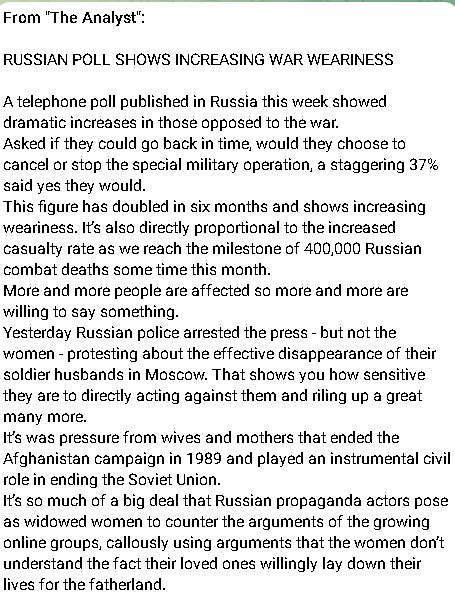
From "The Analyst":
AVDIVKA UPDATE
Russian forces in the south west salient they created have effectively been cut off as Ukraine has regained the key fortified area of the restaurant services area.
Russia tried to send a column to reinforce their troops in Avdivka’s lower streets, but this was annihilated.
The Russians used a 2km waste water service pipe to get behind the restaurant and into south Avdivka. It’s very narrow and they had to crawl through it, so supplying and reinforcing the now cut off island they’re in in south Avdivka is near impossible, if not pointless.
The tunnel needs to be destroyed at both ends and it’s deep so this hasn’t yet happened.
Eradicating the Russians in the housing they occupied is well underway.
Overall the Russian operation was quite imaginative and it gave them a major gain - taking the southern defences completely and the Ukrainians by surprise. In some ways the Ukrainians should have expected use of the tunnel, or at least taken precautions to block it. It’s far more likely they just never expected it could be used if they even remembered it was there.
Russian success - and it was, there’s no getting away from that, it was a daring and imaginative operation, was simply not followed up. Senior commanders doubted its likely success and no one was ready to exploit it until it was far too late. By then the Ukrainians had snatched back the restaurant’s fortification, because nobody reinforced the Russian forces, and now the few remaining Russian troops are more or less trapped, and the whole thing has turned into a Russian disaster. It’s not something Ukraine will fall for again and they’re probably looking to make sure nothing like happens anywhere else either.
This could have been the most consequential move the Russians made in months.
If they had been ready to exploit the success and acted quickly, given it the support it needed, they could have surrounded Zenit and have broken deep into Avdivka. It would in all likelihood have been the beginning of a much faster end for the town which would have quickly become untenable.
Instead their own handful of competent people were as usual, let down by hide bound commanders with zero imagination. Ukraine has always worked well against such opponents and did so again. That they were just as quick to see what had happened and responded with lightning pace to retake the initiative says it all.
Yet another bad day for Russia!
Slava Ukraini 🇺🇦!
Daily Russian losses
https://t.me/WarriorsUkrainian/20479
Russia has assembled forces to attack Kupyansk - Forbes
According to the publication the goal is to retake a huge swathe of Kharkiv Oblast that the Russians briefly occupied in 2022, perhaps as a "gift to Putin" for the March (so called) "elections".
The information from Forbes about the force in the area corresponds with statements previously made by the Ukrainian head of the press service of the operational and strategic group of troops "Khortytsia" Ilya Yevlash:
"The Russian occupation army has concentrated a total of about 57K troops in the Lyman-Kupyansk direction, including about 500 tanks, 1100 armored vehicles, 530 artillery barrels and 200 MLRS.
Most of these forces are held in the Kupyansk direction:
40,000 soldiers,
500 tanks, 650 armored fighting vehicles,
430 artillery systems, more than 150 MLRS.
That is, together they are very powerful forces. And the enemy does not abandon its intentions to continue gathering its reserves, preparing them. That is, we do not see that the enemy intends to stop its actions. Our task now is to deter and knock out the enemy as much as possible", Ilya Yevlash said.
Forbes write:
It’s obvious what this army aims to do: retake a huge swathe of Kharkiv Oblast that the Russians briefly occupied in 2022—until a powerful Ukrainian counteroffensive liberated most of the oblast late that year.
Everything east of the nearest major river is the goal. “The Russian Federation plans to seize the entire Donetsk and Luhansk Oblasts and part of Kharkiv Oblast up to the Oskil River by March 2024,” the Ukrainian Center for Defense Strategies explained. The river threads through Kupyansk from the north.
Why March? Because that’s when Russia will “vote” for “president” in a national “election.” In fact, Vladimir Putin is the only real candidate—and will maintain his brutal, dictatorial control over Russia and the Russian war of aggression in Ukraine.
A slice of Kharkiv would be an election-day gift to Putin from the Russian army in Ukraine.
Some or part of around 10 Ukrainian brigades, anchored in the north by the 3rd Tank Brigade and south by the 4th Tank Brigade, defends Kupyansk and surrounding settlements. It’s a significant forces with perhaps 20,000 troops and hundreds of tanks, fighting vehicles and howitzers.
But people and vehicles aren’t the problem for the Ukrainians. The problem is ammunition. The United States was one of the biggest donors of 155-millimeter shells for Ukraine’s best big guns—and pro-Russia Republicans in the U.S. Congress cut off aid to Ukraine last fall.
Since then, Ukrainian forces’ daily allotment of shells has fallen by two-thirds to just 2,000 rounds. Russian forces meanwhile fire as many as 10,000 shells a day, thanks to a steady supply of ammo from North Korea.
“Artillery shortages and delays in Western security assistance will create uncertainty in Ukrainian operational plans,” the Institute for the Study of War in Washington, D.C. warned, “and likely prompt Ukrainian forces to husband materiel, which may force Ukrainian forces to make tough decisions about prioritizing certain sectors of the front over sectors where limited territorial setbacks are least damaging.”
Perhaps most importantly, Ukrainian workshops are building explosives-laden first-person-view drones—tens of thousands of them per month. As artillery ammunition becomes scarce, Ukrainian brigades are flinging more and more FPVs at the Russians: sometimes thousands per day all along the 600-mile front.
But the FPVs range just two miles or so—too short to target artillery that might be 15 or miles from the line of contact. Drone-operators have made quick work of small Russian assault groups that, for months now, have been probing the Kupyansk sector.
"But can a swarm of two-pound drones, even thousands of them, defeat 500 tanks and 650 fighting vehicles as they attack behind a wall of artillery fire?", Forbes ask.
Ukrainian President Zelenskyy at the front lines.
https://mil.in.ua/en/news/zelensky-visited-frontline-positions-in-the-village-of-robotyne/
Problems The Commanding Genertal plans to solve in 2024.
https://mil.in.ua/en/news/zaluzhnyi-names-key-problems-of-armed-forces-of-ukraine-to-be-solved-in-2024/
I am a Democrat who supports Ukraine in their battle against The Russian fascist invaders.
I am a 73 year old Covid hermit who
lives on 10 acres in a sparsely populated area of the Ozarks. I heat with wood that is leftover by the lumber industry. When cutting oak for lumber only the trunk is used.
The largest town is population 2993. The county is 13k people scattered over 713 square miles.
Joined Dec 2022
TheOldGuy's choices: