

A Concerned Scientist @BE@qoto.org
Moved full time to my other account @BE soon as this instance is still having issues.
Joined Nov 2022
Presented without further comment.
https://www.nature.com/articles/s41577-019-0143-6
"The adaptive immune response to influenza virus infection is multifaceted and complex, involving antibody and cellular responses at both systemic and mucosal levels. Immune responses to natural infection with influenza virus in humans are relatively broad and long-lived, but influenza viruses can escape from these responses over time owing to their high mutation rates and antigenic flexibility."
https://www.ncbi.nlm.nih.gov/pmc/articles/PMC5291154/
"In summary, herd effects are assumed with influenza vaccine programmes, but there are few studies that quantify the herd effect of vaccination. We found low-level evidence supporting a herd effect of vaccination on influenza virus infection in contacts of vaccinated persons. Further rigorous studies are needed in order to better understand under which circumstances vaccination may prevent influenza and its complications in contacts."
A Concerned Scientist
boosted

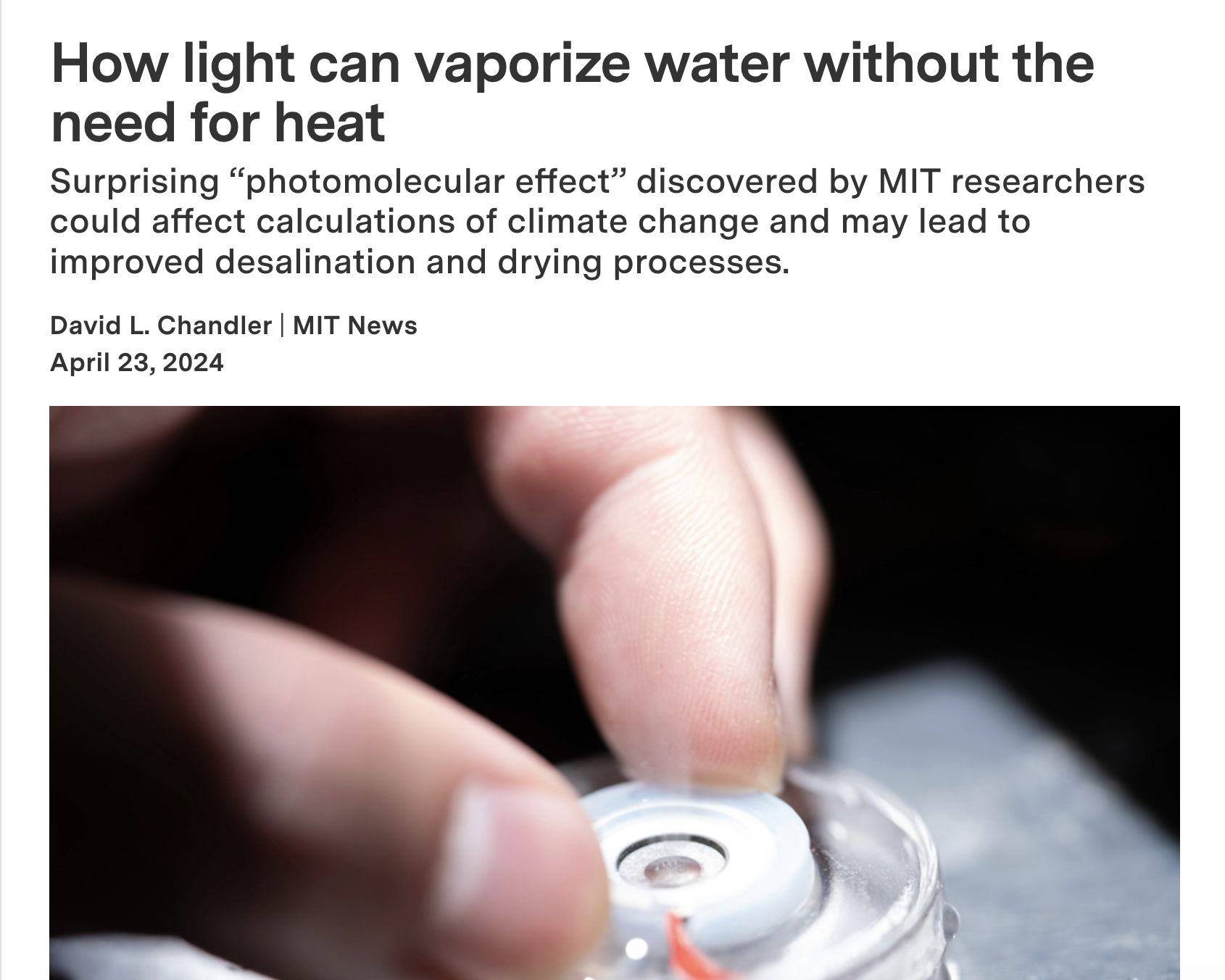
Well, this seems to be an interesting and unexpected big deal: a new paper suggests that light can evaporate water without actually needing to heat the water up first. And it could sort out a few problems in existing cloud physics:
https://news.mit.edu/2024/how-light-can-vaporize-water-without-heat-0423
@PacificNic @Edelruth @NilaJones
Exactly this. I went from 99% confidence, to maybe 90% on this after more reading.
We've cut out grocery store milk as of last night, but, it's a tiny bit of our diet and just seemed like something really easy to do for us.
@PacificNic @Edelruth @NilaJones
Correct. Further testing necessary.
Yes, but really just because someone just sent it to me to try to "talk me down from the ledge" about bird flu. I don't think I'm on any ledge here and I certainly don't need Leana Wen to talk me down 
One of the easiest blocks in history.
I've never turned on the option to not receive DMs from people you don't follow(or something like that) but maybe I should 😂
I don't know how to say this politely. If you take Leana Wen seriously, you're not serious and should probably keep your opinions to yourself.
A Concerned Scientist
boosted

I've been grieving and processing a covid-conscious friend's death, and so far the grief has been quite private, but I put together a document on the biopsychosocial issues faced by our covid-conscious community. I want people to know they aren't alone facing these challenges, that there are things you can do to be prepared before a crisis happens. I want people to know that Covid itself can cause mental health risks. Please feel free to share this resource:
https://docs.google.com/document/d/1GY8SZfIeApt09bTn7Hs3jv0qqneEzFA1AUJEUcOmMvo/edit?usp=drivesdk
We kicked around a bunch of non-dairy options last night. We haven't ever done it, but it's an option for sure.
My kids already much prefer flax milk, so, that's what goes on cereal and whatnot already.
I would hope that it's been/being investigated, but, I was pretty disappointed that the FDA just went "It probably works, but, we haven't tested it." Seems like something that should have been extensively tested ahead of that moment. It really wouldn't have been THAT hard to do.
Great source info on the different ways to treat milk, though. Thank you for that! I definitely learned something there.
I've also been asked a lot whether we're in panic mode here, and if we're running off to the homestead.
No, not at this point. We, obviously, already take airborne precautions. Please don't forget about COVID.
Last night my wife and I did make the decision to stop using grocery store milk. We really only buy 2 gallons a month. It's not a big deal to us, so it seems like an easy thing to do. We use it to make kefir, and kefir can, under some circumstances, harbor and facilitate the growth of viruses from what I've read. So the kefir grains are going to stop being fed for the moment. Sorry kefir grains.
If I bought a lot of ground beef from the store would I be worried? Hard to tell since it's not something we do, but, I guess I'd be cooking it to a higher temperature, at least.
Know your egg substitutes.
Crises precipitate change. Don't be afraid to be flexible as circumstances change.
Otherwise, we're just keeping up to date and seeing what goes on.
Who am I following on this? @HelenBranswell has a string of great articles at statnews.com.
https://www.statnews.com/2024/04/05/bird-flu-cdc-urges-doctors-watch-for-h5n1-in-farm-workers/
https://www.statnews.com/2024/04/18/h5n1-bird-flu-scientists-want-usda-genetic-data-faster/
https://www.statnews.com/2024/04/23/h5n1-bird-flu-genetic-analysis/
https://www.statnews.com/2024/04/23/h5n1-bird-flu-virus-particles-in-pasteurized-milk-fda/
https://www.statnews.com/2024/04/24/h5n1-bird-flu-vaccine-preparedness/
I follow a lot of people. 1,878 as of this morning. I also don't engage in any other social media. Never have, never intend to. Pretty much every other social media domain is blocked at our firewall level. I only looked at twitter(as it was called at the time) in December of 2019, for the first time in my life, to try to get fast breaking COVID news, and have access to scientists who would be ahead of the knowledge curve.
I'm only really here for one reason. To get good info, synthesize it, and redistribute it, often in different words, when I think it'll be helpful. Despite some truly "delightful" DMs I've received recently, I have no ulterior motive. No one's forcing you to believe that, and I take it as a badge of honor to be blocked, so, knock yourself out if you're so inclined.
I'm asking everyone, particularly scientists, to be careful with your words. There's been palatable rising tensions here in 2024. Some of it has to do with science(H5N1, WHO airborne) some of it doesn't(politics), but it's real.
I have seen some truly awful H5N1 takes as things ramp up. Particularly this morning. Nuance matters. If you want to be a prognosticator, be clear. "I think" or "I believe" instead of launching into what you want to say.
Here's a few things I've seen that should be discussed carefully:
- Pasteurization is completely effective against H5N1.
Here's what the FDA says about that:
The FDA believes the pasteurization process is “very likely” to inactivate H5N1, though they acknowledged that no studies have been done to test that.
Here's someone who knows better:
“Daniel Perez, an influenza researcher at the University of Georgia, is doing his own test tube study of pasteurization of milk spiked with a different avian influenza virus. The fragile lipid envelope surrounding influenza viruses should make them vulnerable, he says. Still, he wonders whether the commonly used “high temperature, short time” pasteurization, which heats milk to about 72°C for 15 or 20 seconds, is enough to inactivate all the virus in a sample.”
- It's already spreading person to person across the US.
The only reference I can find that would lead to that conclusion would be this:
"Only one human case linked to cattle has been confirmed to date, and symptoms were limited to conjunctivitis, also known as pink eye. But Russo and many other vets have heard anecdotes about workers who have pink eye and other symptoms—including fever, cough, and lethargy—and do not want to be tested or seen by doctors. James Lowe, a researcher who specializes in pig influenza viruses, says policies for monitoring exposed people vary greatly between states. “I believe there are probably lots of human cases,” he says, noting that most likely are asymptomatic."
Or, perhaps in conjunction with this:
"The genetic sequence from the human case, which occurred on an unidentified farm in Texas, is sufficiently different from the cattle sequences that it can’t be easily linked to them, he said. The differences suggest that the individual was either infected in a separate event — maybe not via a cow, but through contact with infected wild birds — or that there might have been another line of viruses in cattle early on and it has since died out."
I don't want to belabor the point, and I don't want to call out anyone. I just felt the need, after scrolling through my timeline this morning, to point out that language matters. Be careful. Don't spread misinformation. If you want to prognosticate, go ahead, but be clear it's your opinion. Your magic internet points don't matter.
@PacificNic @Edelruth @NilaJones
And one more interesting one, from @HelenBranswell with something I hadn't seen elsewhere yet.
"The genetic sequence from the human case, which occurred on an unidentified farm in Texas, is sufficiently different from the cattle sequences that it can’t be easily linked to them, he said. The differences suggest that the individual was either infected in a separate event — maybe not via a cow, but through contact with infected wild birds — or that there might have been another line of viruses in cattle early on and it has since died out."
https://www.statnews.com/2024/04/23/h5n1-bird-flu-genetic-analysis/
A Concerned Scientist
boosted

This is pretty scary. You just can't escape microplastics. And as a species we don't seem to be doing much, if anything, about it.
https://www.cnn.com/2024/04/22/health/plastics-food-wellness-scn/
@PacificNic @Edelruth @NilaJones
The updates to this article add some details that I hadn't seen previously, as well.
https://www.science.org/content/article/u-s-government-hot-seat-response-growing-cow-flu-outbreak
@PacificNic @Edelruth @NilaJones
Well, so much for #2 it seems. I guess not all of it's been too viscous to make it to pasteurization and then the market.
It's way out of my wheelhouse, too. I'm just wondering if chewing on an H5N1 infected steak would colonize your mouth and esophagus long before it got to your stomach acid.
But a quick search on this for bacteria didn't lead me to any conclusions, and I don't have enough time to figure it out properly at the moment 😂
I suspect you know more about this than I do, so can you explain this gastric acid idea to me? When you inhale IRPs of, say, COVID, they replicate in your nasopharynx, your mouth, your throat, etc.
Why if you ate viral infected food would it not replicate "above" the stomach and any acid?
I had the same thought, especially because there were no die-offs noted in the wild bird population where they were shot, but, this threw at least some cold water on the idea:
"Time-resolved phylogenetic and amino acid analysis found that all the sequences from the bush dogs were the result of a single introduction, however whilst there were amino acid substitutions, these do not appear to have been consistently maintained. Taken together, this suggests that transfer between dogs is unlikely, and that a common source of infection is responsible, although it is impossible to definitively conclude whether dog-to-dog transmission occurred. Critically, of the original bush dog population within the enclosure, 5 animals survived remaining clinically normal throughout. This may indicate that these dogs had not received a dose of virus sufficient to drive a productive infection. This is further supported by low level serological responses being detected in two of the animals (cases 11 and 12) that may indicate exposure to antigen or a low-level infection that was cleared by the host immune response."
Also:
"From the perspective of zoonotic risk, the well-established marker of mammalian adaptation (E627K) was detected in all but one of the bush dog sequences generated."
Seems to indicate that the source was likely non-mammalian. But I agree, it's not an airtight case that there was zero mammal to mammal transmission.
Thanks for pointing out the paper! It was a little morbid, but I learned some things.
https://www.biorxiv.org/content/10.1101/2024.04.18.590032v1.full
A Concerned Scientist
boosted

CIDRAP: "Contaminated meat likely source of avian flu that killed bush dogs in UK zoo, preprint suggests"
'Likely' is an interesting choice. Let's take a look at the alternative transmission possibilities noted in the study:
* scavenging of wild bird carcases/sick wild birds landing in the un-netted pen
* indirect contact (e.g., wild bird faeces)
Both of these possibilities can involve bioaerosols
"Wild bird activity was observed on the site during epidemiological investigations"
(Cont.) 🧵
Moved full time to my other account @BE soon as this instance is still having issues.
Joined Nov 2022
