

 @angelobottone@qoto.org
I teach #philosophy and work as a researcher for the Iona Institute (www.ionainstitute.ie) Abruzzese. #Distributism
Joined Jul 2019
A quiet revival? Adult baptisms and an unexpected religious trend
For many years the dominant narrative about religion in the West has been one of steady decline. Church attendance has fallen, fewer children are baptised, and in several countries the proportion of people describing themselves as religious has decreased sharply. In places such as Ireland, France, Belgium and the Netherlands, the weakening of traditional religious culture has been widely documented.
Yet alongside this well-known story, a quieter and less noticed development has begun to appear. In a growing number of Catholic dioceses across Europe, North America and beyond, more adults are asking to be baptised or received into the Church. The numbers remain modest in national terms, but the pattern has become visible enough to attract attention.
Some commentators have begun to speak of a “quiet revival.” The phrase is meant to capture a paradox. Conventional indicators of religious vitality, such as Mass attendance, infant baptisms, or religious identification, often continue to decline. Yet at the same time, a new form of religious engagement seems to be emerging: adults consciously choosing to enter the Church.
Recent reports illustrate how geographically widespread this phenomenon appears to be. France has attracted particular attention because of the scale of the increase. The country recorded more than 10,000 adult baptisms in 2025, the highest number ever observed. When adolescents are included, nearly 18,000 catechumens were baptised at Easter that year. Belgium has seen adult baptisms roughly triple over the past decade, while the Netherlands has reported steady increases despite being one of Europe’s most secular societies.
Ireland has also begun to see signs of the trend. In the Archdiocese of Dublin, for example, the number of adults preparing for baptism or reception into the Church has grown sharply in recent years. Only a few years ago the figures were in the teens; today they exceed one hundred. Although the numbers remain small relative to the population, the growth is large enough to be noticeable within parish life.
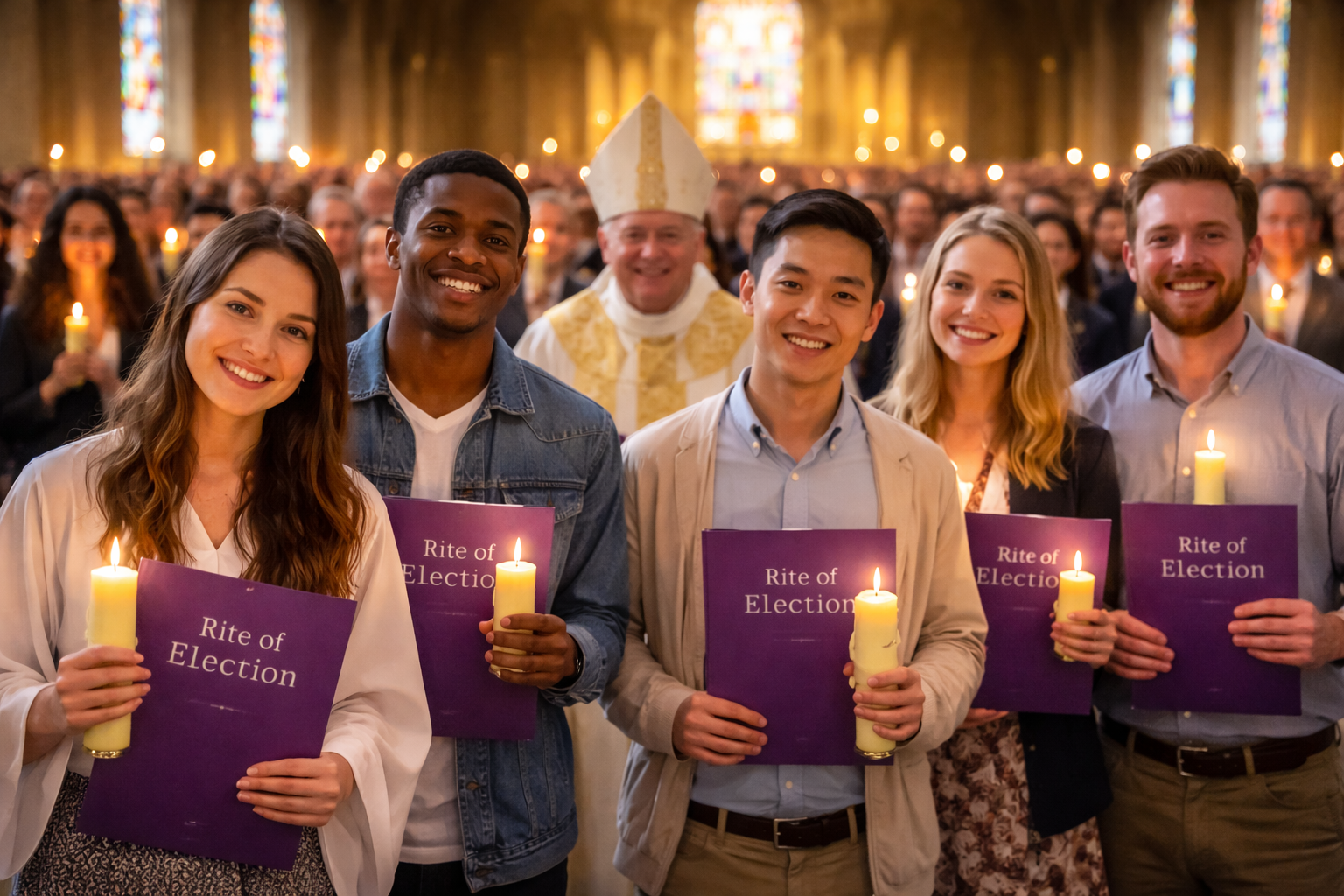
Similar developments are being reported elsewhere. In England several dioceses have recently celebrated the largest Rite of Election ceremonies in fifteen years or more. In the United States, a number of dioceses have reported striking increases in the number of catechumens and candidates preparing for Easter. In some places the numbers have risen by around 20 to 50 per cent compared with the previous year, while in others the growth since the early 2020s has been even more pronounced. Australia has seen comparable developments: in the Archdiocese of Brisbane, for instance, the number of participants in the Rite of Election has almost doubled in a single year.
The pattern extends beyond the Western world. In Singapore, the Catholic Church expects roughly 1,250 new Catholics to be baptised or received at Easter, reflecting a steady rise in recent years. When a similar development appears simultaneously in such different regions, it becomes difficult to attribute it simply to local circumstances.
One of the most intriguing aspects of the trend is the age profile of the converts. In France the largest group of adult catechumens is now between 18 and 25 years old. Many come from families with little or no religious practice. They are not returning to a faith they inherited; rather, they are discovering it for the first time.
This helps explain a paradox that has become increasingly visible in countries such as France. The decline of cultural Christianity and the weakening of religion as a social inheritance may actually create the conditions for more adult conversions. In earlier generations most people were baptised as infants, whether or not they would later practise the faith. Religion was embedded in the culture and transmitted automatically through family and community. Today that cultural framework has largely disappeared. As a result, a growing proportion of adults reach maturity without ever having been baptised at all.
This means that the potential pool of adult catechumens is much larger than it once was. When religion ceases to be something inherited, those who become believers must do so deliberately. The decline of cultural Christianity therefore produces an unexpected effect: fewer automatic baptisms, but potentially more intentional conversions later in life. In this sense, the rise in adult baptisms may not contradict secularisation so much as represent a new stage within it.
It is important, however, to keep the phenomenon in perspective. Even where adult baptisms are increasing rapidly, they remain small in comparison with national populations. They do not reverse the broader trend of declining religious affiliation. The rise in adult baptisms should not be interpreted as a dramatic religious revival.
Yet statistics alone do not capture the whole picture. At the level of parish life, even a modest group of catechumens can make a noticeable difference. Priests often remark that a handful of adults preparing for baptism can transform the atmosphere of a parish. New converts frequently bring enthusiasm, curiosity and a willingness to ask questions that long-time parishioners may take for granted. In communities where religious practice has weakened, such groups can be a source of encouragement.
Another possible explanation for the timing of the surge has received surprisingly little attention: the Covid-19 pandemic. During the pandemic years churches across much of the world were closed or severely restricted. Catechetical programmes were interrupted, and many sacramental celebrations, including baptisms and confirmations, were postponed.
For adults preparing to enter the Church, the disruption could be significant. The catechumenate normally involves a process of formation that may last two or three years. When lockdowns interrupted parish life, many candidates were unable to complete that process at the expected time. Once normal church life resumed, several cohorts of catechumens may have finished their preparation simultaneously. From a statistical point of view, this would naturally produce a temporary surge in baptisms.
There may also have been a second effect. The pandemic was a period of uncertainty, isolation and heightened awareness of mortality. For some people it prompted deeper reflection about meaning, faith and community. It is therefore plausible that a number of individuals began exploring religion during that time.
What is striking is that many commentators have largely ignored or underplayed the role of Covid in explaining the recent increase. Most articles focus instead on broader cultural or spiritual factors. Yet the pandemic explanation is both simple and compelling. It helps to explain why the rise in adult baptisms appears particularly pronounced in the years immediately following the reopening of churches.
If this interpretation is correct, part of the current surge may prove temporary. As the backlog of delayed catechumens works its way through the system, the numbers could stabilise in the coming years. Nevertheless, the deeper pattern may persist: religion becoming less a matter of cultural inheritance and more a matter of conscious choice.
For now, the rise in adult baptisms remains a phenomenon that deserves careful attention. Even if the numbers are modest, they reveal something important about the changing nature of religious belief in contemporary society. In an age often described as secular, the search for faith has not disappeared. Instead, it may simply be taking a quieter, more deliberate form.
https://bottone.blogspot.com/2026/03/a-quiet-revival-adult-baptisms-and.html
My review of Ten Meditations for Catching and Losing One’s Breath
> My review of Jean-Louis Chrétien: Ten Meditations for Catching and Losing One’s Breath, originally published in Phenomenological Reviews.

Ever more people simply don’t want to have children
Personal choice more than circumstances is the reason why younger generations are not having children, a new study reveals.
Recent figures from the Central Statistics Office showed that fewer children are being born in Ireland and the fertility rate is well below the replacement level. Understanding the reasons why people choose not to have offspring is crucial for comprehending the shifting demographics and future family structures.
A new study from the Pew Research Center on U.S. adults without children offers a detailed examination of the various reasons why this is the case, highlighting significant trends and differences across age groups.
The survey is based on two distinct cohorts: adults aged 18-49 and those aged 50 and older.
Lifestyle choice is a predominant reason for the decision not to have children, especially among younger adults.. Over half (57pc) of childless adults under 50 state they simply do not want to have kids. This figure is notably higher than among older adults (ages 50 and above), where only 31pc cite the same reason. This indicates a generational shift towards valuing personal autonomy and lifestyle choices over traditional expectations of parenthood.
Comparing these findings with past surveys reveals a clear move towards more people opting out of parenthood by choice rather than by circumstance. The share of non-parents under 50 who say they are unlikely to have children has increased by seven percentage points since 2018.
Thirty-nine percent of older adults report that having children "just never happened," indicating that circumstances and timing played a certain role for them. This contrasts with younger adults, where the primary reason is a deliberate personal choice. Additionally, 33pc of older adults cite not finding the right partner as a major reason, whereas younger adults are more likely to mention wanting to focus on other aspects of life, such as their careers or personal interests.
Infertility and other medical reasons also play a role for both age groups, but they are more significant among older adults compared to younger ones.
Financial concerns are another major factor. About 36pc of adults under 50 indicate that they cannot afford to raise a child, compared to just 12pc of older adults who give this reason.
Among adults under 50, women (64pc) are more likely than men (50pc) to say they do not want children as the reason for not being a parent. Additionally, women are more likely to mention negative experiences with their own families as a factor in their decision, highlighting the personal and emotional dimensions influencing their choice.
Among the older age cohort, women (42pc) more than men (27pc) felt pressure from society to be parents.
Men, on the other hand, are more likely than women to cite financial concerns (14pc vs 9pc) and the state of the world (15pc vs 10pc) as major reasons for not having children. This reflects a broader societal expectation on men to be financial providers.
Education also impacts these decisions. Among older adults, those with higher educational attainment are more likely to cite career focus and personal choice as reasons for not having children. In contrast, those with less education are more likely to point to financial concerns and the state of the world.
This research reveals that the decline in fertility rates is driven not just by economic factors but also by significant cultural shifts. Especially among younger adults, the preference for personal autonomy and lifestyle choice is a predominant factor. This reflects a broader societal shift towards individualism and self-fulfilment, often without considering the consequences for the common good.
A similar shift in values is probably happening here in Ireland as well. It is not just economic factors that have driven down our fertility rate to just 1.5.
---
Image by DianaZG from Pixabay

Vote NO on Referendum Proposals https://familysolidarity.org/vote-no-on-referendum-proposals/

Surrogate motherhood: it’s high time for a universal ban https://familysolidarity.org/surrogate-motherhood-its-high-time-for-a-universal-ban/


Insurance companies could easily offer euthanasia in the future
The Oireachtas Committee on ‘assisted dying’ continues to hear expert testimony on the matter. Last week it heard from a Dutch academic who was once a supporter but has now turned into a critic. He spoke of how insurance companies in his country are already funding the procedure for one provider, which is a chilling possible glimpse of the future.
The Dutch expert, Theo Boer, who is a professor of healthcare ethics, said the legalisation of euthanasia in the Netherlands has turned our view of suffering, ageing and taking care upside down. The numbers are speeding up and the biggest increase is now in illnesses that are not terminal.
He was initially supportive of euthanasia legislation and now, having reviewed 4,000 cases on behalf of the Dutch government, has become critical of it.
He told the committee that in 20 years the numbers availing of it in his country have quadrupled and, in some neighbourhoods, medically assisted euthanasia account for 15pc to 20pc of all deaths. These figures are underestimated, he said, as a governmental evaluation has found that between 10pc and 15pc of doctors do not report their participation in the programme.
He noted that there has been an expansion in the reasons for euthanasia — from those at the end of a terminal illness, to people today fearing loneliness, alienation and care dependency. Once euthanasia is introduced, why should it be provided only for terminally-ill patients, or for those suffering from physical illness and pain, he asked. Sometimes it is the absence of hope that provokes the suffering, he said.
“That is why we have now a law in parliament that legalises euthanasia for all people over 74 years, with or without an illness. Their age is the only reason they can have assisted dying. That in turn is why we now have a regulation that allows parents to request euthanasia for their young children aged from zero to 11 years old. I am convinced it is only a matter of time before we take the next hurdle, namely, allowing children of dementia patients to request euthanasia for their demented parents”, he told the committee.
The second expert who spoke was Silvan Luley, representing Dignitas, a group that facilitates assisted suicide in Switzerland, where it has been legal since 1942. Currently, about 1,700 per year avail of it. He claimed that Dignitas has almost 100 Irish members and 12 people from Ireland have been helped to kill themselves by his organisation.
Dignitas offers assisted suicide not only to those who are terminally ill but also to anyone who has an “endurable incapacitating disability” or suffers ‘unbearable pain’. Mr. Luley told the committee that fewer than 50pc of those who avail of their assistance are terminal. He explained that they offer a professional alternative to violent suicides.
“It is about having an emergency exit door that provides emotional relief and can prevent people from using rough, violent do-it-yourself suicide methods. The people in Ireland should have what everyone deserves: a legal way to exercise the human right of freedom of choice on all options of professional care to soothe suffering and end life at their home” he said.
Luley was challenged by Prof Boer who referred to new studies presented at a congress of 250 psychiatrists he attended recently. One study found that since the Netherlands allowed euthanasia for reasons of psychiatry, dementia and long-term chronic illnesses, the number of violent suicides has risen against expectations by 35pc, while it went down by 10pc in neighbouring Germany.
Moreover, another new study showed that “in places where there is more euthanasia, there is also a slightly higher suicide rate. … It cannot be proven that if one provides euthanasia, it will bring the suicide numbers down”, according to Prof Boer.
(Previous research from the Anscombe Bioethics Centre found similar results https://ionainstitute.ie/assisted-suicide-does-not-reduce-overall-suicide-rate-says-new-study/)
Prof Boer said that there is a general societal pressure that makes feel the patients a burden to their families and to their country.
He also pointed out that in the Netherlands, one organisation, funded by insurance companies, offers euthanasia. The cost is €3,300, of which the performing physician receives €2,000. “For some of these physicians it is kind of a profit thing. I have heard several of them say that they need this money for several reasons, even though most of them are retired. However, it is officially not for profit. … they only offer euthanasia. They do not offer any other help. They do not offer psychiatric or social help. They can only refer the patient back to where they came from.”
The Swiss group Dignitas, which is also not-for-profit, charges the equivalent of about €11,500, plus VAT, for the complete service, which includes funeral and administrative costs.
As the population ages, and healthcare costs mount, it is easy to envisage insurance companies offering to pat their customers for euthanasia. Think of all the money they would save.

Isabel Vaughan-Spruce tells Family Solidarity of her prolife heroism https://familysolidarity.org/isabel-vaughan-spruce-tells-family-solidarity-of-her-prolife-heroism/

The proposal to introduce assisted suicide and euthanasia in Ireland https://familysolidarity.org/the-proposal-to-introduce-assisted-suicide-and-euthanasia-in-ireland/

New sex education programmes completely ignore long-term commitments and marriage https://familysolidarity.org/new-sex-education-programmes-completely-ignore-long-term-commitments-and-marriage/

Relationship breakdown is the main reason for families becoming homeless https://familysolidarity.org/relationship-breakdown-is-the-main-reason-for-families-becoming-homeless/

Pre-Rally for Life talk with Isabel Vaughan-Spruce https://familysolidarity.org/pre-rally-for-life-talk-with-isabel-vaughan-spruce/

Marriage in Ireland still declining despite a bumper 2022 https://familysolidarity.org/marriage-in-ireland-still-declining-despite-a-bumper-2022/

Bénédicte Colin on the European Certificate of Parenthood https://familysolidarity.org/benedicte-colin-on-the-european-certificate-of-parenthood/

Webinar on the European Certificate of Parenthood https://familysolidarity.org/webinar-on-the-european-certificate-of-parenthood/

FAFCE calls the European Commission to include surrogacy in the review of its EU Directive on human trafficking https://familysolidarity.org/fafce-calls-the-european-commission-to-include-surrogacy-in-the-review-of-its-eu-directive-on-human-trafficking/

Webinar: A special family https://familysolidarity.org/webinar-a-special-family/

Children are left unprotected against extreme pornography https://familysolidarity.org/children-are-left-unprotected-against-extreme-pornography/

CW LONG POST ORIGINAL CONTENT
A new organ donor bill is ethically questionable
If a proposed new law is passed, after you die your organs can be removed from your body for medical purposes unless you expressly say beforehand that you do not want this to happen. Consent is otherwise assumed. As usual, the law is going through the various parliamentary stages without proper debate, even though the proposal is ethically questionable. An Organ Donor Register, instead, should be established.
The proposed law is called the ‘Human Tissue 2022 Bill’. It covers issues such as the donation and transplantation of organs from deceased persons.
At present, an opt-in system exists. This means that only those who have expressly declared their intention to donate organs after they die will have them removed from their bodies, and even then only with the final approval of the family.
The new regime will mean consent is assumed, although final authorisation from a designated family member will still be needed.
The proposed regime is motivated by the good intention of addressing the problem of a shortage of organs for transplant in Ireland, but it is still ethically questionable as donation should arise only from an informed and deliberate decision on a person’s part.
Presumed consent is based instead on the assumption that we are all aware that our organs are available for transplantation upon death and we are happy with that. But what is this assumption really based on?
The HSE’s own consent policy says: “Consent involves a process of communication about the proposed intervention in which the person has received sufficient information to enable them to understand the nature, potential risks and benefits of the proposed intervention”.
It is very unlikely that the new system of presumed consent will meet these criteria.
To make the new system more ethical, patients should be explicitly asked to express their opinion on the matter when attending a hospital or their GP. This will prompt awareness and provoke conversation about donation, which must remain a choice freely and explicitly made and not assumed. Taking without asking is not giving.
As suggested by the Irish Kidney Association, there should be an Organ Donor Register, where all wishes – to opt in or out – are explicitly recorded. “Knowing that a loved one had proactively recorded their wish to be an organ donor makes the family decision to consent a much easier proposition”, a representative of the Irish Kidney Association told the Oireachtas.
What is positive in this new Bill is that it is not inspired by a principle of absolute bodily autonomy of the patients, but it requires the involvement of their families, who could even overrule the decision of the deceased and veto the donation.
There are many reasons why the ultimate word should be with the families rather than with the individual.
While it is important to honour the wish of the deceased, we need to consider that personal decisions affect others, particularly the family. Some cultures place special importance on respecting the integrity of the body after death. Moreover, when organ donation happens against the wish of the family, they might refuse to cooperate, or their discontent could also affect the work of the health-care staff.
A proper ethical system in this area should follow two basic principles: explicit (not presumed) consent from the individual, and approval from the family following the death of the person. The second principle is still followed, but not the first and more important one.
Photo by Robina Weermeijer on Unsplash

CW Long post. Original content.
How parents of DS children are subtly directed toward abortion
There has been little reaction to the news that 95pc of babies diagnosed with Down Syndrome before birth at the Rotunda hospital are subsequently aborted in England.
The response to these horrendous figures has been silence or fatalism. For some, it is an individual “choice” to be respected. There is nothing to be worried about or, even when people find the figures regrettable, little can be done.
“I don’t have a view on whether that is the right thing. We don’t advocate for it, that is just the lived experience”, said prof Fergal Malone, master of the Rotunda.
Is it true? Is it really a purely personal choice, without outside influence or expectations from others? Two recent studies on the experience of parents of children with DS indicate otherwise.
Irish research published last year interviewed eight people following the birth of a child with DS. Some praised the doctors and nurses, but others said the information they received was too medically focused and too negative. It is very hard to believe the same does not happen to couples who are told their baby has DS before it is born.
“Don’t come in with a list of negatives, all the negatives that were put in your head initially we never expected her to be this good now”, said one of the interviewed mothers.
She recalls: “We received purely negative information that she could have this or that, …”
A father said, “Doctors should show compassion when they are delivering the news, have patience and don’t be rushing in and out”.
A Danish study spoke to parents who were told their babies had Down Syndrome before they were born. In Denmark, almost all children with DS are aborted.
The study notes: “Following the diagnosis, the couples were generally critical of the information provided by the hospital. Some felt that the health professionals had painted an unnecessarily grim picture of Down Syndrome based on what couples perceived as outdated information. … Some felt that there was an unnecessary focus on potential diseases and additional diagnoses when the couple was more interested in their potential for living a fulfilling life.”
Participants in the study report feeling pressure from health professionals they encountered to abort, or else that they were presented with overly negative information about their babies.
The research found that “couples felt that termination of pregnancy had been taken for granted following the diagnosis: ‘As the obstetrician sat down, she put those abortion application forms on the table in front of her’”, recalls a mother.
Even conveying apparently neutral information, such as presenting what other couples generally do, can condition parents. We tend to imitate others. Social expectations can be subtle and unconscious.
“Maybe there’s something wrong with me since I don’t just do what 98pc of all people would do”, said a Danish mother in the study, who decided to have the baby.
“The high percentage of terminations in Denmark was a source of doubt and uncertainty during the decision-making process. This left the couples feeling vulnerable”, it notes.
“Why is Down Syndrome the disability [considered] socially acceptable to terminate? And how do we come back from that?”, asks actress Sally Phillips in her documentary “Prenatal Genetic Testing” where she investigates how Non-Invasive Prenatal Tests have increased the number of babies with DS, and other genetic or chromosomal anomalies, who are being aborted. Phillips has a son with Down Syndrome.
These tests, which can take place in the first trimester of pregnancy, are becoming more affordable and available. They can be used to prepare families to welcome a child with medical anomalies, or they can be used to get rid of them, as almost always happens when a diagnosis of DS is given. A proper ethical debate about those prenatal tests has still to happen in Ireland.
In a society that has normalised abortion, the main way to fight the progressive elimination of children with DS is for doctors to portray life with the condition, and life for the parents of such a child, in far more positive terms than seems to be the case at the moment. The medical professionals claim to be neutral about their use, but being not directive isn’t enough when society goes in one direction only.
Certainly, a national debate is called for.

I teach #philosophy and work as a researcher for the Iona Institute (www.ionainstitute.ie) Abruzzese. #Distributism
Joined Jul 2019
