
I tested doing a Google search. Can you spot the only link on this page that is not a Google Ad?


@ocdtrekkie That'd be the one that doesn't say "Ad" next to it.
@mtomczak Just the one Best Buy link that managed to slide in there at the bottom of the screen, yep! And of course, even though it's the first real result, most people will end up clicking the Best Buy Ad directly *above* the Best Buy organic result, giving Google money for... being awful and shoving the organic result nearly off the page.
@ocdtrekkie Why should a Best Buy organic search result be the best result for "new computer?"
(re-draft): ... as opposed to someone else? Because if the final arbiter for what the answer should be is "What Google says it should be based on their opaque algorithm," incentives are massive to game that algorithm, leading (as we saw in the past) to hard-to-use web pages and a generally bad web experience.
Ads let people who would spend the money on organic SEO spend it on ads instead, leaving the organic algorithm to do its thing. The result is win-win for the end user (modulo abuse, which (a) is something Google actively works to mitigate and (b) would happen in the absence of ads, just via abusers gaming organic search instead).
@mtomczak Well, at least in my area, Best Buy would almost certainly be the best organic search result: They're nearly the only electronics store around here, and they have sub-stores for Apple, Microsoft, Samsung, etc. in-house. So whether you are shopping online or in-person, it's one of the leading places to compare some options.
That is not my point. Larry and Sergey themselves said it was unethical to force someone to pay for an search ad if their result would be at the top anyways.
@ocdtrekkie I remember; you shared that document previously.
It's something like two decades old, right? Maybe they were just wrong.
(As a side-note: did the search in DDG for idle curiosity. Lower-density of information; the first organic result is Best Buy and is still way at the bottom of the page. But FWIW, I don't also see a Best Buy ad above it, so maybe DDG is still more ethical?)
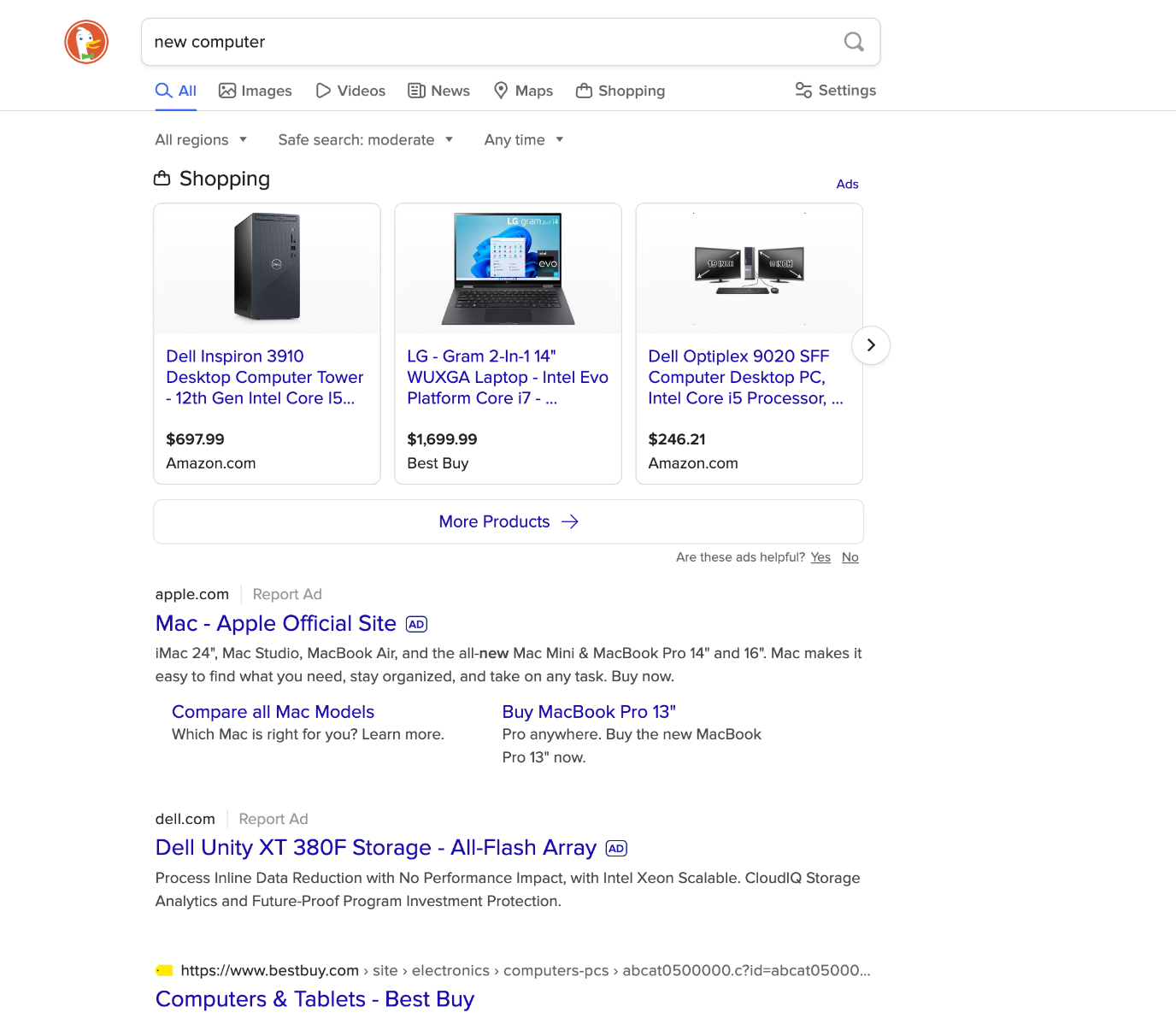
@ocdtrekkie I think they discovered what I mentioned previously: letting people who want to be on the top just pay to be on the top (instead of paying SEO firms to put them at the top) turned out to be a win-win: companies that want to game can pay to play; tech-savvy users can skip the game by scrolling down.
In an ideal world, non-tech-savvy-users win also, but there's an adversarial-actor challenge that makes that difficult---if enough people *stop* clicking on ads, ad spend goes back into SEO spend and we're back to the bad-old days of explicitly-gamed SEO outstripping the engine developers' ability to handle it.
