

Olives @olives@qoto.org
Software Engineer. Psy / Tech / Sex Science Enthusiast. Controversial?
Free Expression. Human rights / Civil Liberties. Anime. Liberal.
Joined May 2023
"Patient’s medical data are confidential, normally released only by a court order in case of suspected criminality."
Honestly, I'd argue against even that. "criminality" can be pretty vague. To give a random example, illegal drugs is a "criminal activity". So, then, someone wouldn't be able to tell the doctor about that...? #ehds
I remember her because she was fairly visible in fighting against it (as anyone should).
Well, the chat control is so obviously awful that you can see the awfulness of it from the Moon.
I see Sophie has jumped from D66 to Volt. She had some good takes against the chat control earlier this year, although is conspicuously quiet on EHDS.
Think of how obnoxious things like #ehds are. It has nothing to do with these folks up in the E.U. It's none of their business.
But, they just *have* to barge into other's personal sensitive medical matters, to collect all this data into one of their "databases", and to share it with whoever they want. #privacy
https://privacyfirst.nl/artikelen/ehds-buitensporige-machtsgreep-van-brussel/ A Dutch privacy org tears the #ehds apart (in Dutch).
https://reclaimthenet.org/playstation-to-remove-shows-even-if-customers-already-paid-for-them Are they going to provide a refund?
"In recent years, a growing number of people have been handing their DNA over to tech companies for the apparent benefits of finding out information about their ancestry and more about their health. However, as with digital IDs, when such entities get access to your most intimate data, it becomes the target of hackers and cyberattacks.
A considerable number of user ancestry files were exposed during a recent cyberattack on genetic testing giant, 23andMe. As per an official filing released on Friday, cybercriminals infiltrated around 14,000 user accounts – a figure that equates to approximately 0.1% of the company’s global customer base of over 14 million."
"However, the attack didn’t end with the initial victims. 23andMe incorporates a feature whereby users can opt to share selected information with other users. Consequently, the breach also extended to individuals linked through this feature."
"What amplifies the gravity of the data breach is the nature of the exposed information — mainly personal user ancestry details, and in some cases, health-related genetic information. The exact number of affected ‘other users’ or the precise extent of accessed files remains unclear as the company has yet to release specific figures."
"The EU’s next legislative goal post that opponents see as part of a big push to strip citizens of their privacy, has now reached medical histories and associated data.
Interconnecting – in effect, centralizing (and making remotely accessible) – that data is the key premise of what has now emerged as European Health Data Space (EHDS). The upcoming bill has been backed by the European Parliament (EP), its Committee on Civil Liberties, Justice and Home Affairs (LIBE), and Committee on Environment, Public Health and Food Safety (ENVI).
EP member (MEP) and lawyer Patrick Breyer, a long-time critic of this type of policy, explains that EHDS – which he voted against – would “bring together information on all medical treatments received by citizens.”
Doctors will have to submit summaries of treatments they provide to “the new data space” – with the initial proposal not containing provisions that would allow for objections or exceptions. And while access can be restricted if a patient so wishes – the actual creation of the database can’t be prevented.
And let’s just reiterate that this might concern some of the most sensitive personal medical information: “mental disorders, sexual diseases and disorders such as impotence or infertility, HIV or drug abuse therapies,” writes Breyer.
“The EU’s plan to collect and interconnect records on all medical therapies entails irresponsible risks of data theft, hacking or loss. Even the most delicate therapies can no longer be administered off record in the future,” the German Pirate Party MEP further warned, blasting the idea as the end of medical confidentiality in the EU."
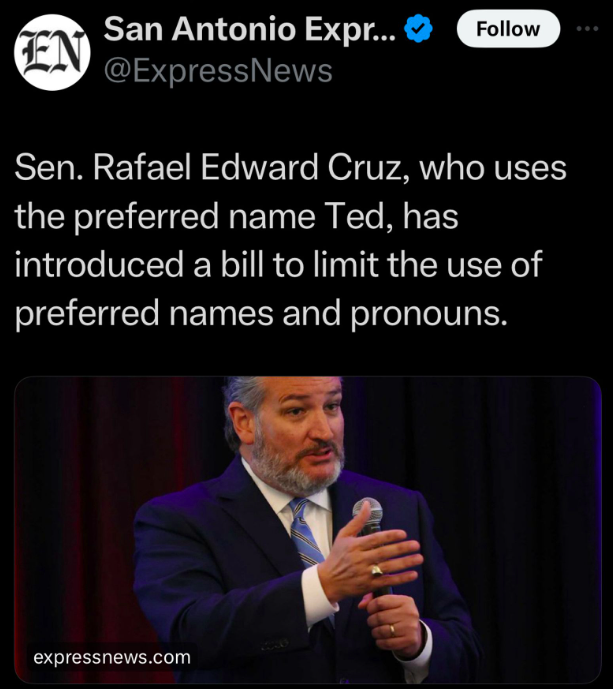
You know what that name reminds me of? Have you ever seen that film with the talking teddy bear who does drugs?
Isn't that the name of an angel? Anyway, I can see why he prefers that other name, it's catchier. I don't think that is what the bill does though (...
Isn't that the name of an angel? Anyway, I can see why he prefers that other name, it's catchier.
I don't think that is what the bill does though (or not the latest version), it goes after trans individuals in like government emails. Don't really see the point of it tbh.

The Australian High Court passed down a ruling that indefinite detention of migrants was unconstitutional and these people are absolutely losing their shit...
https://www.theguardian.com/australia-news/2023/dec/03/labors-new-laws-to-re-detain-migrants-at-risk-of-reoffending-to-be-modelled-on-coalitions-an...
https://www.theguardian.com/australia-news/2023/dec/03/labors-new-laws-to-re-detain-migrants-at-risk-of-reoffending-to-be-modelled-on-coalitions-anti-terror-orders If someone has served their time, then they should be free to go. This flies in the face of the rule of law.
I made the language in my post a bit more explicit because otherwise someone might miss something obvious.
Resisting the temptation to comment on bad takes.
Ugh... There's more puritanical nonsense, so it looks like I have to debunk that again...
First off, even if online porn "might" be "problematic" to someone out there, it would still not be anywhere remotely near proportionate to engage in censorship, or privacy intrusive measures. Especially, as it can be important free expression to someone.
Secondly, a typical recommendation is sex education, not censorship (which is harmful in it's own ways).
Thirdly, the science isn't really showing that porn is this awful thing:
https://www.tandfonline.com/doi/abs/10.1080/00224499.2015.1023427
https://psyarxiv.com/ehqgv/
Two studies showing porn is not associated with sexism. One carried out by German scientists, another carried out by Canadians.
https://qoto.org/@olives/110462274531891870
American scientists carried out a meta analysis of 59 studies. They found porn isn't associated with crime. A meta analysis is a study where someone studies studies.
https://pubmed.ncbi.nlm.nih.gov/31432547/
Nor does it seem this is the case among adolescents (the meta analysis also points to that). Here, the minors who used more porn engaged in less sexual aggression.
https://www.psychologytoday.com/us/blog/all-about-sex/201601/evidence-mounts-more-porn-less-sexual-assault
https://qoto.org/@olives/110400288665794817
There are even studies (across the United States, Japan, Finland, and more) showing that porn is associated with less crime, even among criminals.
https://pubmed.ncbi.nlm.nih.gov/31042055/
While an older Dutch study showed there might be worse levels of "sexual satisfaction" among adolescents using porn, a Croatian lab failed to replicate that.
https://www.sciencedirect.com/science/article/abs/pii/S0747563222001637
This is a meta analysis on sexualization in video games. It finds that studies tend to pick cut-offs where it's difficult to distinguish signal from noise. This increases the number of false positives.
There are also results which contradict the theory of sexualization being harmful. In the end, it fails to find a link between this and sexism, and this and mental well-being.
I'm also usually sceptical of apparent links, as the "scientific pile on effect" (as one described it) drives people to go looking for "links" between porn and "something bad" however tenuous it might be, or methodologically flawed an approach it might be (and later, that something is debunked, or the "link" is a phantom due to methodological limitations).
I could add it doesn't matter if they're "child-like" or "fictional children", (this is far, far more likely to hit someone good than someone bad who don't need it, and a bad actor could still do bad things). If it was actual real children, I'd oppose that on ethical grounds (though, I still wouldn't want to burn down the Internet / sites, because of unwanted bad actors). This is covered above but it is also kind of common internet sense.
Fourthly, while I'm not making a point about anything in particular, to inoculate you against potential problematic arguments, it's worth mentioning the basic precept that correlation does not imply causation.
Let's use ice cream as an example. Everyone loves ice cream, right? Well, I like ice cream.
Anyway, ice cream is correlated with crime. No one would say ice cream causes people to go out and commit crimes though. Just because there is a "correlation" doesn't mean it is meaningful (curiously, both are apparently also correlated with warmer weather, some think that is the real culprit here). And that's not the only way in which correlation might not imply causation. That might come in useful somewhere...
Fifthly, here's one just for #auspol: https://reason.com/2015/07/23/despite-all-the-panic-millennial-teens-h/ Basically, U.S. data shows teens having less sex with each other (in a world with more porn).
Software Engineer. Psy / Tech / Sex Science Enthusiast. Controversial?
Free Expression. Human rights / Civil Liberties. Anime. Liberal.
Joined May 2023
