
@freemo
I think metric is the clear winner in scientific areas where you have to switch between scales at least a half dozen orders of magnitude apart.
But in engineering, Metric has no clear replacement for:
* Pounds per square inch
* Foot-pounds (torque)
* Foot-pounds (work)
These are intuitive to anyone who knows inch, foot, and pound.
Pascals and Joules are obviously not intuitive, and neither are Newton-meters because meter-long wrenches are exceedingly rare.

 🇳🇱
🇳🇱
@cjd
An ATM is far more intuitive than a PSI even if you work with foots pounds and inches, its literally a multiple of ambient atmosphere pressure.
But the problem with your whole premise is your saying "as long as i already work with obscure and confusing measurements, and as long as i never have to work with them at large or amall scales, their great".. everything about that statement suggests their broken, especially considering that you cant in any practical sense avoid working with them at scale anyway.
@freemo
Well, if you're SCUBA diving then ATM is very useful and logical. But if you're dealing with compressed air or hydraulic, say you have a piston of 1.5 square inch area and you're running 5000psi hydraulic on that piston, you can do it in your head that you're going to have 7500 pounds of force on that piston. Now try that with ATM and Newtons...
@cjd "say you have this piston of this really obscure and confusing measurement called an inch and it is 1.5 square inch".... thats not an argument for it in my mind as it relies on the idea that PSI is more useful only if you already know an obscure measurement no one uses outside of the USA and is inherently less useful as it doesnt allow for metric prefixes...
On the other hand lets say you had a piston of an actually more useful base measurement, say 1.5 cm squared... all of a sudden metric is just as easy and with multiple additional advantages not the least of which being that the base unit is more intuitive
@freemo
Piston of 1.5 cm2 with 200 ATM pressure, how many Newtons of force, no calculator :P

@wolf480pl @freemo
So basically I'm not saying that the metric system is bad, what I'm saying is that trying to force people to standardize on one system is.
* Datacenter people measure in U (4.4cm)
* Oil traders use Barrels (159L)
* Navel and Aeronautic people use Nautical Miles (1.852km)
* Astronomers use Light-year (9460730472580.8km)
Only a bureaucratic busybody could think that everyone should switch to the same unit.
@cjd @freemo ok, but when the systems these people build interface with each other, it's helpful that they can use a common system that both sides understand.
For example, instead of calculating an orbit in light-seconds, then converting that to miles to calculate how much fuel you need in gallons, and then someone calculating the mass of said fuel, etc. it's easier to use metric throughout.
@wolf480pl @freemo
Yup, it's a balancing act, on the one hand you want units which are easy to work with in common computations used in that sector of industry, on the other hand you want interoperability.
In practice though, you want to just go along with whatever is being used in the space you're working in, units are political.
@wolf480pl @freemo
The problem with kPa is a result of the Newton. If instead of Newtons there was just kg-force then anyone who understood what a kg and a cm is (everyone in Europe) would then be able to reason out the measurements of pressure and torque.
@cjd You seem confused...
you said
> If instead of Newtons there was just kg-force
A newton is a unit force, so adding kg into it as kg-force makes no sense. A newton (as any force would be) is mass-acceleration which in this case is the standard kg * m/s^2
So its already in standard units and all nice simple multiples (unlike PSI which becomes quite confusing in any other multiple like feet)
@freemo
Have you ever operated a lathe, milling machine, surface grinder, welder, air compressor, impact wrench, or torque wrench ?
@cjd yes many times both in metric and imperial units. All the ones in the netherlands and europe are exclusively metric of course.
In fact aside from a small global population in the USA virtually the entire world of people who work with such things all do so in metric...
your point?
@cjd You probably dont realize it but doing science tends to require building things, and often those things can be fairly advanced with very critical specifications. A few millimeters off and you wind up with something that doesnt work at all or bad data.
Have you ever built a particle accelerator by hand for example?
@freemo
Before I got into computers I studied Machine Technology, I've used every one of those things I mentioned at least a little. I also replaced a transmission, built a firewood saw, did a fair amount of residential wiring, and my point is that the Metric system is *not bad*, but there are applications where it doesn't make sense.
I've definitely never built a particle accelerator, but if I did you can bet I'd be working with the measurements used in that field.
@cjd Your expiernce is not in question. I was merely pointing out that scienctists that tend to take on personal projects need to work with every single one of those pieces of equipment as well. Building devices is hard to escape in most areas of science and they tend to have demanding specifications.
Thing is, you havent actually given a single reason that the imperial system is better, the few you gave were simply incorrect (like implying that newtons wasnt based on base metric units).. .yet there are quite a few reasons metric is superior (intuitive units that scale by simple powers of 10).
If you could list even one example of how imperial units are easier to work with in any context at all (that doesnt rely on simple familiarity with imperial units itself) then I'd be happy to consider it. But so far there isnt a single advantage mentioned to imperial units of any kind, not a single setting where imperial units are the norm (outside of the USA), and quite a few reasons metric units are suprior.
There is a reason the entire world, except the USA, uses metric units whether its science, woodworking, carpentry, metalwork, lathe, or any other field you can imagine.. because its the better choice in every field except in the USA which for whatever reason prefers to stay in the dark ages when it comes to unit of measurements.
@freemo
Havent actually given a single reason that the imperial system is better <-- All I ever wanted to say is that forcing a system of measurement on people is bad.
If you could list even one example of how imperial units are easier to work with in any context at all <-- I already told you: PSI, foot-pounds (torque) and foot-pounds (work). They are intuitive to anybody who knows two of the most basic units of that system of measures.
> I already told you: PSI, foot-pounds (torque) and foot-pounds (work). They are intuitive to anybody who knows two of the most basic units of that system of measures.
Yes but that was trivially debunked... Anyone working with the metric system has equivelant units.. Pascal (pressure), Newton-meters (torque) and Newton-meters (work), which require only knowledge of the two most basic units of the metric system, meters and newtons...
So you havent in any way given why imperial is superior at all.. you just said "if i already know how to work with these really obscure units that no one in the world but me and people near me use then its easier cause im familiar with it"... thats a horrible excuse considering we live in a wider world..
Moreover there ARE disadvantages beyond just familiarity.. the lack of easy to remember prefixes being the most notable which makes the imperial system far far less intuitive when working PSI or foot-pounds at large or small scale, while its trivial to work at large or small scales in the metric equivalent.
so while you did try to make that argument it ultimately failed quite poorly IMO.
Moreover forcing a system of measurement on a people is only bad if its arbitrary, when the new system of measurement is significantly superior, as metric is, then it isnt a bad thing at all. Americans would be better off in the end by far considering they are adopting a system with many advantages and leaving behind a system without a single advantage aside from familiarity (which is temporary).
@freemo
Newtons are not the most basic units of the metric system, a common person only knows kg, cm, meters, km, and L.
On the topic of forcing measurement systems on people, have you read Seeing Like A State by James C. Scott? He speaks a bit about the actual history of the Metric system.
@cjd Everything you said applies just as much to imperial as metric... Newton is no more a basic unit than the pound-force is.. However a newton is a combination of the same units in metric as pound-force is in imperial, except that of course imperial units use convoluted numbers and multiplies where metric does not.
In metric is really simple, a newton is the force it takes to make 1 kg of mass accelerate at 1 m/s^2, nice and easy... not so much with the imperial pound-force. 1 pound-force is equal to the force it takes to accelerate 1 pound by 32.174 ft/s2 (good luck remembering that).. or if you really want to get convoluted 1 ounces (16 ounce-force) by 514.784 ft/sec^2
I think its quite obvious that newtons are far more intuitive and easier to remember than the convoluted pound-force.
@freemo
Everybody in the US knows 1lb mass (from buying food) and 1lb-force is almost the same. A newton would work great if it was almost the same as 1kg, but it's not.
But I think the overarching point here is that forcing people to change their units of measure is, and has always been, an act of colonialism. Historically it has usually been combined with forcing people to change their language and religion.

@mithrandir @freemo
Hmm so 1 newton-meter of torque can be imagined as roughly 1kg worth of force on the end of a 10cm wrench, this is not bad but foot-pound has it right in the name...
@mithrandir @freemo
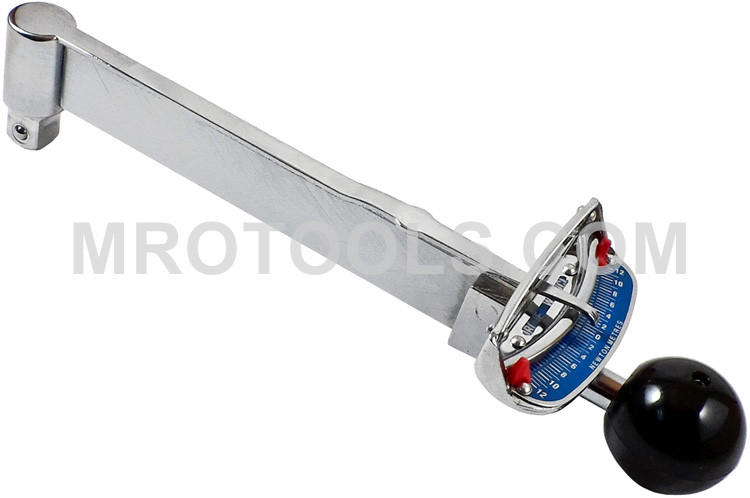
Incidentally, I was watching a video of an engine build and the guy (Canadian) commented that he was so glad all of the bolts were metric so he wouldn't need to get a separate set of sockets for them - then without blinking he started reading off the torque specs in foot-pounds, and I'm sure his torque-wrench would support newton-meters.
Thats weird, in most of the world other than the USA torque wrenches are indeed in newton meters. You can see one attached.
@freemo @mithrandir
North American wrenches will almost invariably have both types.
Canadians especially use quite a mixture of US and Metric measurements. Liters for fuel, Km for road distance, miles and acres for land (because that's how it was originally surveyed), some weird mix of inches and cm when doing construction...
@mithrandir @freemo
I think Americans are slowly moving to metric bolts and nuts because it's just easier to only stock one set. Feet, gallons, quarts and miles, just nobody cares.
Actually we tend to be even moving towards metric volume.. when was the last time you saw a gallon of pepsi :)
@freemo @mithrandir
One of the places where the American system is way better is in cooking. I'm not sure why this happened but for some reason French recipes specify everything by weight rather than volume. It's not really Metric's fault here but having a measuring cup with "grams flour", "grams rice" and "grams water" on it is utter nonsense, so tea-spoons, table-spoons and cups will probably not go away any time soon...
There is actually very good reason for that.. volume lacks consistency if we talk about powders and solids.. 1 cup of flour can range in actual mass considerably if you pack the flour tightly into the measuring cup, vs loose.
Strictly speaking in american cooking when you measure the volume of flower your suppose to use a sifter which is quite messy as most of it misses the measuring cup and needs to be put back into the bag. If you measure it by just scooping it you get the wrong quantity (but close enough most people dont care)...
When you use weight none of that is an issue as the weight represents the same quantity whether its packed or not. For this reason the french tend to use weight because
1) with solids/powders it avoids extra steps and mess
2) with liquids its directly equivelent to volume and thus interchangable, if you dont care about a few decimal points percision (1 ml of water is 1 gram of water exactly by definition).. oil has a different density so doesnt work there, but is it really anymore difficult to weight it at that point?
3) its cleaner, if you use a single measuring cup for everything you have to clean it between uses or else things get into your food from earlier measurements. When its by weight you can weight it directly in the mixing bowl your using so no need t mess up an extra piece of glassware.
@freemo @mithrandir
Well that's definitely a better explanation than I was lead to believe based on the wild measuring cups I've seen. I find it a bit hard to imagine measuring baking soda directly into the mixing bowl but I suppose...
well you might not be able to measure **everything** direct into the mixing bowl. But the point is there is rhyme to the reason.
@freemo @mithrandir
So this sort of hits the nail on the head. When you decide how you're going to measure, you choose what is and is not important.
Measure by weight -> flour density
Measure by volume -> ease of adding baking soda.
I argue that this extends also to measurements themselves, so forcing them on people will always be colonialist.
if we are talking about volume vs weight measurements then I agree, they have their uses depending on what your doing.
Though for baking soda youd still want weight like any other solid powders because it prevents the need for sifting. You just would want to use a separate vessel for measuring.
But as a general principle i agree with volume vs weight.
But when we are talking about the base units themselves, metric vs imperial... I still haven't heard a single situation where imperial serves an advantage over metric, yet there are several advantages of metric.
nautical miles are not SI metric unit, they are internationally used but not metric.That nsaid I would agree that its somewhat common to use nautical miles at sea internationally, which is more to the point than if its metric or not.
Actually thats an older definition, but the newer one I think is still relatively close in practice. But yea, at sea it makes some sense where lattitude and longitude is all you have to go on.
@freemo @mithrandir
Now if you're saying a unit is valid just for having significant international usage then you'd better let in:
* 40x8x8.5 feet (standard international shipping container)
* Troy ounce (gold)
* Bushel (lots of grains)
* Bail (cotton)
* Barrel (any oil)
I actually have a hard time thinking of any commodities which are internationally traded in SI units.
Actually you are mistaken, all the things you listed are in fact only traded by the unit you mentioned in the us, internationally they use metric units and that includes international market trading..
Lets start with hay, grains and cotton, those are traded by the metric ton, here we can see the italian hay market, for example, listing all their prices in metric tons: https://www.clal.it/en/index.php?section=conf_foraggi
gold is actually price per gram or kg and not just in europe and internationally but even in the US (though troy ounce is sometimes used too but only int he US): https://www.kitco.com/gold-price-today-europe/
In fact the only commodity that doesnt use a metric measurement that you listed is oil, but that isnt "any oil" but only crude oil. refined oils are in liters.
@freemo @mithrandir
That's not a commodity market, this is a commodity market: https://live.euronext.com/en/product/commodities-futures/EMA-DPAR/contract-specification
and it does trade in 50 tonne contracts.
And this is a commodity market which trades in 5000 bushel (about 128 tonne) contracts:
https://www.cmegroup.com/trading/agricultural/grain-and-oilseed/corn.html
Now you'll notice the American market has about 20x the volume, which when you include difference in unit size is closer to 40x. America isn't 40x the size of Europe, it's just where the trade happens.
Yea which is as i said, american markets will use american units. But international markets use metric.
The reason the american market has more volume doesnt tell you much because your looking at one among many markets, its not a measure of total market volume across all USA.
@freemo @mithrandir
Most international commodities trade is just done in American markets.
How ya figure? Far more international trade takes place in asian than america, by several orders of magnitude.

@freemo @mithrandir
The point is it's 1 minute of a degree of latitude along any line of longitude, so if you're using charts this is pretty handy.