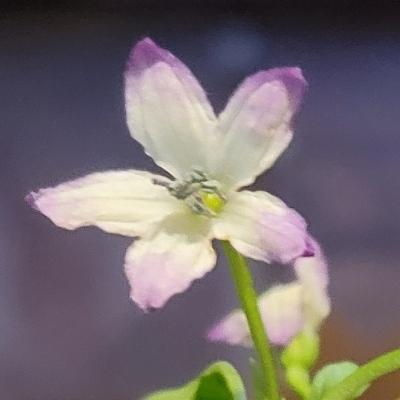
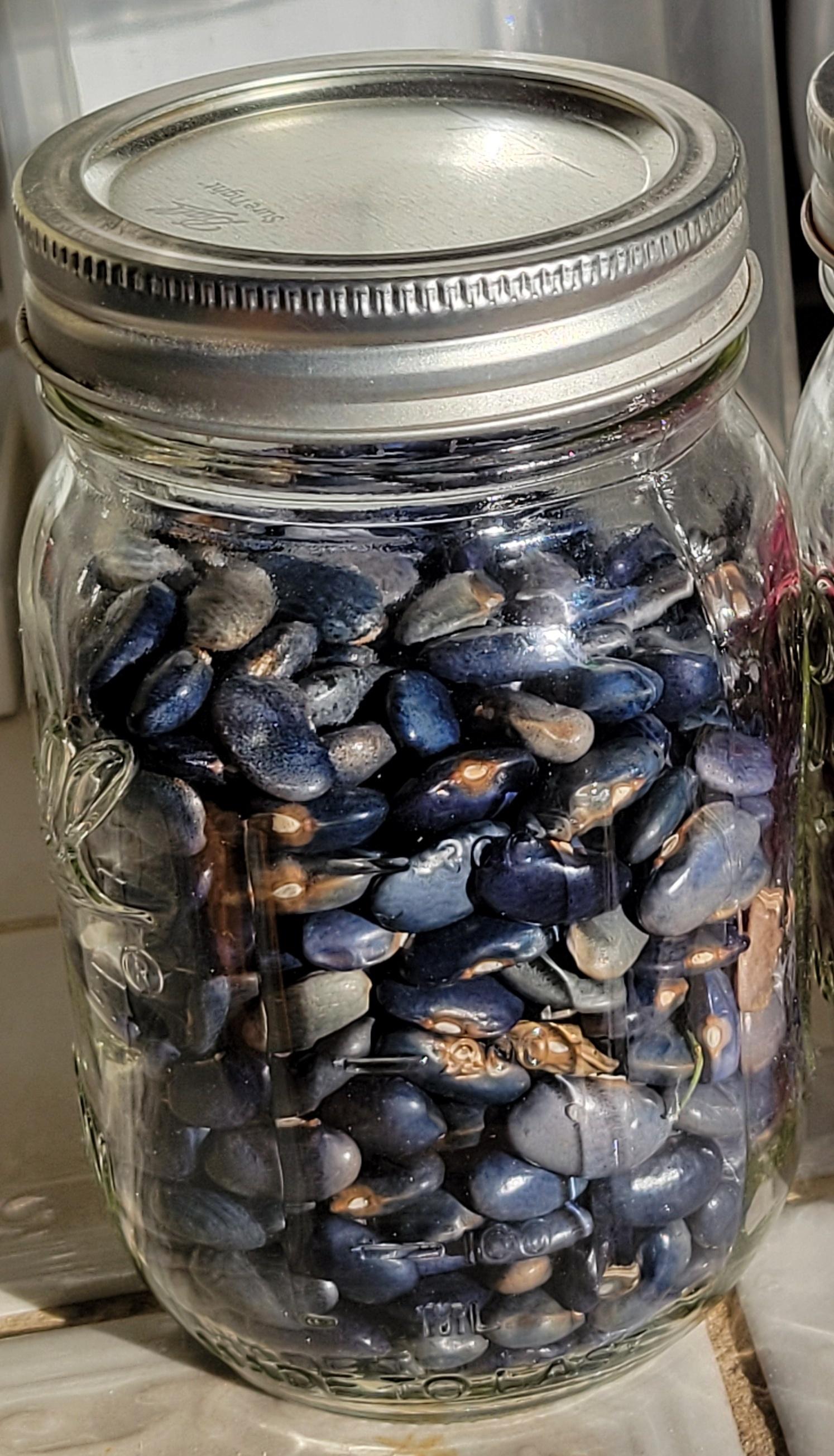
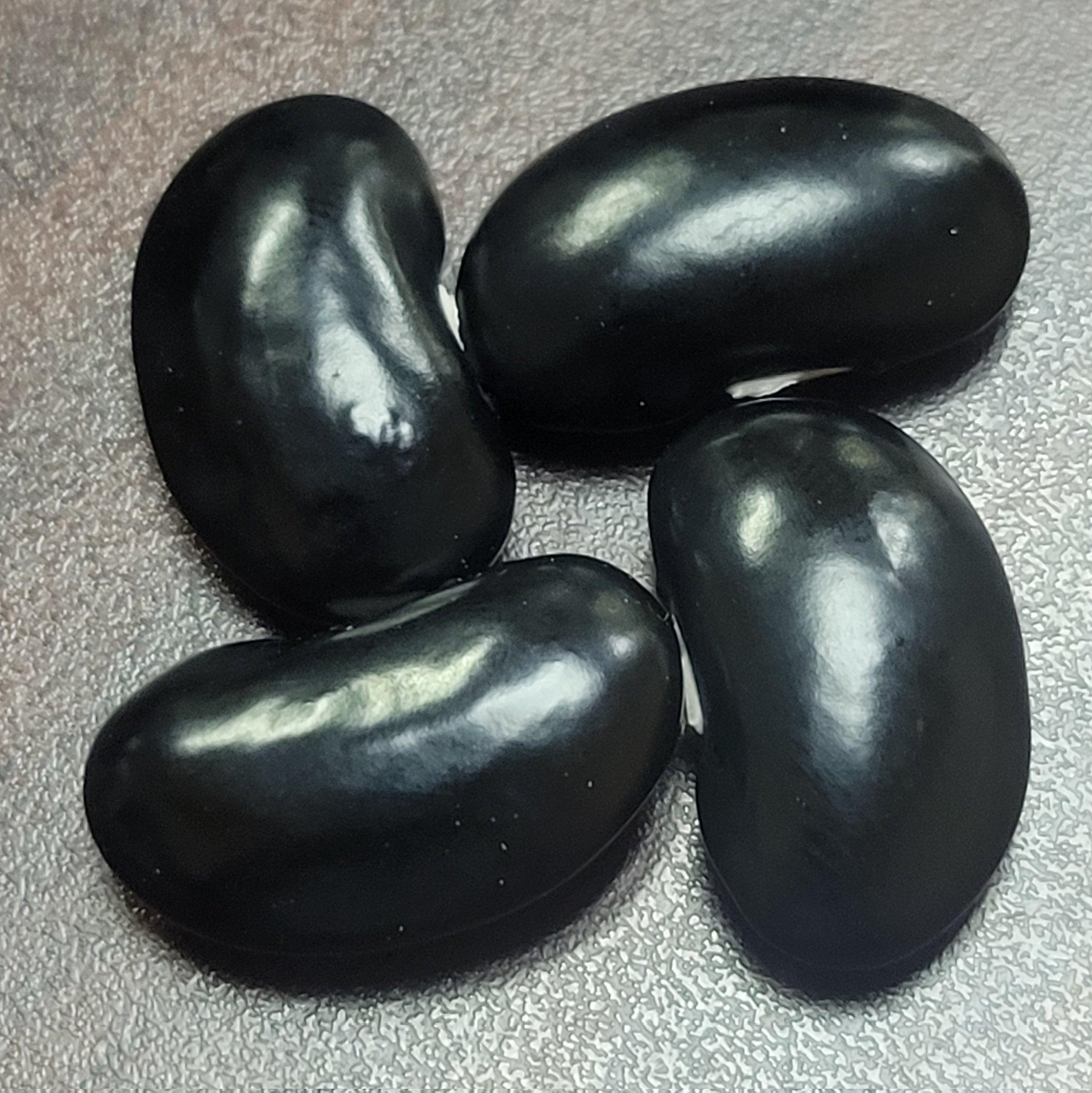
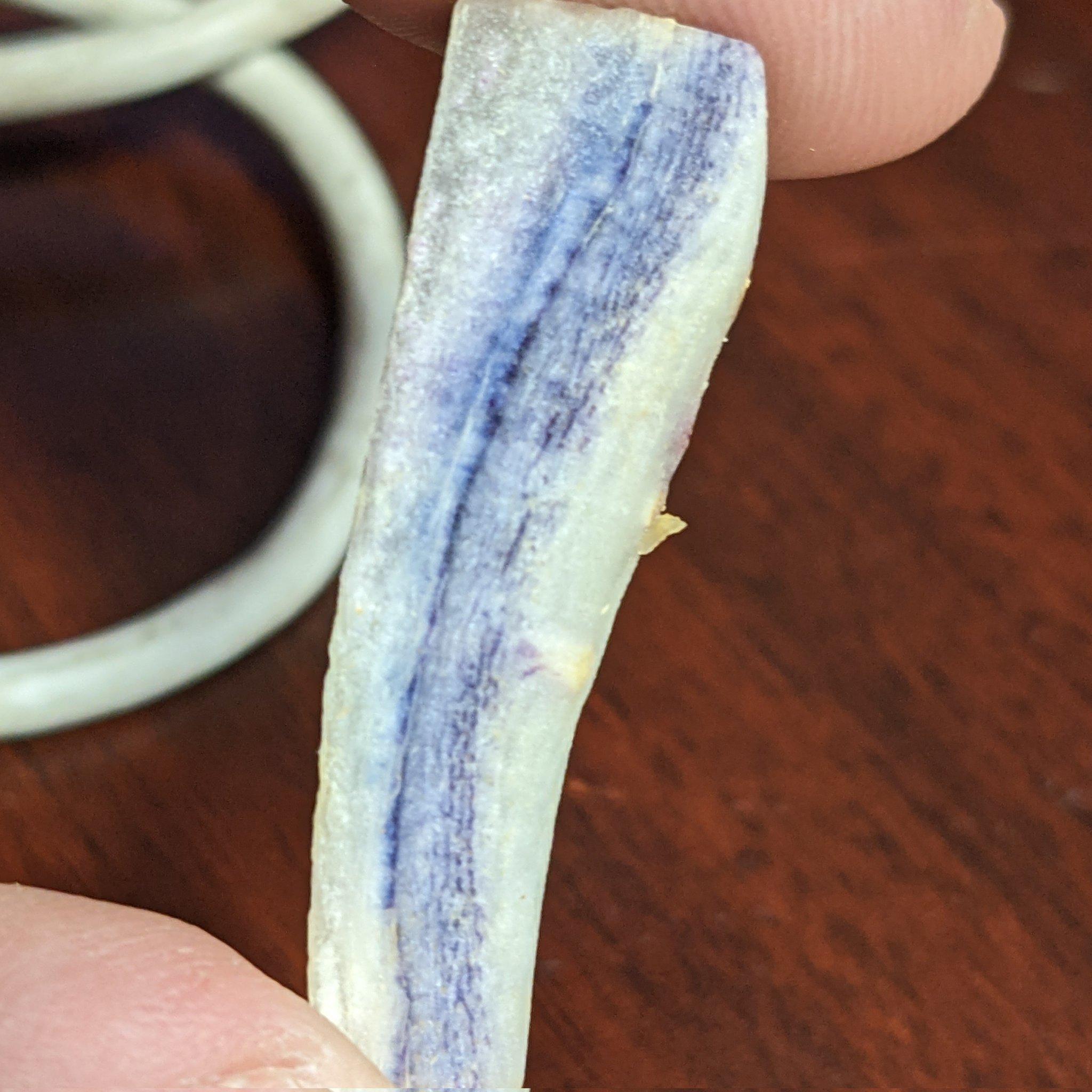
A few years ago, through luck and vibes, I managed to produce this blue colored bean variety.
This was an early step in trying to answer the question, "Why isn't blue as common as red in beans, even though they're both anthocyanins and the plant has the genes for both?"
As a next step to figure this out, I started parallel efforts to make blue versions of lima beans (Phaseolus lunatus), runner beans (P. coccineus), & tepary beans (P. acutifolius) using the knowledge I had gained working w/ common beans (P. vulgaris).
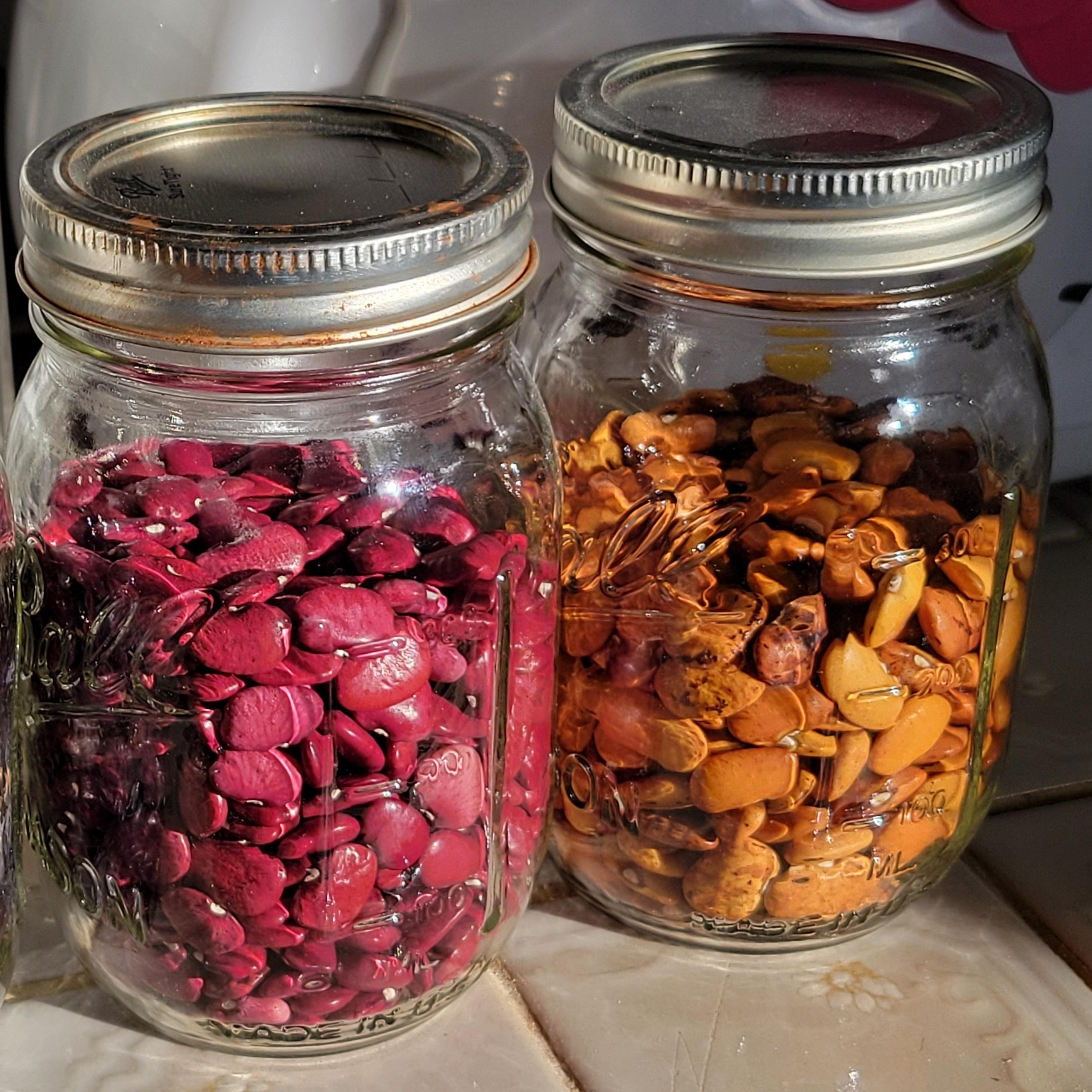
With the lima beans, I acquired this pink/magenta variety (from https://trueloveseeds.com/products/ceceilia-davis-family-lima-bean) and then produced this unmarked yellow variety (after starting from https://www.nativeseeds.org/products/pl011) to cross w/ hopes of getting me closer to the goal.
So far, I have failed to cross the two.
With tepary beans (P. acutifolius), i haven't really found the starting varieties I was looking for. I've been growing some yellow and purple speckled types, but they aren't all that productive for me and seem to be still adapting to my environment.
I've had more success with the runner beans (P. coccineus).
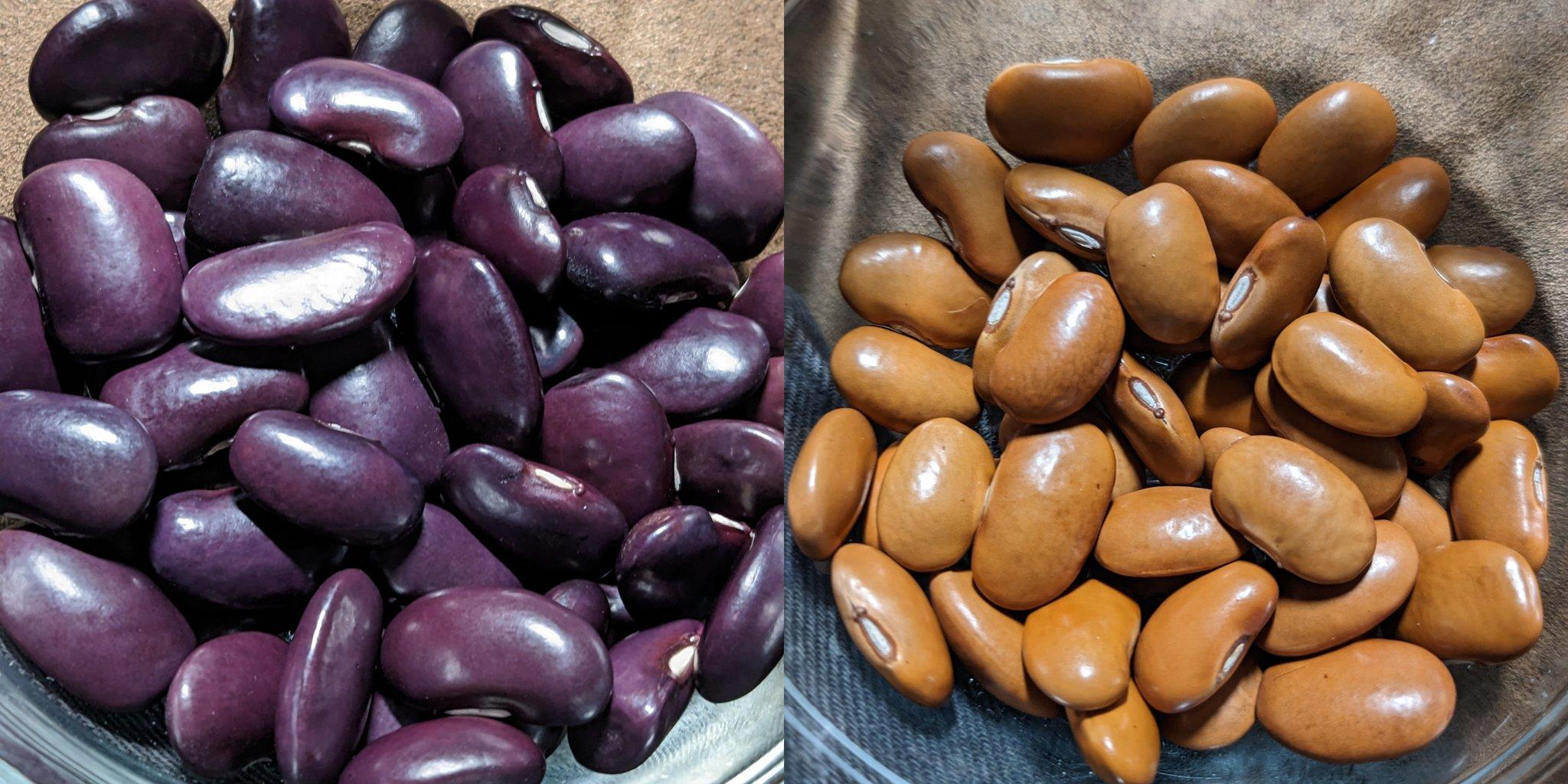
I managed to find purple and yellow varieties from Mexico. These barely managed to mature, producing 5 seeds before frost.
One of those seeds turned out to grow into a hybrid with deep black seeds.
That plant bloomed a month earlier than either parent, leading to plenty (50+) of seeds.
The first plants in the F2 population started blooming a month earlier than the initial F1.
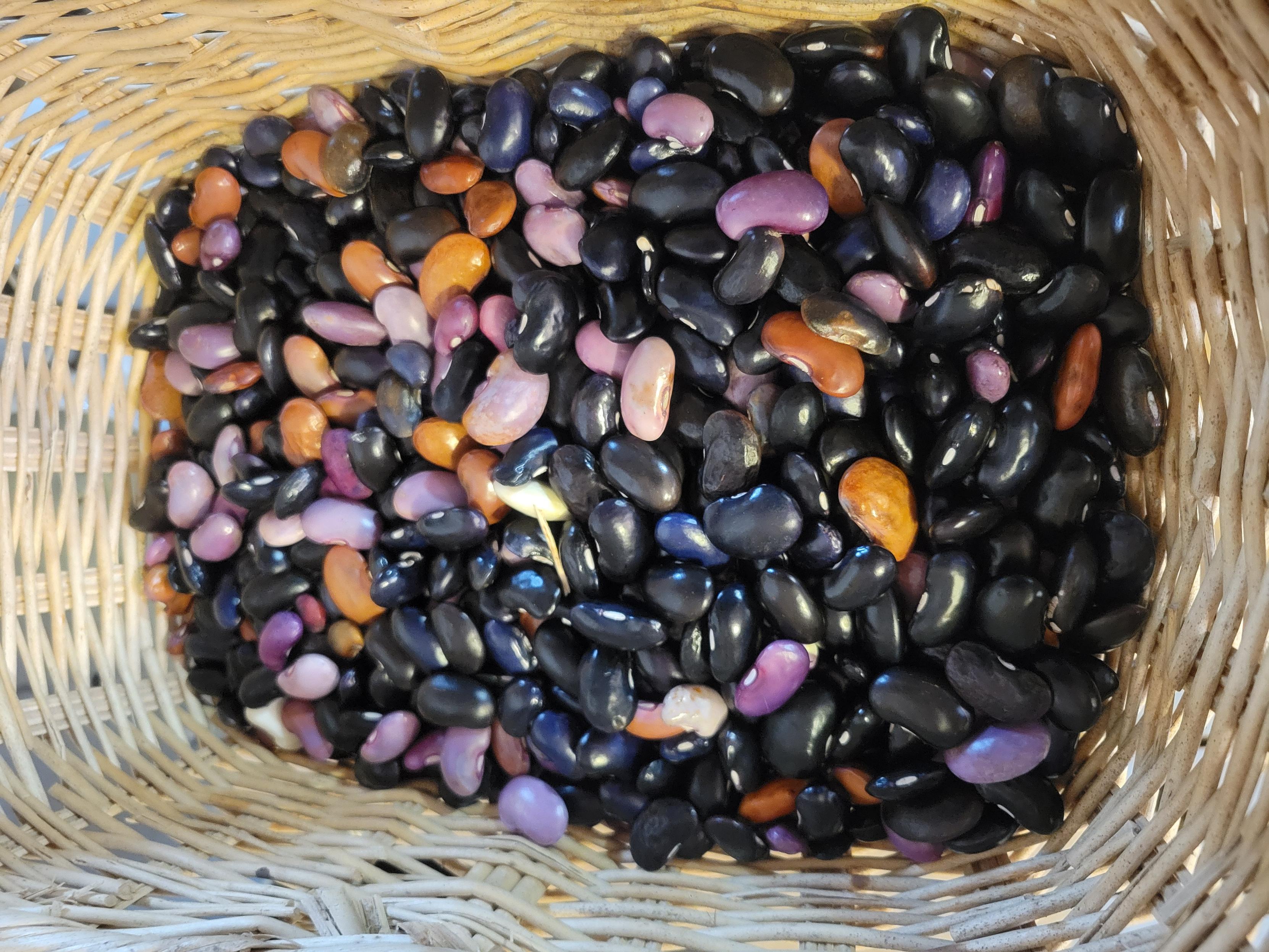
Most seeds produced were black, as expected, but brown, yellow, purple, pink, & white were found.
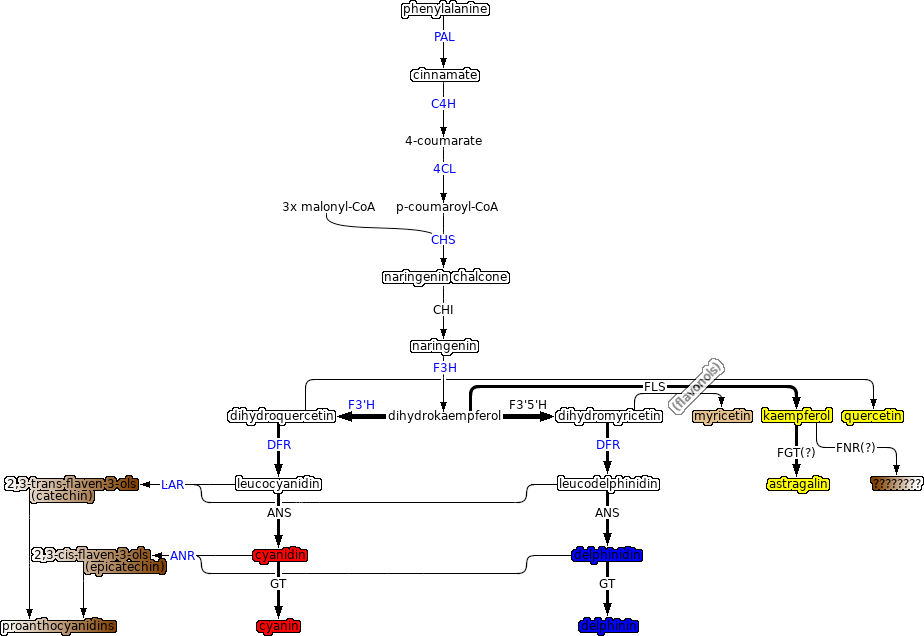
The yellows/browns have one branch of the flavonoid pathway active. The purples/pinks have the two other branches (red and blue) active.
The rare "white" F2s have all three branches inactive.
I was hoping for recombinations to turn up separating the red and blue branches from each other.
That I was only able to recover the combinations of the red and blue genes seen in my starting varieties tells me that the genes for the two important enzymes (F3'H & F3'5'H) are tightly linked.
The "V" genes (F3'5'H) is on chromosome Pv06 of the common bean genome.
F3'H, responsible for producing red anthocyanins, may or may not have a specific gene label associated with it.
When doing real research, you very quickly find unknowns, and you have to forge your way forward anyhow.
I'll refer to the gene for F3'H as "R" (for red). It has canonically been thought to be found on chromosome Pv02.
This wouldn't be linked with the "V" trait, as I have observed (repeatedly).
So... what's going on?
It turns out that F3'H is important for how plants respond to UV stress. (https://www.mdpi.com/2223-7747/10/1/118)
Thus, essentially, every plant species will maintain an active copy of this gene.
Beans with this gene inactive in the seed coat have to be doing so via a different mechanism than breaking the gene.
Since I've already found that "R" is tightly linked to "V", maybe there is a transcription factor responsible for activating F3'H in the seed coat that just happens to be linked to the V/F3'5'H gene.
As I puzzled over how to identify such a transcription factor gene, I found myself rereading the 2022 paper that identified the location of the V/F3'5'H gene. (https://pubmed.ncbi.nlm.nih.gov/35432409/)
In that paper, as an aside, they mention finding a 2nd copy of F3'H adjacent to the F3'5'H gene, with both resting within a heterochromatic region around the centromere. Such regions show dramatically reduced crossovers, thus recombination.
It looks like that 2022 paper likely found my "R" gene, even though that is in no way what they were looking for!
Ideally, I would now send off some tissue samples for targeted sequencing of the putative "R" gene in my blue (as well as red and yellow) beans.
This would be needed to confirm my blue lines have a broken F3'H, and my red lines have a broken F3'5H. A funded lab would then engineer these broken versions of the genes into a purple bean to confirm each pathway being broken separately.
I don't have a funded lab.
I may still slowly move towards getting these final steps completed, but already, I have a pretty good answer to the question that started this all.
I know that many of you have been following this story over the last years. You don't have to worry, I will continue posting bean content.
I'm just feeling quite pleased with coming to a solid biological answer for this, admittedly quixotic, quest of mine.
Next steps?
I still really want to make blue versions of lima beans, runner beans, and whatever else I can manage.
Because limas have the least brown pigments, I expect a blue in that species will be the most clear and bright blue that is possible. I really want to see that.
With the runner bean project, I may take a different direction to get there.
The two species are very closely related. Their genomes have largely the same order of genes.
I already made one cross between my blue common beans and a purple runner bean with black speckles.
The result is that F1 hybrids are easily made by transferring runner bean pollen to the common bean flower, but not the other direction.
Thus, I can use such hybrids to introgress the blue seed trait into runner beans!
The ideal cross would be between my blue bush beans and the "white" seeded runner beans I found in the F2 population I described above.
I use quotation marks because the seeds aren't actually white.
Instead, they're a pale brown color caused by the oxidation of colorless flavonoids into brown tannins.
The result of this cross will produce blue seeds, and some of them will look almost 100% like runner beans.
This lets me short-circuit my blue runner bean project.
I can grow all these together in 2026 to advance three goals.
* "white" runner beans.
* blue common beans.
* magenta lima beans.
* yellow lima beans.
This will increase the "white" runner beans while possibly producing the common-x-runner bean hybrid I need.
The lima beans will have more trellis area than I've grown before, increasing the odds of finding or producing a hybrid between them.

@thebiologistisn a blue butternut squash would bring interesting contrast to the winter holidays meals 🤩
