**English Translation (neutral, publication-ready):**
I want to tell a story that has nothing to do with the present day, and any similarities are purely coincidental. It is a story about how the United States once helped its “ally” achieve peace.
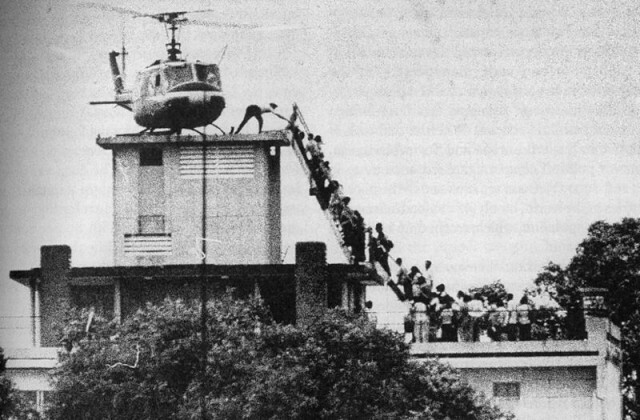
Henry Kissinger entered history as a Nobel Peace Prize laureate. In reality, he became the man who first forced South Vietnam to accept a capitulation-style “peace,” and then steadily cut off its ability to resist, hiding behind the word “corruption.” The ending was predictable: the country America had promised to protect “to the end” was simply abandoned, and the final chord became the panicked helicopter evacuation from the roof of the embassy in Saigon.
It began with bargaining. Washington was exhausted by protests and political crisis. President Nixon tasked Kissinger with achieving “peace with honor”—a formula that sounded good in newspapers and briefings but in practice meant withdrawing U.S. troops, leaving the southern ally to slow suffocation, and pretending that “the Vietnamese people chose their own future.” South Vietnamese leaders resisted: they understood that the 1973 Paris Accords were not peace but a delayed death. Yet they were pressured. Kissinger held direct secret talks with Hanoi, presented his ally with faits accomplis, and forced them to “be constructive,” because Washington needed to show results.
Next came American promises: if the North violated the agreement and launched a new offensive, the United States would return, help, and not allow its ally to fall. Later, when the North did exactly that, it suddenly turned out that there were “problems.” Congress began speaking of “corruption,” “inefficiency,” and “lack of reforms” in Saigon. The same people who had ignored abuses for years now opened their eyes very wide—at the exact moment when doing so made withdrawal easier.
Financial and military aid began shrinking “on principle.” Ammunition arrived late or not at all; aviation fuel was cut; spare parts did not support combat missions; security guarantees dissolved into phrases about “public fatigue” and “impossibility of intervening in a domestic conflict.” Kissinger—who only yesterday had shaken hands with Saigon’s leaders and spoken of a “joint struggle against communism”—shifted rapidly to new geopolitical calculations: opening China, détente with the USSR. Vietnam became a disposable variable in that game.
When North Vietnam launched its decisive 1975 offensive, the South was already suffocated. Promises of “we will return, we will not let you fall” proved empty. American personnel who were supposed to “stand until the end” received orders to evacuate. The world saw the images: helicopters on the embassy roof, people clinging to ladders, desperate allies staring at the ships in the bay—and the cold, pragmatic silence of Washington.
That is how the “defense” of South Vietnam ended. Kissinger received a Nobel Prize and a place in textbooks as an “architect of peace.” South Vietnam received re-education camps, repression, refugee boats and hundreds of thousands of dead. The corruption Washington invoked so conveniently was only a curtain. The real reason was different: a strategic decision to abandon an ally once it ceased to be useful, and to wrap that abandonment in the language of a “peace process.”
---
**Bibliography (recommended sources):**
• Kissinger, Henry. *White House Years*. Little, Brown & Co., 1979.
• Kissinger, Henry. *Ending the Vietnam War*. Simon & Schuster, 2003.
• Nguyen, Lien-Hang T. *Hanoi’s War: An International History of the War for Peace in Vietnam*. UNC Press, 2012.
• Oberdorfer, Don. *TET! The Turning Point in the Vietnam War*. Johns Hopkins University Press, 2001.
• Logevall, Fredrik. *Embers of War: The Fall of an Empire and the Making of America’s Vietnam*. Random House, 2012.
• Moyar, Mark. *Triumph Forsaken: The Vietnam War, 1954–1965*. Cambridge University Press, 2006.
• Hastings, Max. *Vietnam: An Epic Tragedy, 1945–1975*. HarperCollins, 2018.
• Congressional Research Service archives on U.S. aid reductions, 1973–1975.
• Pentagon Papers (Gravel Edition), Volumes III–V.
---
**Hashtags (English):**
#VietnamWar #Kissinger #ColdWarHistory #USForeignPolicy #Saigon1975 #ParisPeaceAccords #HistoryAnalysis #Geopolitics #SouthVietnam #WarAndPeace