
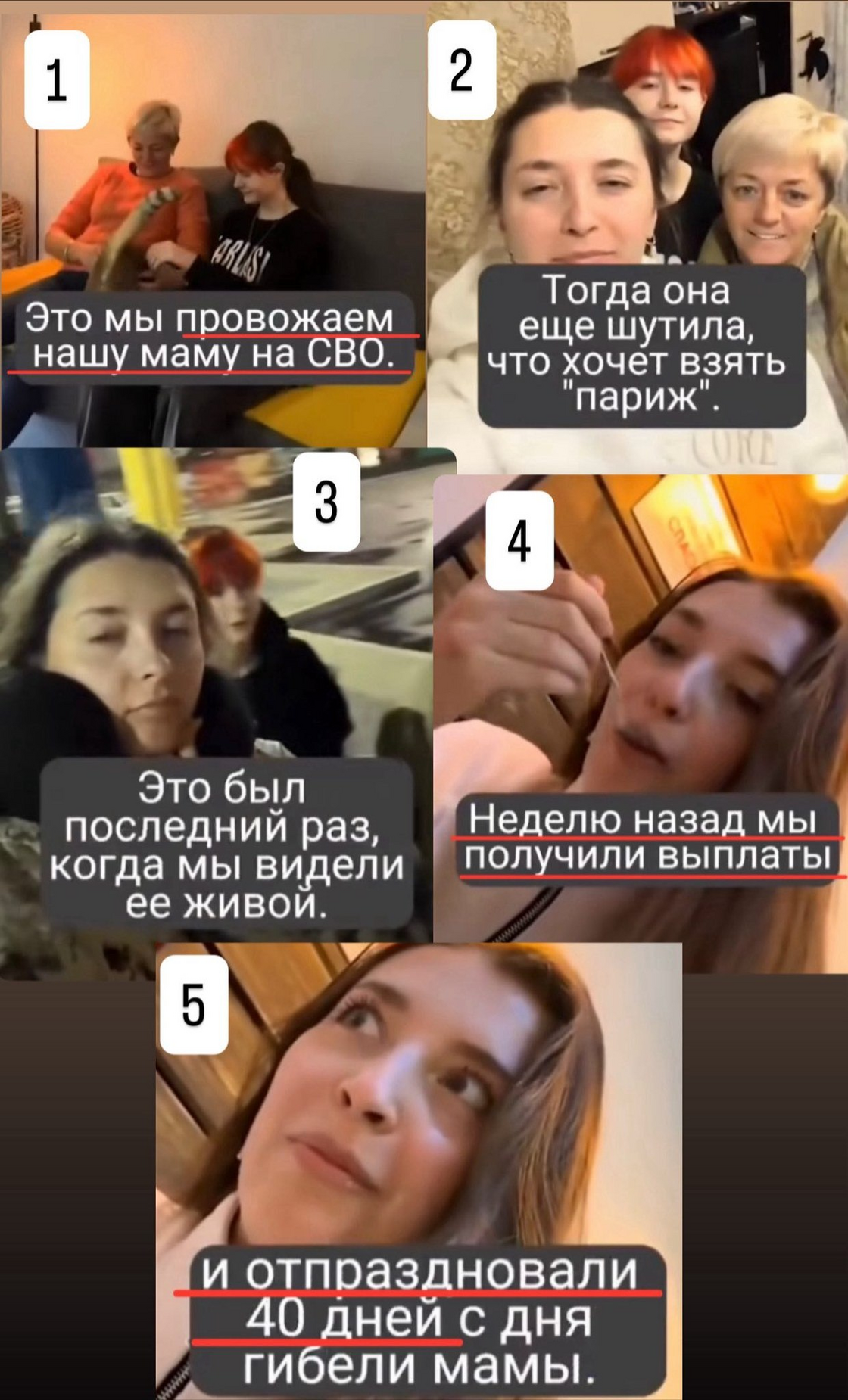
Fact-checking the authenticity of the collage (English translation)
The collage is a video-style story (likely from TikTok or a similar platform) in which a family — a grandmother, a daughter, and a son of the alleged deceased — appears to share memories about sending their mother/wife to the war, her death, and the compensation they received forty days later. The emotional narrative leans heavily on farewell, last moments, tears, and the grim “commemoration” with a mention of state payments. In reality, this is fake — a staged video created to manipulate emotions and possibly to facilitate fraud. Below is a breakdown based on available sources (verified across news reports and social media as of 28 November 2025).
1. Plot and characters: fiction, not a real family
– What the video shows: The family says they sent off “Elena Kovaleva” (a warrant officer), recall her supposed death in a rear-area mine explosion, and mark forty days since her death along with recently received compensation.
– Fact: No such story appears in official records (Russian Ministry of Defence, casualty databases such as “Cargo-200,” or regional registries). The people on screen are either actresses or unrelated individuals, and “Elena Kovaleva” is a fabricated name. The video was posted by the TikTok account @aktualno_na_svo, but that account is not the source. The admins claim the “family” contacted them requesting publication for 10,000 rubles, then refused to pay and accused the admins of lying.
– Evidence of fabrication: The main “daughter” is a Belarusian TikToker named Nastya (Anastasia). Her real mother, Zhanna, is alive, has never served in the military, and condemned the video as defamation. Zhanna learned of her own supposed “death” from social media and filed a complaint. This is a classic deepfake-style collage: assembled clips from unrelated videos with added captions to heighten the drama.
2. Details about death and payments: superficially plausible, but distorted for emotional effect
– What the video claims: A mine explosion in a rear area (“because it wasn’t marked on maps”), payments received “last week” after forty days.
– Fact about the death: Mine incidents in rear zones do occur (for example, detonations on legacy minefields), but “Elena Kovaleva” does not appear in casualty records. Overall losses in 2025 number in the thousands, but without verified names, this specific story is fictional.
– Fact about payments: These are real and governed by law (Federal Law No. 52-FZ, Government Decree No. 855). In 2025:
Type of payment Amount (RUB) Recipients Timeframe Presidential lump sum 5,000,000 Immediate family (children, parents, spouse) Within 6 months Insurance payment (“SOGAZ”) ~3,439,562 (indexed) Immediate family ~30 days after paperwork Monthly survivor benefit 200% of social pension (~22,908, split) Minors, dependents Via social fund / draft office Regional payments 1–2 million (varies by region) Family Local
Payments often arrive within 1–3 months and might realistically coincide with the period after the 40-day memorial. The video exploits this timeline for emotional punch rather than factual accuracy.
3. Distribution and motive: manipulation and scam
The video gains traction on TikTok/X (millions of views), provoking tears and reposts under hashtags like #СВО and #груз200. It fits a broader pattern of fake “war stories” designed for donations or engagement farming. Admins of the reposting account promised to transfer funds to the “family,” but never did.
Similar fakes have been documented in 2025: videos about a “fallen mother” used to solicit donations, followed by account shutdowns. When compared with real verified cases (such as regional court disputes over compensation), none of the details match.
On X: mentions of the video exist only in the context of debunking (“fake”). There are no organic posts from any “family members.”
Conclusion
This is a fabricated story (0% authenticity). It is an emotional trap engineered for social media engagement and fundraising scams, exploiting the real tragedies of the war. Genuine bereaved families receive support, but not through staged videos of this sort. If you encounter donation requests linked to this collage, avoid transferring money — this is a scam. For verifying such claims, rely on primary sources such as official MoD casualty records, the Social Fund, or established media.
