

EtnaUpdater @EtnaUpdater@qoto.org
Volcanophilic nerd & #volcano hiker blogging about Mt #Etna since 2004. Find tweets about Etna and also my backyard geology, the #Vogelsberg area.
Joined Nov 2022
EtnaUpdater
boosted

https://nitter.cz/search?q=%23ImageOfTheDay
A new paroxysm occurred at
https://nitter.cz/search?q=%23Etna
volcano 🌋 during the evening of 12 November
⬇️The thermal signature of the cooling lava flow 🟥 was still visible yesterday, 13 November, at 10:00 UTC in this
https://nitter.cz/search?q=%23Copernicus
https://nitter.cz/search?q=%23Sentinel2
🇪🇺🛰️ image
🐦🔗: https://nitter.cz/CopernicusEU/status/1724321356290916458#m
[2023-11-14 07:00 UTC]
Short update - Mt Etna, Sicily
After a long build-up phase, the expected paroxysm occurred today at the South East Crater complex of Mount Etna. Lava fountains were released and a lava flow was emitted in a southerly direction. Ash rain fell on the villages on the east/south-east flank of the mountain.
You can find more information on my website https://www.vulkan-etna-update.de (German language).
This webcam photo was taken during the peak of the paroxysmal episode by INGV. It was taken from the eastern flank and shows the strong glow within the cloud cap that unfortunately covered the summit area during the eruption. Above you can see the eruption column of gas and ash, which is being bent by the wind in an easterly direction:
EtnaUpdater
boosted

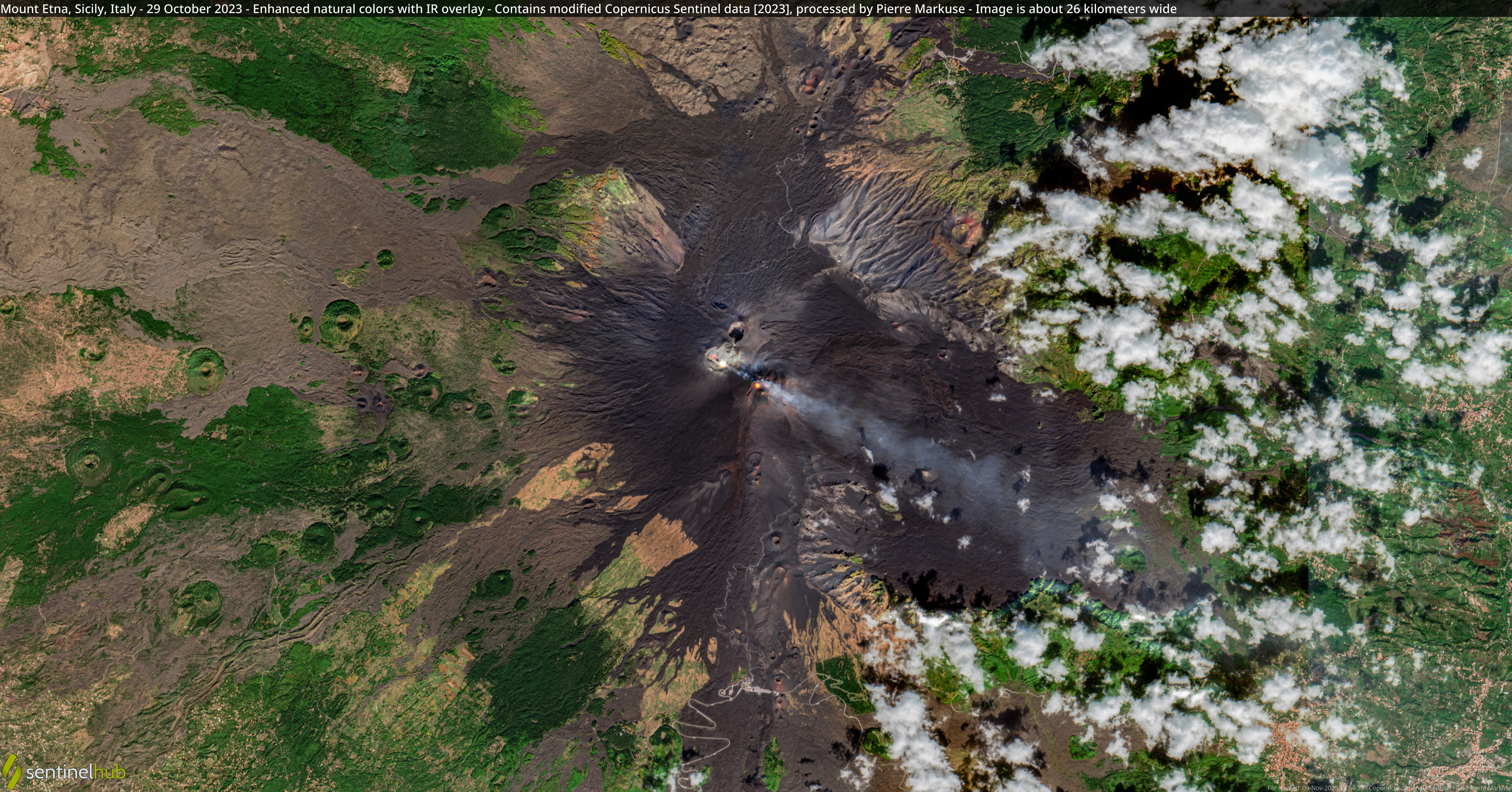
🟠 Mount Etna Volcano🌋, Sicily, #Italy🇮🇹 29 October 2023 #Copernicus🇪🇺 #Sentinel-2🛰️ Full-size ➡️ https://flic.kr/p/2peKbZb #scicomm #OpenData #RemoteSensing #Etna More of Etna ➡️ https://flic.kr/s/aHskTG22RE and other volcanoes ▶️ https://flic.kr/s/aHsmB6US6x Image is about 26 km wide @CopernicusEU @CopernicusECMWF
Short update - Mt Etna, Sicily
During last week, the mild strombolian activity at Etna's Southeast Crater complex continued. The tremor remained unchanged and the seismic activity was only slightly increased.
You can find more information on my website https://www.vulkan-etna-update.de (German language).
EtnaUpdater
boosted

They’ve moved on of the live webcams on the Reykjanes Peninsula to point south overlooking the area where there MIGHT be a volcanic eruption soon. 🗻
https://www.youtube.com/live/YAQzsB9ev9Q?si=RPLPjYgyIqLt104k
Short update - Mt Etna, Sicily
For several days, there has been ongoing strombolian activity at Etna's Southeast Crater complex. Meanwhile, Bocca Nuova emitted pulse-like hot gas and produced many gas rings.
You can find more information on my website https://www.vulkan-etna-update.de (German language).
This webcam photo taken last night from the eastern flank of Mt. Etna shows one of the mild strombolian explosions in the Southeast Crater complex. The incandescent material is ejected several tens of metres higher than the crater rim:
Short update - Mt Etna, Sicily
Mild strombolian activity has resumed at Mt Etna. Since the early morning hours of 22 October, very sporadic and mild strombolian explosions have been occurring at Etna's Southeast Crater. The explosions take place in the area between the old and new cones of the Southeast Crater complex and usually also release some brownish ash.
This photo of the La Montagnola - webcam (I.N.G.V.) from the evening of 23.10.2023 shows a mild strombolian explosion inside the Southeast Crater:
Short update - Mt Etna, Sicily
During the last week, Mt Etna remained somewhat unsettled. The energetic emissions of hot gas in Bocca Nuova continued and a swarm quake occurred on the northern flank.
You can find more information on my website https://www.vulkan-etna-update.de (German language).
Short update - Mt Etna, Sicily
The mountain remained unsettled last week as well. There were individual ash releases from the southeast crater complex. The tremor increased somewhat and the seismograms showed occasional explosion signals.
You can find more information on my website https://www.vulkan-etna-update.de (German language).
Short update - Mt Etna, Sicily
During the past week, Etna's restless sleep continued. There was pulse-like emission of hot gas, as well as production of gas rings from Bocca Nuova. Seismic activity has increased somewhat and slight inflation of the volcanic edifice has been observed.
You can find more information on my website https://www.vulkan-etna-update.de (German language).
EtnaUpdater
boosted

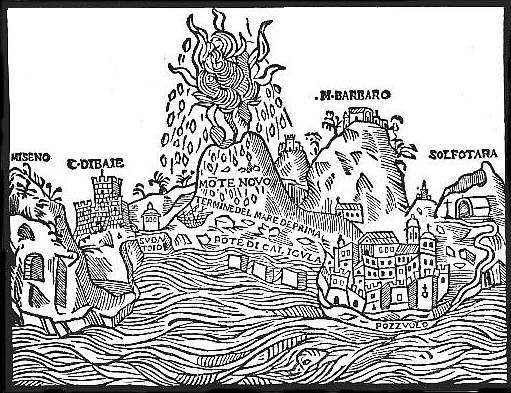
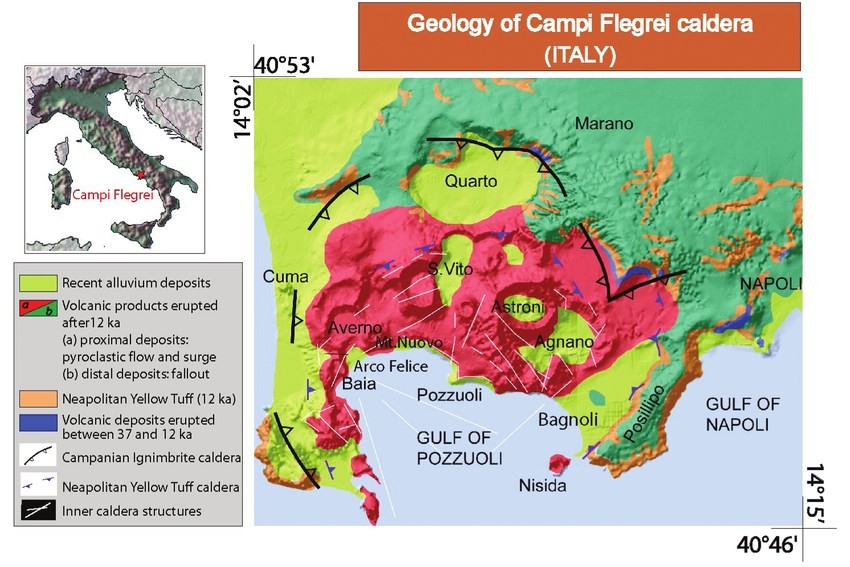
October 6, 1538, the last historic eruption in the #CampiFlegrei , building up the 133m high Monte Nuovo west of #Pozzuoli, ends with a last explosion killing 24 people who ventured to the "new mountain" believing the worst was over 🌋
https://forbes.com/sites/davidbressan/2023/10/04/italys-supervolcano-shows-signs-of-seismic-unrest/
EtnaUpdater
boosted
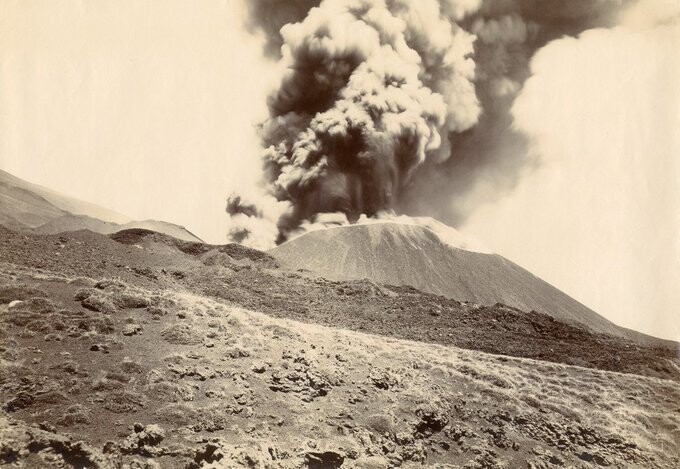
August 5, 1943, World War II: at around 11 o 'clock in the morning during the Battle of Troina, Italy, Mount Etna erupts, spewing lava & sending an ash column into the sky 🌋
http://geoscenic.bgs.ac.uk/asset-bank/action/viewAsset?id=305409
EtnaUpdater
boosted

Rings of steam captured today over the volcano #Etna
Everytime Etna does it, this means there is an eruption coming!
EtnaUpdater
boosted

Where The Lava Meets The Sea, Stazzo, Sicily
Even though Etna is a relatively calm volcano, it sometimes does reach the sea, as evidenced by this lava-formed coast near Stazzo, Sicily.
http://welchwrite.com/blog/2023/07/13/where-the-lava-meets-the-sea-stazzo-sicily-photography/
https://pixelfed.social/i/web/post/585191731219939424
#lava #volcano #mountetna #etna #coast #coast #rocks #stazzo #sicily #italy #ocean #coast #sea #nature #harbor #outdoors #travel #sky
EtnaUpdater
boosted

Latest video from the Iceland eruption. Yeah buddy, that’s close enough.
EtnaUpdater
boosted






"A clear message - an eruption is coming" by @RUVEnglish - A geothermal well bore hole which overflowed 1-2 days before #Fagradalsfjall #volcano🌋 eruptions in 2021 & 2022 is doing it again. https://nyr.ruv.is/english/2023-07-09-a-clear-message-an-eruption-is-coming-387366 #Iceland #geology
Quick Etna Update, 09.07.23
Today, minor ash emissions have started at Mt Etna's South East Crater complex. The source is apparently a vent located in the northeast summit area of New Southeast Crater. The grey ash clouds are accompanied by increased gas emission. In the evening, images from the INGV thermal imaging cameras also showed small thermal anomalies, suggesting the ejection of hot material. The tremor shows no particular abnormalities.
#Etna #volcano

Etna update, 07.07.2023
Last week, strong gas emission continued to occur at Bocca Nuova. Occasionally, pulse-like gas releases were also visible. Today, around 19:26, a relatively strong pulse-like gas emission occurred, which was associated with a seismic signal. At the Southeast Crater complex, most of the gas was emitted from a vent in the northeast summit area of New Southeast Crater. Here, gas emissions were persistent and appeared more powerful than in previous weeks. Occasionally, gas was also emitted in pulses. From the central area between the old and the new South East Crater, gas was persistently emitted from fumaroles extending along the inner crater walls. Fractures on the upper north flank of New Southeast Crater also persistently released some gas and white steam.
I did not observe any gas emissions at Voragine and Northeast Crater.
The evaluation of the data from the GPS stations showed no significant changes for the period between 26.06. and 02.07. However, the data showed the continuation of the slight inflation phase of the volcanic edifice [1].
The signals from the clinometric stations showed no significant changes for the period between 26.06 and 02.07 [1].
After a slight increase in the number of infrasound events from 26 June, the infrasound activity at the summit craters slowly decreased again until 02 July. However, strong winds also affected the measurements during this time. The amplitude of the events was low. In most cases, Bocca Nuova could be identified as the source, although some events also occurred at Southeast Crater [1].
Sulphur dioxide emissions at the summit craters remained at a medium level in the week from 26.06. to 02.07..
During the same period, ground carbon dioxide emissions (ETNAGAS station) decreased significantly, but remained just at a medium level [1].
Last week, the online seismograms of station ECNE showed weak noise, as well as repeated various weak signals, some of which resembled explosion signals. These signals occurred about every 5 - 15 minutes. Today, two short sequences (2 - 3 min.) of stronger noise were recorded. The second event was associated with stronger gas emission from Bocca Nuova.
The tremor was at a medium level during the past week, with a slightly increasing trend [2].
In the period from 26 June to 02 July, the source of the tremor was below the southeast crater at a depth between 2400 - and 2900 m [1].
On 05.07. a series of earthquakes occurred in the area a few kilometres west of Bronte (west flank). The strongest quake had a magnitude of 4.0. The quakes occurred at a depth of between 9 and 30 km [3].
1. INGV-Sezione di Catania. 2023. Etna - Bollettino settimanale, 26/06/2023 - 02/07/2023
2. INGV-Sezione di Catania. 2023. Home. TREMORE VULCANICO. ECNE
3. INGV. Osservatorio Etneo. Sorveglianza e Monitoraggio. DATABASE TERREMOTI. Localizzazioni di sala operativa. 2023


Etna update, 30.06.2023
During the last week, clouds temporarily hindered the observation of the summit craters via webcams. During the cloud-free hours, the usual gas emissions appeared, which continued to be most intense at Bocca Nuova and at times also intensified like pulses. At the southeast crater complex, gas was emitted persistently from the central area between the old and new southeast crater. The upper northeast to north flank of New Southeast Crater also emitted gas or white steam persistently. At Voragine and Northeast Crater I could still hardly observe any gas emission.
The analysis of the data from the GPS stations showed no significant changes for the period between 19 and 25 June [1].
The signals from the clinometric stations showed no significant changes for the period between 19 and 25 June [1].
The measurement of infrasound activity at the summit craters showed a low number of events between 19 and 25 June. The amplitude of the events was predominantly weak and the source of the events was located in Bocca Nuova [1].
Sulphur dioxide emissions at the summit craters remained at medium levels during the week of 19-25 June.
Ground carbon dioxide emissions (ETNAGAS station) decreased slightly during the same period, but still remained at a high average level.
The concentration of helium isotopes (3He/4He - ratio) in the Etna area, which was last determined on 21 June, was slightly higher than in the last measurements with a value of 0.63. The measured value was at a high level. The measured value was at a high level [1].
The online seismograms of the ECNE station showed weak noise last week, as well as some occasional weak signals.
The tremor was at a medium level last week and was subject to only minor fluctuations. Overall, there was a slightly increasing trend [2].
In the period from 19 to 25 June, the source of the tremor was below the southeast crater at a depth between 2000 - and 2800 m [1].
On 23 June, an earthquake of magnitude 1.5 occurred near Milo (eastern flank). Between 24 and 25 June, several weak earthquakes occurred in the area of Monte Fontane (eastern flank), the strongest reaching a magnitude of 1.9. From 27 to 30 June, a series of earthquakes occurred in the Fleri - Zafferana Etnea - Santa Venerina - Milo area (eastern flank). The strongest earthquake reached a magnitude of 3.1, but most of the quakes were much weaker and had magnitudes below 2.0. The depth of the quakes varied between 2 and 12 km [3].
My interpretation of the data and speculations about the further development:
The recent series of earthquakes in the Zafferana - Santa Venerina area was, in my opinion, most likely caused by a fault that extends along the eastern flank of Etna from north to south. The quakes that occur there are tectonic in nature, but the stresses that are discharged are often caused by magma movements under the mountain. Thus, this series of earthquakes could be an indication of rising magma or inflation caused by it. The still high ground carbon dioxide emissions also point to rising magma. Another indication that fresh magma continues to flow in under the mountain is the still high 3He/4He ratio.
Unfortunately, it is difficult to predict when this magma will reach the surface. This could be in a few hours, but also in a few weeks. Anything from a paroxysmal eruption to a purely effusive eruption is possible, as has been shown again in recent months. The most likely location for an eruption is probably the southeast crater complex.
At present, there are no indications of an imminent eruption.
1. INGV-Sezione di Catania. 2023. Etna - Bollettino settimanale, 19/06/2023 - 25/06/2023
2. INGV-Sezione di Catania. 2023. Home. TREMORE VULCANICO. ECNE
3. INGV. Osservatorio Etneo. Sorveglianza e Monitoraggio. DATABASE TERREMOTI. Localizzazioni di sala operativa. 2023
Etna update, 16.06.2023
Etna remained quiet last week as well. However, increasing inflation and gas emissions, as well as a slight increase in tremor, could be the first signs of an imminent eruption.
Clouds continued to frequently hinder observation of the summit craters via webcams last week. During the cloud-free hours, intense gas emission was observed at Bocca Nuova, which was occasionally intensified in a pulse-like manner. At the Southeast Crater Complex, steam was emitted persistently from the area of the large breach respectively the crater between the old and the new Southeast Crater. From the northeastern to northern summit area of the New Southeast Crater, fumaroles released gas and steam persistently. On the other hand, Voragine and Northeast Crater continued to emit only minor amounts of gas.
The evaluation of the data from the GPS stations showed an increase in the inflation of the volcanic edifice in the area of the central mountain flanks for the period between 5 and 11 June. This put an end to the persistent slight deflation that had been going on for several months [1].
The signals from the clinometric stations showed no significant changes for the period between 05 and 11 June [1].
The measurement of infrasound activity at the summit craters was affected by strong winds in the period between 05 and 11 June. The number of events was at a similar level as in the previous week. The amplitude of the events was low. The source was mainly Bocca Nuova [1].
Sulphur dioxide emissions at the summit craters were at a medium level during the week of 05 June to 11 June, subject to an increasing trend.
Ground carbon dioxide emissions (ETNAGAS station) increased significantly during the same period and moved towards a high level [1].
The online seismograms of station ECNE were only available again last week from 14.06. and showed only weak noise.
The tremor moved at a medium level last week and was subject to a slightly increasing trend [2].
From 5 to 11 June, the source of the tremor was below the southeast crater at a depth between 2500 and 2800 m [1].
On 15.06. an earthquake of magnitude 1.7 occurred southwest of Rifugio Citelli (east/northeast flank). On 16.06. an earthquake of magnitude 2.5 was registered near Santa Venerina (east flank) [3].
My interpretation of the data and speculation about further developments:
The increase in the inflation of the volcano edifice, as well as the increased emissions of carbon dioxide, indicate that more magma is rising in the mountain at the moment. The tremor has also increased slightly, which indicates that magma is in motion. Presumably, these are moderate amounts that can probably be stored in the mountain for the time being. Sooner or later, however, there will probably be another eruption. But it is difficult to say when this will be the case. The character of the eruptive activity cannot be predicted either. It is possible that the magma that is now rising will first degas slowly and then, in a few months, there will be an effusive and prolonged eruption, as in November 2022. However, if there is a larger amount of fresh magma, there may also be strombolian and effusive activity at the Southeast Crater complex. However, it is also possible that, as in May, a paroxysmal episode suddenly occurs at the Southeast Crater complex, resulting in a brief but very explosive eruption. At the moment, however, nothing points to an imminent eruption. In any case, the mountain is always good for a surprise!
1 - INGV-Sezione di Catania. 2023.Etna - Bollettino settimanale, 05/06/2023 - 11/06/2023
2 - INGV-Sezione di Catania. 2023. Home. TREMORE VULCANICO. ECNE
3 - INGV. Osservatorio Etneo. Sorveglianza e Monitoraggio. DATABASE TERREMOTI. Localizzazioni di sala operativa. 2023.
Volcanophilic nerd & #volcano hiker blogging about Mt #Etna since 2004. Find tweets about Etna and also my backyard geology, the #Vogelsberg area.
Joined Nov 2022
