

We also tried to toss out all kinds of ideas but to give you an example. When Google Code shut down, we launched Code.FossHub.com (a subdomain) but a different website and separated platform, similar to Google Code. A dozen projects migrated from them to us. Some users and developers started to criticize us that for the sake of simplicity, it would be better if we would use a single domain/platform. We finally ended listening to their suggestion.
The problem here is that our user base uses both Open Source and Freeware software. With all respect in the world, most of them can't tell the difference between them.
The obvious question would be: why don't you educate the users or get involved?
We are trying to educate them to check the file signatures while a lot of developers don't even list them. The success rate is so low that I doubt people will ever learn, or we can convince devs to make them public.
While we struggle with signatures, the most asked question is this: which version do you recommend to download: 32-bit or 64-bit?
Or those that change their license, Classic Shell was freeware and later was released as Open Source software.
Another problem is with the developers that create free software, but again, these are both: open source and freeware. They won't like the idea of having a separate platform for each software.
Frankly, when we registered FossHub, we had at least ten domain names, and there was a vote where many developers/projects participated. 90% of the votes went for FossHub. In that enthusiasm, we forgot that we'd listed a few freeware software titles, and yes, the vote came from them too - everyone loved the FossHub name. Back then, we had other problems, and we still face all kinds of new issues all the time.
We did not anticipate that we will upset some people that have a point.
I will say that your suggestion is welcome. How can we marginalize them when, in fact, the services we provide are free? The platform that we've built is for them, so they don't have to rely on sponsors or other services that might do more harm than good.
OK, that statement will be removed at your suggestion when we launch the latest major update. It was added there some time ago in a delicate context and as a form of protest.
An observation: The download page for the 64-bit version, there's a link under "Available Mirrors." The existing link redirects the users to a "Not Found" page. In this example, the Inkscape project can use FossHub to serve the download: https://www.fosshub.com/Inkscape.html?dwl=inkscape-1.0-x64.exe
Assuming the download from Inkscape doesn't work, visitors would be able to download from us, regardless of how much traffic you send.
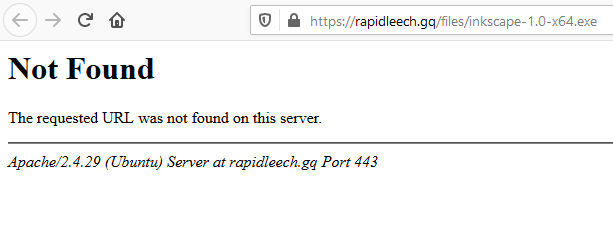
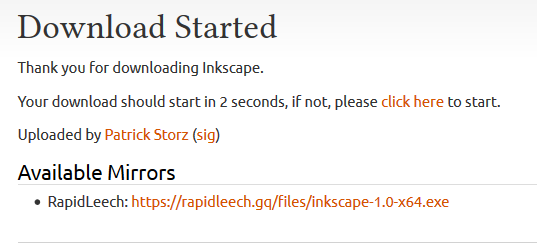
To make it clear. We had no intention to ask you to replace Fastly. We were trying to update Inkscape for 24 hours. It didn't work, and we offered our free multi-CDN service as a backup solution. Just like Fastly, we have worldwide POPs from where people can download fast, so considering this scenario, it made sense to offer FossHub as a secondary mirror. Inkscape team is more than welcome, anytime, we will provide access and support 24/7/365. Thank you!
That is very kind of you @paperdigits to defend us, thank you!
Hey, it was meant to be an irony. Except for the few, pure FOSS evangelists, most services (or corporations) hide behind Open Source. Mostly PR to make it look good when, in fact, they care about profit. We use the .com extension so we can onboard the few projects that use a closed source license. The .org will be 100% for "Open Source," but it will continue to rely on .com to support this project. Or we can implement a good filter for open-source. For your consideration, the "FOSS" acronym is probably the only argument against FossHub.
