

Ok, Let's talk about #hydrogen Fuel Cell Electric Vehicles (#FCEV) as an alternative to Battery Electric Vehicles (#BEV).
A FCEV uses the same electric motors as BEVs but gets its power from chemically reacting H₂ with O₂ from the air in a way that produces an electric current - a fuel cell. None of this is new technology Fuel Cells were a mature and reliable power source by the time the Apollo program was landing people on the moon. The issue with fuel cells is the same as with Enteral Combustion Engines(ICE) they are most efficient in a very narrow energy band great if the goal is to power the life support on a space craft, but not for the extremely variable loads needed to drive a car.
For this reason, FCEVs are hybrids with the same Li batteries as BEVs and ICE Hybrids like the Prius. Like ICE Hybrids they use the battery to accelerate and as storage for regenerative breaking with the fuel cell providing a constant recharge.
**Why I'm skeptical of FCEVs**
1) Greenwashing Hydrogen. FCEV advocates will point out that the only tailpipe emission is water vapor. The question is where does the hydrogen come from. By far the least expensive way to produce hydrogen gas is to crack the hydrogen atoms off of petrochemical hydrocarbons. As a mater of basic chemistry it takes far less energy to crack hydrocarbons than it does to electrolize water. And unlike the electrical grid where technologies like solar, wind and nuclear are already deployed and becoming an increasing share of our electric grid. Processes to produce hydrogen from water at anything close the the cost to strip it off fossil fuels is in the same development stage as cold fusion. at least for the next decade green hydrogen will be a premium product only available to the wealthiest buyers.
2) Hydrogen storage is hard. To fit enough hydrogen on a moving passenger car for it to have a 300 mile range requires pressures of 10,000psi (700 bar). The kinds of pressure vessels that can safely handle that pressure are expensive, and need regular inspection. Having had to keep a compressed air tank of just 200 psi in a fixed certified, I can tell you that there will be significant costs to regularly inspecting a 10,000 psi tank full of flammable gas that needs to survive a collision with one of the 2023 lineup of full sized puck up trucks.
But that is just the start. Hydrogen leaks. No matter how good you think your valves and fittings are the smallest molecule in the universe stored under huge pressure will find a way out. Ask anyone who has experience in the space industry where hydrogen is already the fuel of choice and they will tell you that hydrogen leaks are just a fact that has to be engineered around. On a vehicle this will be a small annoyance but at a fueling station this will be significant. The farther Hydrogen is transported and the longer it must be stored the higher the losses. There is also the energy factor of compressing that gas. To the best of my knowledge the prodigious amount of work done to pressurize the fuel is never recovered
FCEVs and BEVs both started to be produced about a decade ago, and while Tesla has scaled out its supercharger network world wide in that time. Hydrogen has less than 100 filling stations all in California. While these stations can fill a car in 5 minutes, they can only fill 2 to 5 vehicles before spending an hour refilling their high pressure storage tanks. One could argue that all Hydrogen needs is an eccentric billionaire ready to lose money for a decade building out infrastructure, however I think the infrastructure challenges with hydrogen exceed even Musk levels of ambition.
3) Cost. My M3 already costs noticeably less per mile that the equivalent ICE vehicle. Baring a huge technological leap, hydrogen will always be more expensive. because the least expensive hydrogen is processed out of the same fuel that runs ICE cars and provides less energy per molecule than those hydrocarbons when reacted with O₂ hydrogen cannot help but be a more expensive fuel.
So why are hydrogen FCEV still a thing? Well the vehicles are lighter, fueling times are comparable to gasoline, and the petrochemical industry is desperate for them to succeed. The oil industry can see the writing on the wall as states like California will ban new ICE vehicle sales in 2030. While holding out hope for a green hydrogen future a generation away, they can continue to have a market for their product as gasoline and diesel phase out. "Hydrogen will become the green fuel of the future" explain their sock puppets knowing that dirty hydrogen from their product will always have a price advantage. And to be fair, turning a mobile source into a point source of emissions does provide the opportunity for carbon capture ([so called Blue Hydrogen](https://www.petrofac.com/media/stories-and-opinion/the-difference-between-green-hydrogen-and-blue-hydrogen/)), but all this still add even more cost while BEVs already have a price advantage in their fuel - not to mention that every home in the developed world has the infrastructure to charge BEVs.
Why write all this? Because when you get down to it most of the #FUD being spread around #EV s is coming from FCEV advocates who are trying not to let hydrogen become the betamax of the transition away from ICE transportation. In doing so they are making it harder than necessary for the world to move away from ICE transportation.
References:
https://www.thedrive.com/tech/33408/why-we-still-cant-deliver-on-the-promise-of-hydrogen-cars
https://www.caranddriver.com/features/a41103863/hydrogen-cars-fcev/
Tags:
#GreenHydrogen #BlueHydrogen #ClimateCrisis #fossilefuel #greenwashing #Tesla #Toyota #Mirai #electrolysis

@antares It is not accurate to say that H2 comes from cracking hydrocarbons. Most H2 today is actually obtained from cracking water with carbon as the enabler.
https://techhub.social/@icanbob/110941409690106296
It is not accurate to say that BEVs on a grid with renewables is carbon free.

@antares @mackaj Yes the CO is often further shifted towards CO2 and one more hydrogen. When coal is used all the H2 comes from “cracking” water. Calling existing hydrogen production processes hydrocarbon cracking isn’t accurate. Making H2 today =CO2 emissions. Making on demand electricity today =CO2 emissions. We need to invest in CO2 free ways to make both currencies. Also just because we can interchange both doesn’t mean it makes sense to do so.
He actually said the "least expensive" way to produce hydrogen is to crack the hydrogen atoms off hydrocarbons, and he's right. SMR is the cheapest, liberating all the H2 from the CH4 and all the H2 from the water.
Personally I don't care for hydrogen. Direct renewable electricity generation, its storage, use in domestic heating and transport is what I find exciting and enjoy reading about. Hydrogen is a distraction.
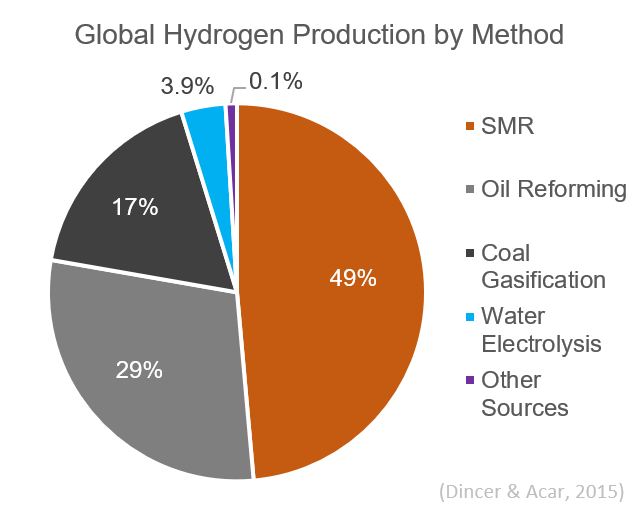
@antares @mackaj Actually there are really only two energy currencies: electrons and molecules/chemistry. Energy sources are really also only two: Remote nuclear fusion and local nuclear fission. Renewable generation=electrons. Batteries, hydrogen, synfuels=moleciules/chemistry. We can’t avoid using both. The molecules/chemistry side is diverse. It is a mistake to only look at intersection between electrons and chemistry as the only climate solution.
I see Hypx has chipped in with one of his usual brainless answers. 96% of hydrogen production today comes from fossil fuels 🙄
I can't imagine there was no sun or wind elsewhere in Canada. You need more solar and wind turbines at strategic distributed locations to generate energy where it's actually happening.
@antares @mackaj Ontario is a vast province. It takes almost 2 days to drive across. We have wind energy distributed across 2 time zones. The facts are undeniable. In Ontario our wind power only works on our grid because we have full gas backup. It is true when our winds off the Great Lakes are blowing we reduce our gas consumption but if we think that adding more wind turbines is going to fix today’s grid condition we are dreaming.
Well then something doesn't compute. Your screenshot shows just 385 MW of solar generated, but as of December last year you have 1.9GW of solar installed in Ontario. How can that be on the hottest day of the year with a clear sky?
In the UK we have a different scenario. Take today's generation breakdown. We clearly have the potential to capture huge amounts of solar and wind. We have to scale up what we have including our capacity to store it to reduce or eliminate reliance on gas. This picture is seasonal of cause. In winter months we get a lot less solar, but our wind increases substantially too.
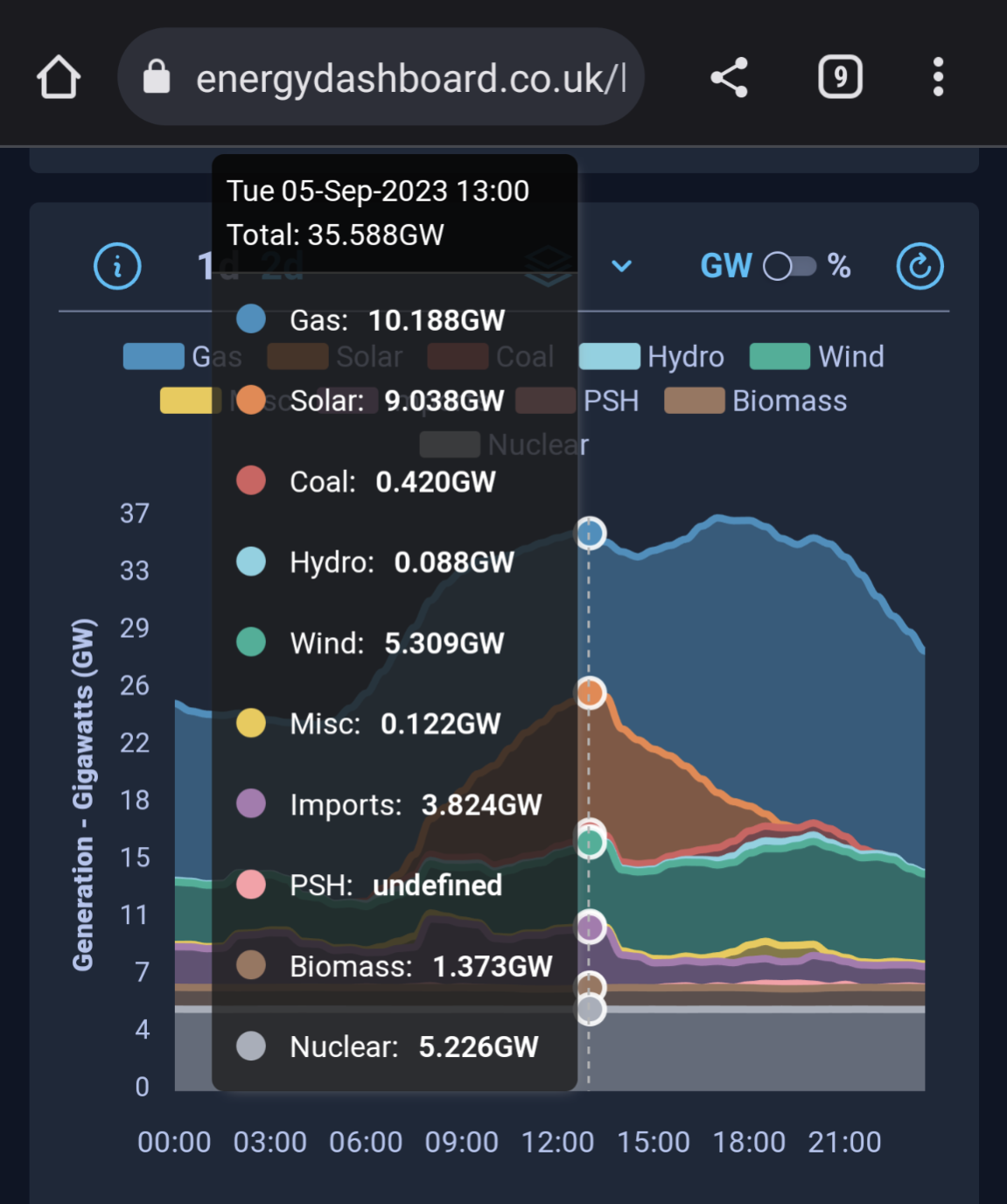
@antares @mackaj You still have a very high gas component. Here’s the problem, from a climate perspective it makes no sense to store wind or solar until that gas component is driven to zero. I’ve never seen our grid in Ontario be gas free. In reality gas generation is like a giant “battery” on the grid that never needs recharging. It can follow any fluctuations of load and generation intermittency: in other words the ideal grid “battery”. Hard to replace.
That's what I was saying. We (in the UK) need to continue to grow our renewables until there are times of excess where we don't consume any gas at all. Plus anticipate storage capacity requirements to capture that excess and avoid using gas when generation dips below demand.
We get enough solar and wind to make that happen. It just needs the right political will and focus.
Your challenges I think are different.
@mackaj @icanbob Report from the US West: In the summer our [duck curve](https://www.eia.gov/todayinenergy/detail.php?id=56880) *is* hitting zero. Texas, (who for regulatory reasons has an isolated grid) is also seeing hour-ahead prices go briefly negative. With California [adding 5 Gigawatts of solar per year](https://www.seia.org/state-solar-policy/california-solar) we will consistently have excess power on the grid in the near future.
As I said earlier in the thread, in the arid west we can kill 2 birds with one stone by pumping more water through the California Water Project which will both reduce the demand on Colorado River water and provide energy storage. (Water goes up the hill at peak solar production and back down the other side at peak demand). It may also be time to thing about adding infrastructure to pump water over the Cascades, Trinity Alps, and the Sierras so we don't "[run out of water](https://mastodon.social/@Hypx/110987599493751453)" to pump. We also my need to think about municipal desalination which becomes practical in this scenario.
50m is not very high. Pyramid lake is 780m above LA, Shasta is dam is 184m, Oroville dam is 237m. A proposed project to divert water from the Klamath River over the Trinity Alps would Raise water almost 1500m.
You talk about a weeks storage, but that is not what we need, we need to move power production four hours. Peek production is from 10am to 2pm while peek demand is from 4pm to 8pm which interestingly enough also matches the peak demand for water.
Further, this water has to move anyway. The good people of Los Angeles are thirsty and 66% of their water comes from outside the LA basin. 450 billion litres of water must get pumped into LA every year anyway. This water can find an additional use as short term power storage.
@antares @mackaj In your LA example if you pumped all the annual drinking water into Pyramid lake you could store 1 TWh of power annually. Google says LA uses 26 TWh annually. 1 TWh=4% storage. 4 hours per day=17% = 4.4TWh storage required. From a climate perspective that the 4.4 TWh has to be surplus power with grid fossil generation driven to zero. That is before we add the entire fleet of cars in LA as EV load on the grid.

@mackaj @antares The physics says that energy depends linearly on height. 10x higher=1/10 water mass. The problem is that in many parts of the world like Ontario we don’t have the elevation so we’d have to go for volume. 4 hours storage in Ontario will not allow renewables to assume the grid. Wind dies off for days on end and the sun doesn’t shine much from Nov-Feb. Neighbouring province with surplus hydro has over promised to all interconnects.