

Nick has moved to Mathstodon @internic@qoto.org
- Pronouns
- he/him/his
Moved to Mathstodon.xyz
Theoretical physicist by training (PhD in quantum open systems/quantum information), University lecturer for a bit, and currently paying the bills as an engineer working in optical communication (implementation) and quantum communication (concepts), though still pursuing a little science on the side. I'm interested in physics and math, of course, but I enjoy learning about really any area of science, philosophy, and many other academic areas as well. My biggest other interest is hiking and generally being out in nature.
Joined Nov 2022
@nixCraft A @frameworkcomputer laptop is also a very good alternative.
@johncarlosbaez But presumably @BartoszMilewski's statement that "you'd see the horizon as a black surface coming at you" is true at some level, because what you see in the distance is not only a function of local spacetime (unless you're inside an enclosure, which is the usual conceit of equivalence principle thought experiments).
Nick has moved to Mathstodon
boosted

As you're freely falling through the air you don't feel any force except the wind - but you're also getting *stretched* a tiny amount because gravity is a bit stronger near your feet. This is called a 'tidal force' because it creates tides: for example, water on the side of the Earth facing the Moon is pulled toward the Moon more than water on the opposite side.
As a star falls toward a black hole it can get stretched and even destroyed by this tidal force - we've seen it happen! It can create a huge flare of radiation.
But surprisingly, the bigger the black hole, the smaller the tidal force is near the event horizon. We could be falling through the event horizon of a truly enormous black hole right now, and we'd never notice - though I consider this very unlikely.
More importantly, a star like the Sun will only get disrupted *before* it crosses the event horizon if the black hole is < 100 million solar masses. Otherwise it will get sucked in and be lost to sight without any drama!
The big black hole in the center of our galaxy is only 4 million solar masses, so this 'silent death' doesn't happen here. But it happens elsewhere. The biggest black hole known is 66 *billion* solar masses!
Black holes emit flares of light that we don't understand. Some must be from stars falling in. But many flares show very little light in hydrogen's spectral lines! This talk is pretty fun, and it's all about these mysteries.
Nick has moved to Mathstodon
boosted

On SciComm.xyz, we have a rule about the use of image description; there are good reasons for that.
The most important one is because we believe that people using screen-readers (or with sight-related problems) should be 1st-class citizens on the Fediverse and should not feel excluded by inaccessible content.
But there are also very down-to-earth reasons why scientists and science communicators should use image descriptions.
A thread.
1/3
Nick has moved to Mathstodon
boosted

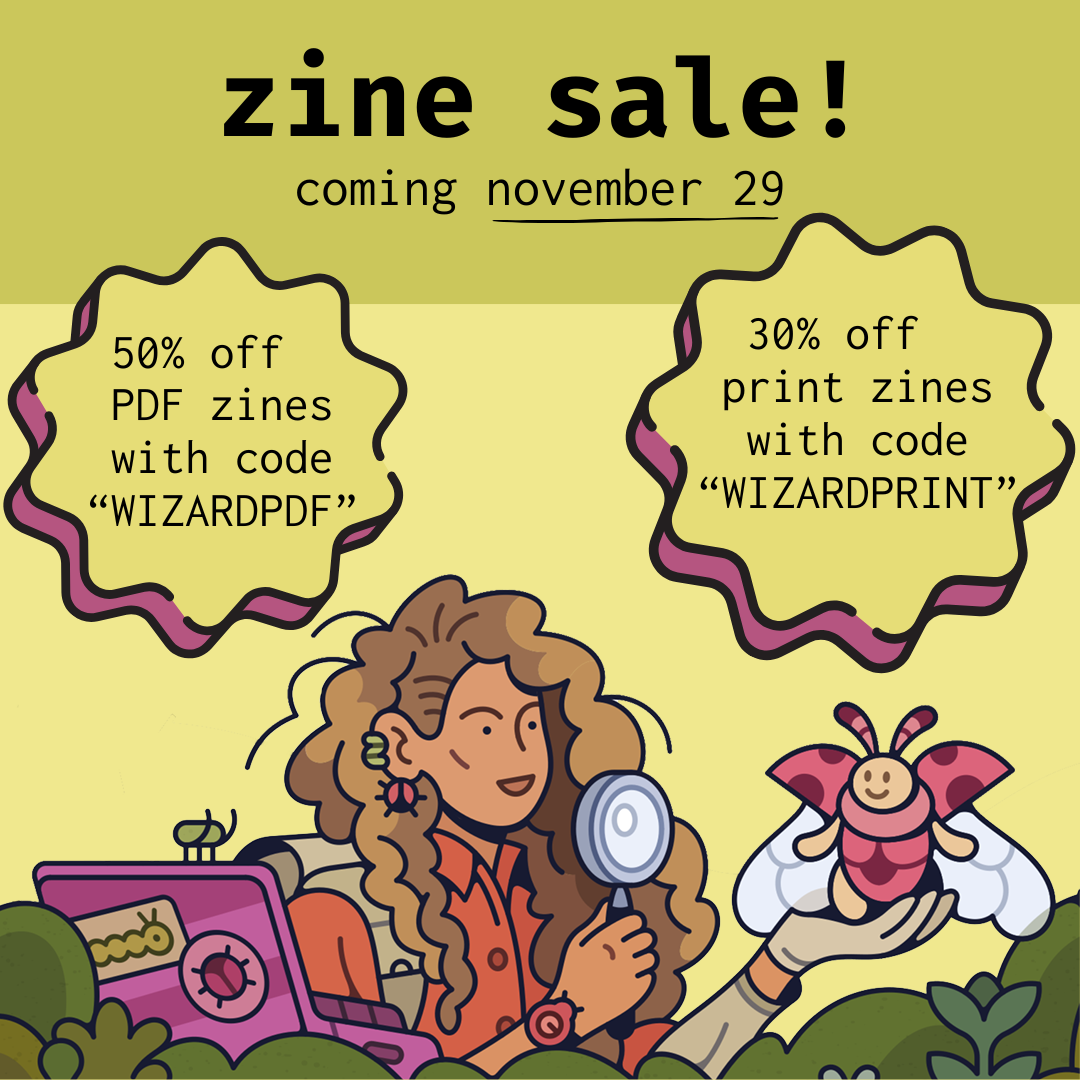
Wizard Zines is doing another Big Zine Sale again this year on **Friday, November 29th**! One day only.
here’s a google calendar link for the duration of the sale if you want a reminder: https://wzrd.page/cal (or ical: https://wzrd.page/cal.ics)
@Cyclist Diversity would be a boon to the richness of the conversation here (not to mention the moral obligation we owe our fellow human beings), but even aside from that, yes, bigger is better.
We use social media to connect with people. Sometimes those are new people we find via a social network, but often it's people or communities we're already connected to (friends, organizations, professional community, etc.).
This is unlike a text editor or something, where you can find a small niche tool and if it works the way you like and keeps being developed, then it doesn't matter if others like it. Network effects are very strong for a social network. That means that, all other things being equal, bigger is inherently better. So if the Fediverse ever hopes to offer a compelling alternative to commercial social media, it has to make growth a serious priority and get over the attitude you sometimes see among the user base that growth is not important.
Nick has moved to Mathstodon
boosted

I'm looking for some good resources on navigating conflict and difficult conversations in academia/science/the workplace for grad students and other early career researchers. Does that exist?
@vbuendiar Yes, that's disturbing. I expect that sort of thing from the various junk journals, but if major journals are exercising so little care in choosing reviewers that seems like a red flag.
Nick has moved to Mathstodon
boosted

Hi all, I'm a french physicist from Marseille.
I work at the interface between statistical physics, network science and sociology (sometimes labelled #sociophysics or #ComputationalSocialScience). I'm basically interested in universal properties in human behaviour, and the mechanisms responsible for these properties.
I also teach maths, network science and Python in Aix-Marseille Univ.
Nick has moved to Mathstodon
boosted
a PSA since a lot of folks have been surprised to learn this: terminal programs often support the mouse! Try:
- opening `htop` and clicking a column header to sort
- opening `nano` (or vim, or micro) and clicking and dragging to select text
- using the scroll wheel in `mc` & clicking on the menus
it's really helpful if I forget a keyboard shortcut
Nick has moved to Mathstodon
boosted

I want my Lyme vax.
Lack of legal protections is one of many reasons my dog can get a vaccine that I cannot.
https://slate.com/technology/2021/07/lyme-vaccine-history-lymerix-hesitancy-ticks.html
Nick has moved to Mathstodon
boosted
Some friends are asking if I'll go to Bluesky. I don't want to, for reasons I'll explain. But people there can follow me at
And if you're on Bluesky and follow @ap.brid.gy and let me know, I should be able to follow you from here. Details to follow, including my problems with Bluesky.
(1/n)
Nick has moved to Mathstodon
boosted

One of my favorite things to do with students in the late fall is to take them outside and point first to the Orion nebula, then to the Pleiades, and finally to the Hyades cluster, saying, “These are snapshots in the evolution of open clusters.” Each of these systems is the home of young stars, but while the Orion nebula is very much a stellar nursery, with stars just 10 million years old or younger, the Pleiades, is more like a daycare center with stars 100 million years old or younger. At the same time, Hyades is more like an afterschool program for stars 730 million years old or younger. All these systems are filled with celestial children. In their youth, these stars still gather in clumps. But, as they age, the stars will drift apart until, as adults, they have no memory of the place they were born. Our Sun is one of these solitary stars and every time I introduce my students to these three open clusters, they ask what happened to the open cluster where our Sun was born.
The truth is, the cluster and our Sun had a falling out.
Read more on Substack
https://open.substack.com/pub/starstryder/p/our-suns-lost-family
Nick has moved to Mathstodon
boosted

I think it's ok to tell you now that @anthrocypher and I have been collaborating on a scientific paper, that might also be a the-beacons-are-lit-Gondor-calls-for-aid thesis, might be the boldest thing I've written in developer science so far, might be something that only could've been written out of the liminal spaces that Ana and I both inhabit, and out of the joy of deciding we wanted to try to articulate science & community of practice wisdom together in one place and see where it took us
Nick has moved to Mathstodon
boosted


Over the past 24 hrs while Mastodon was discoursing about whether or not starter packs are OK, and if slow progress is more due to lack of funding or different priorities, and if people that choose other social networks are just evil, lazy, shiftless people who love to lick VCs boots or are people that just want a better UX...
BlueSky added another 1 million users.
@polotek It might be helpful if you could elaborate on in what ways bookmarking (with tags) is not a sufficient solution (since I think that's sort of the default solution to some similar sounding use cases).
Nick has moved to Mathstodon
boosted

If you're on BlueSky and want to bridge to Mastodon, follow @ap.brid.gy
That's it. Nothing to install, no terms of service to sign, no complicated garbage. If you want to stop, just block @ap.brid.gy
Details here: https://fed.brid.gy/docs
If you want to bridge your account to BlueSky, simply follow this account: @bsky.brid.gy
Why am I encouraging this? Because when BlueSky inevitably goes bad, people there will have friends in the Fediverse to help them move here.
Nick has moved to Mathstodon
boosted
New review feat. THE Sapna Cheryan (essentially if you want to understand STEM gender equity gaps this is the scientist to read) free to access until Dec 2
"Global patterns of gender disparities in STEM and explanations for their persistence"
@undefined @drskyskull Ugh, that's tough (I say from experience). I hope the biopsy may return from helpful information.

- Pronouns
- he/him/his
Moved to Mathstodon.xyz
Theoretical physicist by training (PhD in quantum open systems/quantum information), University lecturer for a bit, and currently paying the bills as an engineer working in optical communication (implementation) and quantum communication (concepts), though still pursuing a little science on the side. I'm interested in physics and math, of course, but I enjoy learning about really any area of science, philosophy, and many other academic areas as well. My biggest other interest is hiking and generally being out in nature.
Joined Nov 2022
