

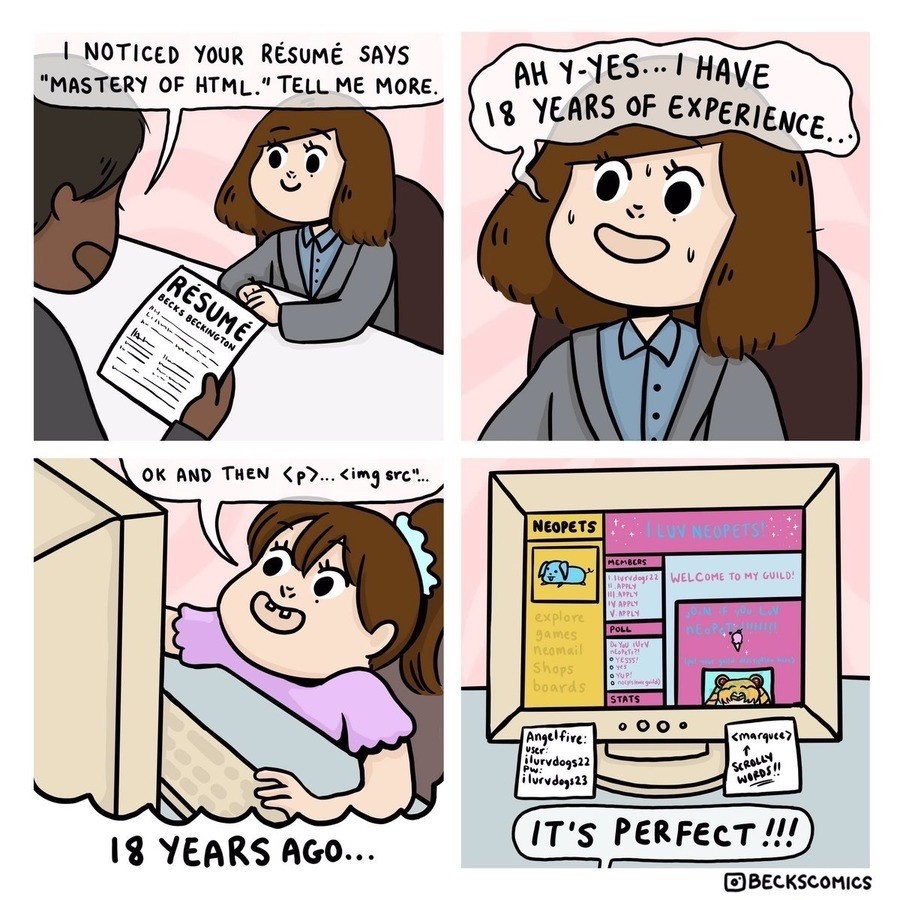
@cypnk I have 22 years of Java experience by this standard.
Also, HTML, Javascript, C, C++, and Assembly...1999 was a busy year for me.
@urusan Hot dang! You could have invented a whole new Internet
But seriously, I miss just exploring for fun. It seemed like there was always time to do anything and the possibilities were endless
@cypnk
In case you're curious, my learning process went like this:
HTML: Well, that was easy! This book says I should learn Javascript next.
Javascript: Wow, this programming thing is hard but amazing! I could do anything! Hmm, how do I write a file? This Javascript thing seems to be deliberately gimped...Java has a similar name.
Java: This is much nicer! Too bad it's too slow to make games with on my computer... I hear Assembly is mega fast!

Hmm.. mine was:
Lua: Point and click. Fun. And I could get turtles to move in Minecraft.
C++: It was that or Java. Java does not compile down to binary. I said "C++ is a super set of C right? So I can just skip C and get all of the features.". My traditional engineering buddies were learning C and I was one-upping them. Although there are more compilers that do cool C things, in retrospect.
assembly: Now that was fun. Good assemblers have macros. There is a wealth of actual machine details accessible in the instructions. Real control. Knuth wrote a book series on it. I like how code is data and everything is so simple.
Scheme: Lisp is the language of AI. I am free to write my own languages. Chicken Scheme inter-ops directly with C, like Lua does. Also Racket is great for designing languages.
Python: Numerical algorithms are so easy. So is AI. So is pretty much everything. I can build a compiler for assembly or C instructions, if need be. I would say actual computer scientists are not limited by their language. So comfort has more value.
Coq: Empires of code-bases come and go. I am not going spend my time re-implementing the wheel, when there is research grade artifacts to build. Also I can code in real numbers via Dedekind cuts or whatever. So few languages have adult level math built into them by default. SMT solvers can do the heavy lifting. Maintenance costs are basically 0.
