
Herbert Simon argued that we manage complexity not by knowing more, but by constraining the problem.
Compression is not summarization. Compression is removing dimensions that do not change action.
Humans cannot process infinite complexity, so we construct boundaries to make problems solvable.
When you feel mentally heavy or blank, it’s often because you’re treating every dimension of a domain as if it matters equally. You’re trying to solve an infinite problem.

@impactology I'd argue that answering this question is close to half of mastery. Because it tells you where not to put your attention, because it remains fixed.
@mapto "Variation theory argues that the most effective way to help students understand a concept is to focus on providing opportunities for students to experience variation in the features of the concept that they currently take for granted"
This is very helpful thank you!
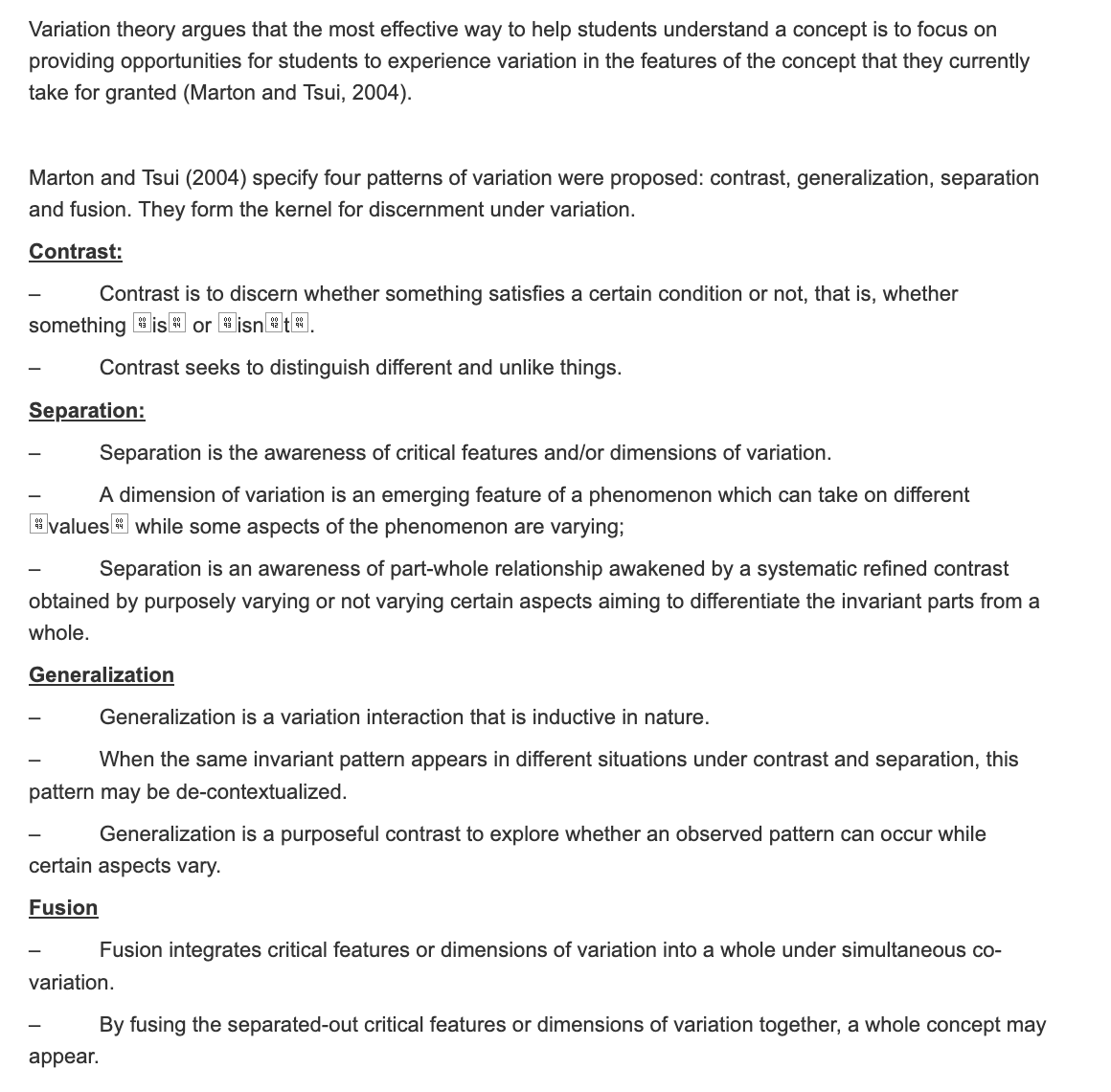
@mapto So this method can help teacher curate examples of a concept intentionally
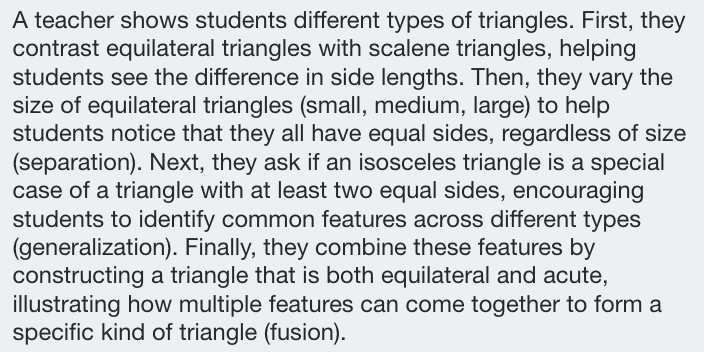
@impactology that's an illustration of an amazing method, to my knowledge first conceived in this article:
https://www.researchgate.net/publication/220041842_On_some_necessary_conditions_of_learning
and then refined (and simplified) in this book:
https://www.taylorfrancis.com/books/mono/10.4324/9781315816876/necessary-conditions-learning-ference-marton
I personally have been very inspired by this work and have been trying to replicate it beyond children learning (it is in fact suggested in the above book that science works similarly to learning). Here's an example:
https://ceur-ws.org/Vol-3558/paper774.pdf
@mapto One theme that I keep detecting from this is that your mind sharpens when it experiences structured variation, so the educator's job is to expose them to variation by different constraints and feedback
@impactology something more, when we practice a lot, our mind learns certain mental schemas https://en.wikipedia.org/wiki/Schema_(psychology) that help us free cognitive load (mental capacity) to combine with further considerations.
So once we get used to fusion, the interplay between these dimensions begins to feel more like one dimension, so that we could use it to accumulatively expand the process with other new dimensions.
@mapto Thanks for sharing that book, found an anna's archive link for it
https://annas-archive.gl/md5/E0985703AEAAC2538C9E7D7B57DB2DE7
@mapto Could you use this approach to teach something complicated in your domain to a stranger in a social gathering?
@impactology Teaching is a complex process that could be seen to start with awareness development and to evolve towards exercise to grow mastery. One surely can use the method to develop illustrative examples, which are crucial to awareness development. Also playing around with fusion is undoubtedly a central part of exercise. What I've seen in my practice is that often there's the temptation to skip some of the initial stages, because they appear trivial.
It appears pointless to play with scaling the triangle from your example without changing anything else. It will start making some sense only when you start looking at its surface too. You see, even this example raises questions.

@impactology if interested, see also phenomenographic variation theory
https://kb.edu.hku.hk/approaches_variation_theory/