**English**
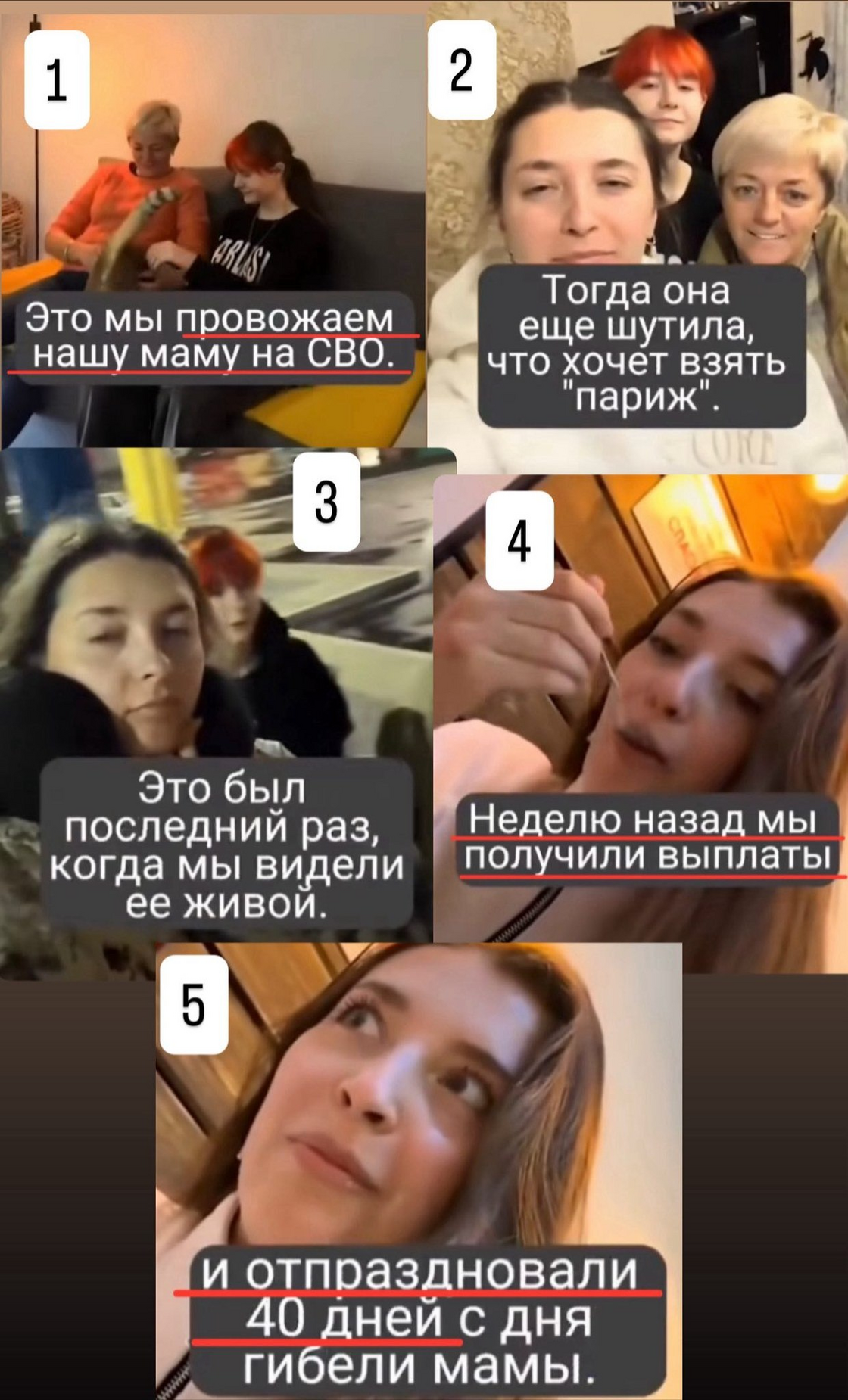
A collage of five frames tells the story of one family whose life was shattered by a tragedy during the military operation.
All photos show the same three people:
– an older woman with light hair (the grandmother),
– a young woman around 20–23 with dark hair (the daughter/older sister),
– a teenage boy with a ginger fringe (the son/younger brother).
Frame-by-frame storyline:
The family is seeing the mother/wife off to the war. All three are at home, the mother is in military uniform, and they embrace before parting. Caption: “This is us seeing our mom off to the front.”
The grandmother makes a half-joking remark through tears that the mother “still wants to take a wig,” so she can look pretty over there. A small attempt to ease the tension.
The last time they saw her alive: the mother in uniform hugging her children and her mother-in-law/mother. Caption: “This was the last time we saw her alive.”
4–5. Some time later. The children have received the compensation payments (“a week ago we received the payments”) and mark a grim date: forty days since their mother’s death. The young woman is crying, speaking into the camera: “And we marked forty days since our mom was killed.”
The whole story is a short but deeply painful account of how an ordinary Russian family sent their mother, a servicewoman, to the front, only to receive her body and the state payouts. The emotional impact comes from the contrast between the first hopeful smiles and the tears on the fortieth day.
#SMO #casualties #body200 #40days #momatthefront #servicewoman #killed #compensation #bereavedfamily #familyloss #childrenwithoutmother #grandmotherandgrandchildren #farewell #lastmeeting #russianfamilies #war #losses2025 #grief #mourning #truestory #pain #memory #eternalmemory
**Nederlands**
Een collage van vijf beelden vertelt het verhaal van één familie die getroffen werd door een tragedie tijdens de militaire operatie.
Op alle foto’s staan dezelfde drie personen:
– een oudere vrouw met licht haar (de grootmoeder),
– een jonge vrouw van ongeveer 20–23 met donker haar (de dochter/oudere zus),
– een tienerjongen met een rosse pony (de zoon/jongere broer).
Verhaal per beeld:
De familie neemt afscheid van de moeder/echtgenote voordat ze naar het front vertrekt. Alle drie zitten thuis, de moeder draagt een militair uniform, en ze omhelzen elkaar. Bijschrift: “Dit zijn wij terwijl we onze moeder uitzwaaien naar het front.”
De grootmoeder maakt half grappend, met tranen in de ogen, de opmerking dat de moeder “nog een pruik wil meenemen,” zodat ze daar mooi kan zijn. Een kleine poging om de sfeer te verlichten.
De laatste ontmoeting terwijl ze nog leefde: de moeder in uniform omhelst haar kinderen en haar schoonmoeder/moeder. Bijschrift: “Dit was de laatste keer dat we haar levend zagen.”
4–5. Enige tijd later. De kinderen hebben de uitbetalingen ontvangen (“een week geleden kregen we de uitkeringen”) en herdenken een sombere datum: veertig dagen sinds de dood van hun moeder. De jonge vrouw huilt en spreekt in de camera: “En we herdachten de veertig dagen sinds mama is omgekomen.”
Het hele verhaal is een kort maar zeer aangrijpend verslag van hoe een gewone Russische familie hun moeder, een militair, naar het front stuurde en later haar lichaam en de staatsuitkeringen ontving. De emotionele klap wordt versterkt door het contrast tussen de eerste voorzichtige glimlach en de tranen op de veertigste dag.
#SMO #verliezen #body200 #40dagen #moederaanhetfront #dienstplichtige #omgekomen #uitkeringen #rouwendifamilie #gezinsverlies #kinderenzondermoeder #grootmoederenkleinkinderen #afscheid #laatsteontmoeting #russischefamilies #oorlog #verliezen2025 #rouw #treurnis #waregeschiedenis #pijn #herinnering #eeuwigeherinnering
Пост від @did:plc:zarogoihuzjcrqinmizgadqf — Bluesky
https://bsky.app/profile/did:plc:zarogoihuzjcrqinmizgadqf/post/3m6ndsvji5k2g


@pureacetone на Украине?