

Phillip Winn @pwinn@qoto.org
- Pronouns
- he/him
- Pronounce
- like "Quinn"
Love conquers fear
#nerdery #books #puzzles #ttrpg #anime #Christian #feminist #antiracist #photography #sudoku #golang #python #OpenWeb #AIart #GenshinImpact #tfr
Joined Nov 2022
This site presents "both sides" of at least one aspect of AI art by displaying the content of a current lawsuit over AI art on the left, and via fair use, a response or rebuttal on the right.
http://www.stablediffusionfrivolous.com/
(Replace frivolous with litigation in the URL to get the original site.)
I'm obviously a fan of AI art, and occasionally post it here. I'm also very far from a copyright maximalist, although I'm *not* in favor of abolishing copyright altogether. I agree with the right side of the site on at least two points:
1. Copyright law doesn't apply here.
2. The suit dramatically misrepresents, I think because Butterick doesn't understand, how latent diffusion works.
That said, while I overall agree with the critique, I think I'm more sympathetic to the complaint than the rebuttal writers are.
There's something truly disconcerting about adding an artist's name to an existing prompt and seeing the result change to be much closer to something in line with previous works of that artist.
I can understand that statements about how latent diffusion works fall flat after seeing that. No, there are no images stored in the model, not even textual representations of images. And yet, there's something, right? It's not nothing. There's some sort of minimal association of given names with a given set of characteristics, more so for some than for others, and the effect is often uncanny. The example of what seems like an arbitrary series of words consistently producing Buddha statues is a good start to counter that, but it doesn't quite seem adequate.
Overall, I think there are serious ethical issues with how art is being sourced for training the current generations of AI art models. However, I don't think there are legal issues; copyright certainly isn't being violated.
More to the point: the primary users of these tools currently seem to be artists. In that sense, it really does seem like the advent of photographs, or the advent of photoshop, and it will likely be quite a while before we will know how these issues settle. In the meantime, anybody using these tools to try to mimic a particular artist is probably missing out.
The CSV spreadsheet is usually the one that's a day ahead, so I guessed it was the one using GMT. Except... every now and then, it's the one that's a day behind. The inconsistency rules out GMT shenanigans, I think, but also, I don't ever supply a time when marking a book as read. I select a year, month, and day. Which suggests it's arbitrarily storing a time, and the fact that it's off so often suggests it's storing a time within five or six hours of midnight. And apparently inconsistently.
Another amusing bug anecdote is that books I finished reading on Oct 1, 2022, are just listed on the site as having been read "Oct 2022." No date shown. The CSV spreadsheet has a date, of course.
It seems like there's an entire class of date/time bugs on GoodReads, before we even get to the missing ISBNs and badly-corrupt data from 2017.
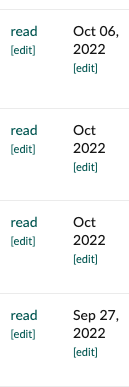
I'm not sure which is worse, exactly: GoodReads exporting my library with no "Date Read" filled in, despite having a "Date Read" on the site, or GoodReads exporting my library with the wrong "Date Read" filled in, one that is a day off from the one on the site.
How does that even happen? Given that it's off by a day when it's off, I'm guess it's a time zone issue, with either the site or the export function using GMT and the other using my local time, six hours removed.
That doesn't explain the many rows in which the date is just missing. Nor the missing ISBNs.
It's been clear for a long time that Amazon doesn't actually care about making GoodReads a GoodSite, but this is really, really bad.
What I've settled on doing is opening the export CSV in a spreadsheet in one pane, sorted by reverse "Date Added," and looking at "My Books" on GoodReads in another pane, sorted the same way.
The Arc browser from https://arc.net/ is working pretty well for this.
As I continue to explore GoodReads with an eye to exiting that site, I am amazed at just how terrible it is. I exported my library, intending to delete everything that wasn't read in the last five years, but the resulting CSV file is missing so much!
There is no "Date Read" for many books that are only present in the file because I read them, and a surprising number of books are missing ISBNs, too. I'm talking about books in print, not ebooks or audiobooks that might not even have ISBNs.
It is clear that Amazon does not prioritize accuracy in export files, and as I explain previously, they don't prioritize accuracy in their own database either, although the effect is seen in different ways.
The long and short of it is that I'm apparently going to need to manually edit the CSV file in order to get anything like accurate data, and giving up the convenient GoodRead mobile app for a BookWyrm server seems more than ever like a fair trade. I'll happily pitch a few bucks a month toward @bookrastinating for their help getting things set up, and to avoid propping up Amazon's less-than-lackluster efforts with GoodReads.
This seems like a good way to spend a day off work, right?
When I decided to jump into the fediverse with both feet, I signed up for a BookWyrm account at @bookrastinating. When I tried to import my history/library, there were two big issues.
The first was timing. I joined and started an import at about the same time many, many, many other people did, and the server promptly fell over. The owner of Bookrastinating was helpful and friendly and eventually the queue started moving again, so that's not an issue anymore.
The second was not actually a problem with BookWyrm at all, but with GoodReads! It turns out that a bunch of books I'd previously tagged as read on GoodRead were no longer the books they had been. No offense to Marc Blake, author of “How to Be a Sitcom Writer: Secrets from the Inside,” but I’ve never read that book. When I “shelved” it on January 9, 2017, I assigned it “baroque, cycle, fiction, hardback, series, read,” so it seems very clear that what I actually shelved was a book by Neal Stephenson, and checking now shows that GoodReads only knows I've read the second book in the tagged "baroque cycle" series, but it has lost the first and third.
I'm not sure when the GoodReads database was corrupted, and in a review of my Reading Challenge book lists for 2022, 2021, 2020, 2019, 2018, and 2017, everything seems probably-correct. But my 2017 Reading Challenge also does not include the book I mentioned above, the book that caught my eye as clearly-incorrect.
When I look at books *shelved* in 2017, I see many that are definitely not right, although they don't have "read" dates. I'm sure <cite>After the Martian Apocalypse: Extraterrestrial Artifacts and the Case for Mars Exploration</cite> is a perfectly fine book, but it definitely wasn't what I tagged with "fiction paperback series dragon king trilogy" on January 9, 2017. <cite>Love on the Dotted Line</cite> could be a fantastic romance novel, but it's not what I tagged "paperback anthology science fiction" on January 9, 2017. A dual-language collection of Italian women's poetry is definitely not what I tagged as a volume of the "Writers of the Future" science fiction anthology series. And so on. The ones I notice most easily are the titles I would never read, but the date January 9, 2017, stands out. Sorting by date added, I can see that some of the books added on that date seem correct. I know the books, and the tags match the books. Most do not.
I'm sure there's some irony in an import failure on the fediverse alerting me to serious corruption on Amazon-owned GoodReads, and the result stopping me from actually migrating.
I clearly cannot trust GoodReads, as they've broken the first and second rules of a database: they've lost data, and represented data falsely to belong to me when it doesn't. I'm not sure which of those is the first rule and which is the second, but both seem bad.
I also cannot import my entire library from GoodReads into BookWyrm, because I don't want to start with bad data. I think it's time to let most of the past go, and create a cleaned-up import file with just my reading history from 2017 onward.
Good thing I have the day off tomorrow!
Responding to an ill-informed rant about SMS (the mobile phone message service), I highlighted parallels to the ranter's proposal, and it got me wondering: Why do some proprietary services so easily replace open protocols, while others don't?
The rant was ultimately demanding that we give up using SMS, instead using WhatsApp, a proprietary messaging services owned by Facebook. This is a clearly horrible idea, and suggested some parallels.
We should give up using RSS for podcasts, instead let's use Spotify. (NO!)
We should give up using HTTPS, instead let's use a new protocol owned by Facebook or Google to visit web pages. (NO!)
We should give up using email, instead let's use a proprietary messaging app. (NO!)
We should give up using IRC, instead let's use Slack. (Most of us already have!)
Spotify's effort to own podcasting is falling flat, fortunately. Attempts to build a Facebook-only subnet seem to have petered out as well. Replacements for email have come and gone (remember Google Wave? or Google Buzz?). But it seems like it took nothing at all for IRC to be tossed aside in favor of something new, *anything* new! If it weren't Slack, it would be HipChat, or Discord, or something else.
There's a lesson to be learned here, and were I a paid pundit, I'd declare what it is with confidence, and return to the theme repeatedly over the next few months to emphasize just how right I was.
But I'm not a paid pundit, and I don't know what the answer is. I'm not sure there is a single answer.
At its peak, IRC wasn't as widely used as the others, or not as widely used by non-technical "normies" at least. RSS feeds for podcasts seemed like they could be as technically fiddly as IRC in the very early days, but people like @davew made sure that the experience was smooth and simple, and so it stands up more than 20 years later.
There have been extensions to HTTPS, like QUIC, but so far they've always been handled as extensions and implemented as open standards. Google's biggest push toward centralizing the web was AMP, and enough people cared enough about that to push back until Google promised to stop emphasizing it in 2021.
Sometimes the most open technology wins, despite efforts by companies to extend or replace it. Sometimes it's tossed aside so quickly people forget we once used something like Slack without paying anybody anything.
I'm not entirely sure why, but I'm on four Slack servers, 18 Discord servers, and only three IRC servers, so I guess I'm part of the problem.
It's pretty amazing to watch Hasbro completely destroy their TTRPG bread and butter by attempting to revoke the existing Open Gaming License v1.0.
I think I get how such a thing happens! The head of the Wizards of the Coast division has states that she thinks the Dungeons and Dragons brand is under-monetized, and that's probably true. For the mindshare DnD occupies in a world dominated by _Stranger Things_, DnD should probably be bringing in much more money than it is. But this ain't the way, chief. There is so much history here, and Hasbro seems intent on grasping ever more tightly to everything they can, which is causing it all to slip through their metaphorical fingers.
The biggest trigger seems to be a clause that, as written, makes any and all third-party content the property of Hasbro. If you create content under the new license, they can take your content and sub-license it to someone else without any compensation to you. Which is obviously completely unacceptable! But I can see how it ended up that way!
Lawyers are paid to think of worst-case scenarios, and one of those is undoubtedly that Hasbro spend time developing a new title, and upon publishing it, some indie publishers speaks up and says hey, that sword you've got in your new title, I developed that sword! And maybe nobody from Hasbro has ever even heard of the indie publisher, but they've got the receipts to show they published months before Hasbro did, and so Hasbro ends up defending themselves in court and possibly losing, and it's a mess. So they say, quite reasonably: look, if you develop a thing, and we develop a thing, and they happen to be similar, that's just life, okay? And being lawyers, they can't just leave it like that, so they spell it out in great detail: if you develop a thing, and they develop a similar thing, that's okay, because they have a perpetual license to do so. And in fact, if they're working with a third party, you can't sneakily sue *them* either, because they can sub-license as needed. And I'm reasonably sure that was the entire point of that clause, that it was intended to be defensive only.
But the law isn't entirely based solely on intent, and the letter of the license is atrocious. Maybe the person in charge today would only use it defensively, but it was written to be very offensive.
And revoking the previous license? I suspect they're just assuming nobody is going to want to fight them in court. They're Hasbro! They've got lawyers for days! But you don't have to be a lawyer to know you shouldn't be able to declare a license null and void because you feel like it. If there wasn't a termination clause in the license, that's it.
So Hasbro, in an attempt to better monetize the D&D brand, has made the D&D brand toxic for all third-arty developers and many dungeon masters.
It's not like there aren't other systems out there! Some of them are themselves relying on the Open Gaming License 1.0, but they soon won't be. Some of them are completely different and unrelated systems already.
Not many people are going to be want to create anything new for a company that tries to change the rules after the cards have already been dealt. It's a scrambled metaphor, but it's a julienned situation.
Me, I'll stick with horror and panic with Mothership. You could definitely run Mothership in a dungeon.
Sometimes I think about how much trouble I have fully re-contextualizing the past. For example, I know now that Reagan was a bad person who said and did bad things, but he was also the first political figure I ever looked up to. As a result, even though I can list for you (in person, never online) many, many, many bad things about him, it's still hard for me to think of him as bad. Rather, my *initial* response when I hear his name is positive, then replaced by a more negative and reality-based assessment based on what I know and understand today.
This makes me wonder: assuming I live long enough and continue to be open to re-evaluating things in the future, who today am I going to have the same trouble with? I'm not sure I have positive feelings about any political figure today as much as I did about Reagan. Maybe Obama.
I think my previous re-evaluations have made me less likely to support anyone quite as ardently today. I'm in awe of Pelosi's effectiveness as a politician while still being very aware of her eerie effectiveness as an investor, the latter of which would seem to require unethical dealings. The caveats are there currently, rather than being layered on later.
In fact, having seen so many people brought low by additional information, I think I'm less surprised when new information is released about people I like now. I mean, I guess the Channel 5 is (allegedly) a serial harasser of women. Okay. I learned some crazy stuff about Bill Cosby some years back, hearing similar things about people now just doesn't hit the same way.
Having learned to see the racism and sexism clearly present in the world today, it can't shock me to find that heroic figures are guilty of perpetuating racism and sexism.
Maybe this is why I couldn't get very excited about Bernie Sanders.
Maybe this is what it's like to be old.
I am amused whenever people talk about the efficiency of corporations, because I see inefficiencies everywhere, and the bigger and more consolidated the company, the worse it is.
A friend of mine left my last employer shortly after I did, but while I've been happy in my new digs, they have not. So they're going back! (They're actually the second former coworker who left and returned, so there's precedent on the team.)
When we were both hired, we were hired by a company with 100-150 employees. A couple of years later, that company was acquired by a company with 600-800 employees. (Somehow the technical leadership of the smaller company ended up as the technical leadership of the combined company, but that's another story.) It was that combined company which we all three left, and to which the other two have returned.
This combined company uses a background-check company, a third party. Apparently for all new hires, even returning hires. Today that company sent my friend an email asking for contact details for a former employer, since they were unable to track them down.
Yeah, *that* former employer. The one with 100-150 employees. The one that was acquired and is now the company that hired the background-check company.
I laughed and laughed. Deep, deep laughter. Oh, the efficiency!
From Vaccines to Golden Rice: 10 Positive Stories From 2022 | Time
Reading comments on Hacker News, I saw a thread which began with "The biggest problem is the like button." In talking about the rise of social media contributing to a decline in "blogging," this seemed a reasonable idea.
The top response to that was "The biggest problem is that you can make money from the internet." Which also seemed reasonable.
The top response to *that* was "I would say the biggest problem is advertising." Which again seemed like a reasonable thought.
Maybe one issue is that humans tend to the superlative, where every issue is "the biggest problem" rather that "one issue."
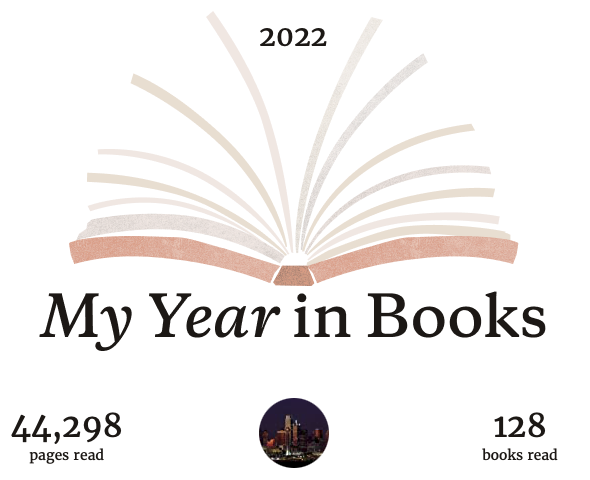
I don't think I have enough time today to finish another book, or even start one, so my count for the year stops at 128.
More pages but fewer books than last year.
That's an average of 2.85 days per book, which seems amazing even to me. I know some books took much longer than that, but I also remember a few days in which I read multiple books back-to-back, reading from morning until night.
31 of the 128 were audiobooks, and two were graphic novels.
I read so many good books this year! In 2022 I finished Ada Palmer's fantastic Terra Ingota series, discovered the wonderful books of Diana Wynne Jones, and met the wonderful Leonid McGill character of Walter Mosley.
I started a new job this year, and the increased demand on my brain meant I read more in the first half of the year than the last half. Then again, I think that seems to be true every year. Still, I'm tempted to lower my target for next year.
I am far behind most of my friends and family when it comes to movies and TV shows, but I think I probably read more than average.
For reasons too boring to go into here, I was searching for the origin of a particular phrase when I came across this amazing work of fiction from 2013:
http://www.defenestrationmag.net/2013/04/you-non-miraculous-son-of-a-bitch-by-eirik-gumeny/
Sadly, the author, Eirik Gumeny, "tried Mastodon and kind of hated it?" (question mark in original), but he does have a substack, which is a thing that people do:
https://notaviking.substack.com
I know next to nothing about him other than that he's a freelance writer in New Mexico, and he wrote a delightfully amusing story set there in 2013.
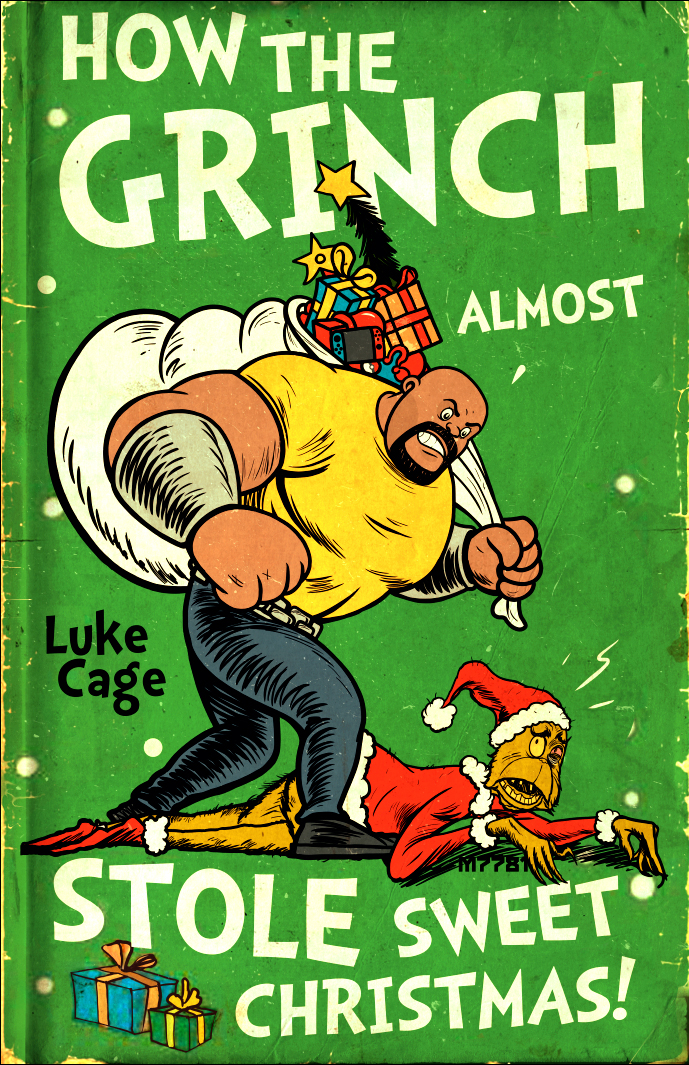
Courtesy of Marco d’Alfonso, a very Marvel Christmas book that never was.
Source: https://www.deviantart.com/m7781/art/how-the-grinch-almost-stole-sweet-christmas-749755064
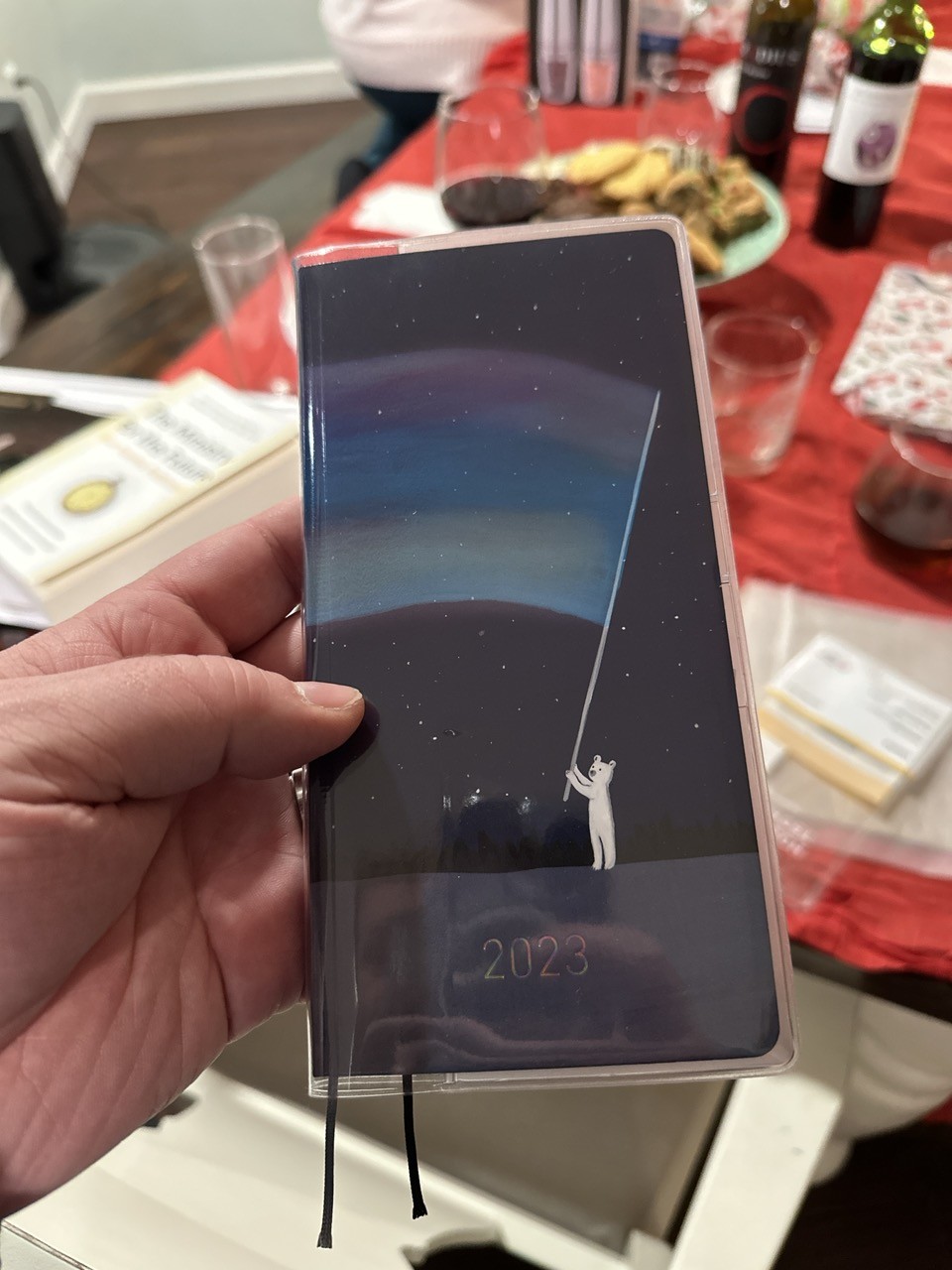
I spent Christmas with my family, and had a lovely time. My Christmas list had only one thing on it, but I was still delighted to receive it.
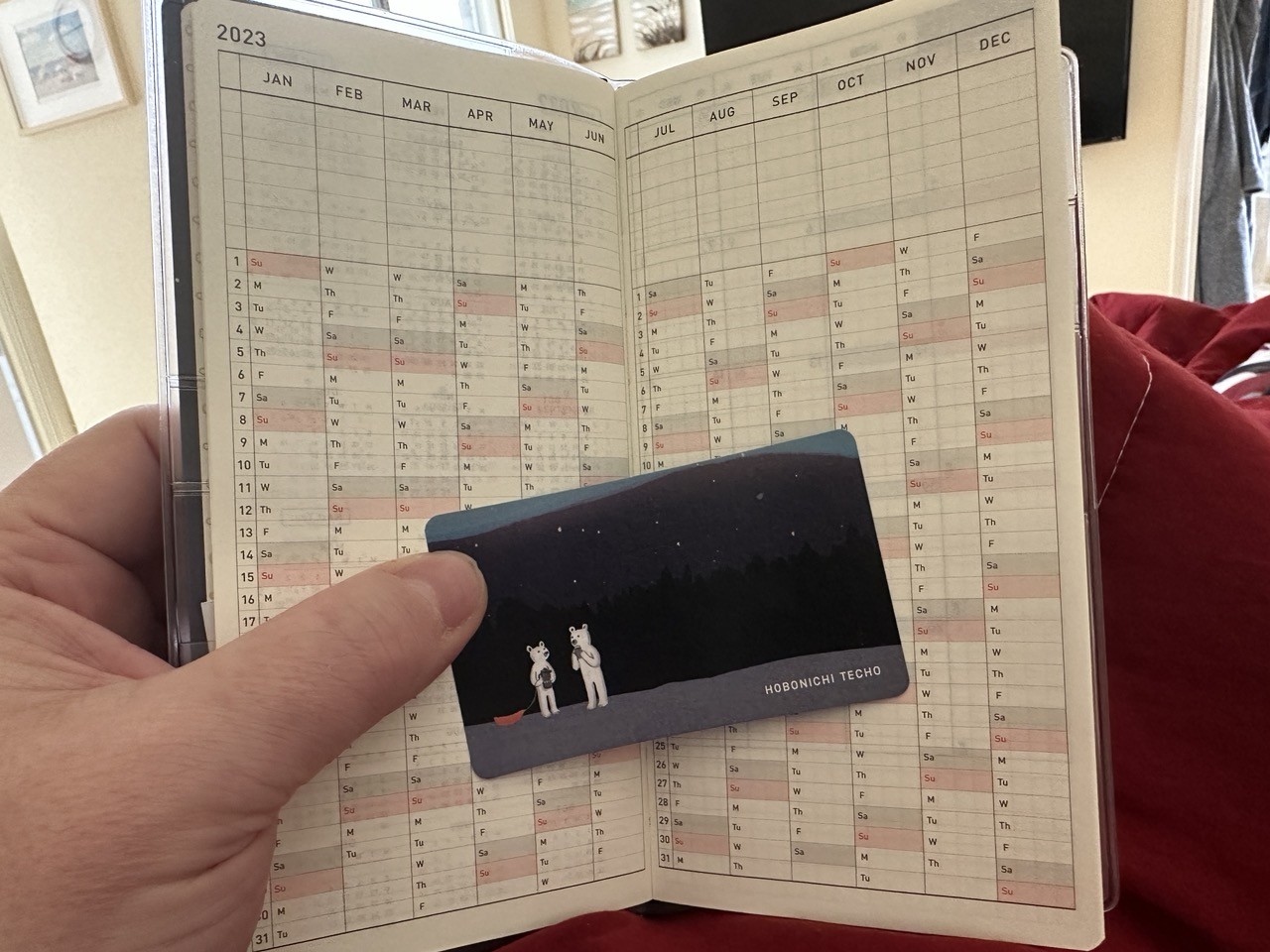
This Hobonichi Techo 2023 notebook is where I plan to note my #dungeon23 progress in the coming year. I hope.

I’m beginning to think that signing up for Cinemark’s movie club might have been a mistake. Not just because it's a bad deal, although movies in theaters have seemed to be somewhat rubbish since I signed up, or unsuitable for reasons peculiar to my family. I was excited when the Black Panther movie was released… but found no passes were allowed, which I think left me out. (Although maybe not, I only realized today, since I have credits, not passes. Oops!)
Finally today, we decided we’re going to see something, anything, because it's Christmas Eve. We picked a 2:55 showing of Black Panther: Wakanda Forever, and… because it’s a matinee showing, it’s cheaper than what I paid for the saved-up credits.
So here I am with six stored up credits for free movie tickets, paying $30 for three people to see a movie I could maybe have seen months ago but was scared away from.
I'm not saying Cinemark's movie club is a bad deal, I'm just saying it might have been a mistake for me to sign up for it specifically.
At my house for the Winter Solstice Festival (in Chinese: 冬至 Dōngzhì), we enjoyed hotpot. Very spicy hotpot!


I’ve had this picture on a series of computers for a few years now, but before posting it I tracked down where I originally got it from, and dimensions.com is pretty amazing. It seems like a person could spend a lot of time poking through the site looking at the size of things.
https://www.dimensions.com/element/fiat-500
For an arbitrary comparison, the 2023 F-150 King Ranch edition with SuperCab is 6.36 meters long, 2.43 meters wide, and 1.96 meters tall. Its wheelbase is 4.17 meters, which is quite a bit longer than the Fiat 500’s entire length! This helps to explain why I’ve seen trucks like this try to make U-turns and block traffic for a while.
I’m not sure I’d be able to drive something that big safely. Perhaps others can.

You know what’s delicious? Peanut brittle!
You know what’s really hard for me to stop eating as long as there’s any left? Also peanut brittle!
Next time I should buy less of it. Or more. I haven’t decided which.
I know my Fiat 500e is small, but every now and then I walk out of a Waffle House and see a stark reminder.

- Pronouns
- he/him
- Pronounce
- like "Quinn"
Love conquers fear
#nerdery #books #puzzles #ttrpg #anime #Christian #feminist #antiracist #photography #sudoku #golang #python #OpenWeb #AIart #GenshinImpact #tfr
Joined Nov 2022
