

Phillip Winn @pwinn@qoto.org
- Pronouns
- he/him
- Pronounce
- like "Quinn"
Love conquers fear
#nerdery #books #puzzles #ttrpg #anime #Christian #feminist #antiracist #photography #sudoku #golang #python #OpenWeb #AIart #GenshinImpact #tfr
Joined Nov 2022

Phillip Winn
boosted

Sorry to break it to everyone, but the universe does not provide a moral arc that bends toward justice. The universe does not care. We have to do the work, and forward progress is not promised.
Phillip Winn
boosted

Happy Martin Luther King Jr. Day
Here's how newspapers portrayed him at the time. If you see a fellow white person sneering at #BLM, know that they'd have said the same about MLK.
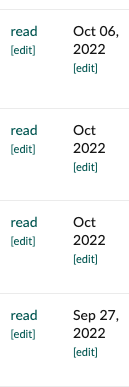
The CSV spreadsheet is usually the one that's a day ahead, so I guessed it was the one using GMT. Except... every now and then, it's the one that's a day behind. The inconsistency rules out GMT shenanigans, I think, but also, I don't ever supply a time when marking a book as read. I select a year, month, and day. Which suggests it's arbitrarily storing a time, and the fact that it's off so often suggests it's storing a time within five or six hours of midnight. And apparently inconsistently.
Another amusing bug anecdote is that books I finished reading on Oct 1, 2022, are just listed on the site as having been read "Oct 2022." No date shown. The CSV spreadsheet has a date, of course.
It seems like there's an entire class of date/time bugs on GoodReads, before we even get to the missing ISBNs and badly-corrupt data from 2017.
I'm not sure which is worse, exactly: GoodReads exporting my library with no "Date Read" filled in, despite having a "Date Read" on the site, or GoodReads exporting my library with the wrong "Date Read" filled in, one that is a day off from the one on the site.
How does that even happen? Given that it's off by a day when it's off, I'm guess it's a time zone issue, with either the site or the export function using GMT and the other using my local time, six hours removed.
That doesn't explain the many rows in which the date is just missing. Nor the missing ISBNs.
It's been clear for a long time that Amazon doesn't actually care about making GoodReads a GoodSite, but this is really, really bad.
What I've settled on doing is opening the export CSV in a spreadsheet in one pane, sorted by reverse "Date Added," and looking at "My Books" on GoodReads in another pane, sorted the same way.
The Arc browser from https://arc.net/ is working pretty well for this.
As I continue to explore GoodReads with an eye to exiting that site, I am amazed at just how terrible it is. I exported my library, intending to delete everything that wasn't read in the last five years, but the resulting CSV file is missing so much!
There is no "Date Read" for many books that are only present in the file because I read them, and a surprising number of books are missing ISBNs, too. I'm talking about books in print, not ebooks or audiobooks that might not even have ISBNs.
It is clear that Amazon does not prioritize accuracy in export files, and as I explain previously, they don't prioritize accuracy in their own database either, although the effect is seen in different ways.
The long and short of it is that I'm apparently going to need to manually edit the CSV file in order to get anything like accurate data, and giving up the convenient GoodRead mobile app for a BookWyrm server seems more than ever like a fair trade. I'll happily pitch a few bucks a month toward @bookrastinating for their help getting things set up, and to avoid propping up Amazon's less-than-lackluster efforts with GoodReads.
This seems like a good way to spend a day off work, right?
When I decided to jump into the fediverse with both feet, I signed up for a BookWyrm account at @bookrastinating. When I tried to import my history/library, there were two big issues.
The first was timing. I joined and started an import at about the same time many, many, many other people did, and the server promptly fell over. The owner of Bookrastinating was helpful and friendly and eventually the queue started moving again, so that's not an issue anymore.
The second was not actually a problem with BookWyrm at all, but with GoodReads! It turns out that a bunch of books I'd previously tagged as read on GoodRead were no longer the books they had been. No offense to Marc Blake, author of “How to Be a Sitcom Writer: Secrets from the Inside,” but I’ve never read that book. When I “shelved” it on January 9, 2017, I assigned it “baroque, cycle, fiction, hardback, series, read,” so it seems very clear that what I actually shelved was a book by Neal Stephenson, and checking now shows that GoodReads only knows I've read the second book in the tagged "baroque cycle" series, but it has lost the first and third.
I'm not sure when the GoodReads database was corrupted, and in a review of my Reading Challenge book lists for 2022, 2021, 2020, 2019, 2018, and 2017, everything seems probably-correct. But my 2017 Reading Challenge also does not include the book I mentioned above, the book that caught my eye as clearly-incorrect.
When I look at books *shelved* in 2017, I see many that are definitely not right, although they don't have "read" dates. I'm sure <cite>After the Martian Apocalypse: Extraterrestrial Artifacts and the Case for Mars Exploration</cite> is a perfectly fine book, but it definitely wasn't what I tagged with "fiction paperback series dragon king trilogy" on January 9, 2017. <cite>Love on the Dotted Line</cite> could be a fantastic romance novel, but it's not what I tagged "paperback anthology science fiction" on January 9, 2017. A dual-language collection of Italian women's poetry is definitely not what I tagged as a volume of the "Writers of the Future" science fiction anthology series. And so on. The ones I notice most easily are the titles I would never read, but the date January 9, 2017, stands out. Sorting by date added, I can see that some of the books added on that date seem correct. I know the books, and the tags match the books. Most do not.
I'm sure there's some irony in an import failure on the fediverse alerting me to serious corruption on Amazon-owned GoodReads, and the result stopping me from actually migrating.
I clearly cannot trust GoodReads, as they've broken the first and second rules of a database: they've lost data, and represented data falsely to belong to me when it doesn't. I'm not sure which of those is the first rule and which is the second, but both seem bad.
I also cannot import my entire library from GoodReads into BookWyrm, because I don't want to start with bad data. I think it's time to let most of the past go, and create a cleaned-up import file with just my reading history from 2017 onward.
Good thing I have the day off tomorrow!
Phillip Winn
boosted

We will hear a lot of disingenuous people begin quoting Dr. King this weekend, take a few minutes or so and listen to this interview. This was eleven months before his assassination. Happy Birthday Dr. Martin Luther King! #BlackMastodon
https://youtu.be/2xsbt3a7K-8

Phillip Winn
boosted

Phillip Winn
boosted

Re-tooting, many have joined & added alt txt
2 iconic images of Margaret Hamilton, Lead Software Engineer on Apollo, software putting astronauts on moon in '69. 1st paper/binders she hand-coded on Apollo (Jan. '69) 2nd in Command Module
"Software was not only informing everyone that there was a hardware-related problem, but... software was compensating for it.” Margaret Hamilton, #Smithsonian Mar. '19
#Histodons #womenintech #software #nasa #hci #ai #space #compsci #science #tech #gender
Phillip Winn
boosted

“I confront [white guilt] every year, about a month into my course on racism, among [white] students who come to me in tears because they cannot deal with the racism that goes on in their families or their home towns or their student residences. Their tears are the result of genuine anguish, care, and a desire to learn and to change. I confront similar attitudes among my colleagues, and I am similarly gratified by their concern. But those who experience white guilt need to learn three things:
1) People of colour are generally not moved by their tears, and may even see those tears as a self-indulgent expression of white privilege. It is after all a great privilege to be able to express one’s emotion openly and to be confident that one is in a cultural context where one’s feelings will be understood.
2) Guilt is paralysing. It serves no purposes; it does no good. It is not a substitute for activism.
3) White guilt is often patronizing if it leads to pity for those of colour. Pity gets in the way of sincere and meaningful human relationships, and it forestalls the frankness that meaningful relationships demand. White guilt will not change the racialized environment; it will only make the guilty feel better.”
— “Women of Colour in Canadian Academia,” Audrey Kobayashi
Phillip Winn
boosted

#FestivalAuDesert I was surprised to learn that Vieux's father did not want him to be a musician. He trained in secret until Toumani Diabate helped convince his father to accept that the son was a musician.
Oddly the electric guitar plays a significant role in the music of the Sahel, where electricity is not always guaranteed. For your listening pleasure some Viuex Farka Toure 2/2
https://youtu.be/ID9Dy3wYrdo
Phillip Winn
boosted


Yes, I'm aware that SMS is a terrible technology, implemented poorly, with a heavy dependence on telephone service providers, that provides little to no protection against spoofing and should never be used for 2-Factor Authentication.
It still beats requiring a Facebook-owned app for communication.
Responding to an ill-informed rant about SMS (the mobile phone message service), I highlighted parallels to the ranter's proposal, and it got me wondering: Why do some proprietary services so easily replace open protocols, while others don't?
The rant was ultimately demanding that we give up using SMS, instead using WhatsApp, a proprietary messaging services owned by Facebook. This is a clearly horrible idea, and suggested some parallels.
We should give up using RSS for podcasts, instead let's use Spotify. (NO!)
We should give up using HTTPS, instead let's use a new protocol owned by Facebook or Google to visit web pages. (NO!)
We should give up using email, instead let's use a proprietary messaging app. (NO!)
We should give up using IRC, instead let's use Slack. (Most of us already have!)
Spotify's effort to own podcasting is falling flat, fortunately. Attempts to build a Facebook-only subnet seem to have petered out as well. Replacements for email have come and gone (remember Google Wave? or Google Buzz?). But it seems like it took nothing at all for IRC to be tossed aside in favor of something new, *anything* new! If it weren't Slack, it would be HipChat, or Discord, or something else.
There's a lesson to be learned here, and were I a paid pundit, I'd declare what it is with confidence, and return to the theme repeatedly over the next few months to emphasize just how right I was.
But I'm not a paid pundit, and I don't know what the answer is. I'm not sure there is a single answer.
At its peak, IRC wasn't as widely used as the others, or not as widely used by non-technical "normies" at least. RSS feeds for podcasts seemed like they could be as technically fiddly as IRC in the very early days, but people like @davew made sure that the experience was smooth and simple, and so it stands up more than 20 years later.
There have been extensions to HTTPS, like QUIC, but so far they've always been handled as extensions and implemented as open standards. Google's biggest push toward centralizing the web was AMP, and enough people cared enough about that to push back until Google promised to stop emphasizing it in 2021.
Sometimes the most open technology wins, despite efforts by companies to extend or replace it. Sometimes it's tossed aside so quickly people forget we once used something like Slack without paying anybody anything.
I'm not entirely sure why, but I'm on four Slack servers, 18 Discord servers, and only three IRC servers, so I guess I'm part of the problem.
It's pretty amazing to watch Hasbro completely destroy their TTRPG bread and butter by attempting to revoke the existing Open Gaming License v1.0.
I think I get how such a thing happens! The head of the Wizards of the Coast division has states that she thinks the Dungeons and Dragons brand is under-monetized, and that's probably true. For the mindshare DnD occupies in a world dominated by _Stranger Things_, DnD should probably be bringing in much more money than it is. But this ain't the way, chief. There is so much history here, and Hasbro seems intent on grasping ever more tightly to everything they can, which is causing it all to slip through their metaphorical fingers.
The biggest trigger seems to be a clause that, as written, makes any and all third-party content the property of Hasbro. If you create content under the new license, they can take your content and sub-license it to someone else without any compensation to you. Which is obviously completely unacceptable! But I can see how it ended up that way!
Lawyers are paid to think of worst-case scenarios, and one of those is undoubtedly that Hasbro spend time developing a new title, and upon publishing it, some indie publishers speaks up and says hey, that sword you've got in your new title, I developed that sword! And maybe nobody from Hasbro has ever even heard of the indie publisher, but they've got the receipts to show they published months before Hasbro did, and so Hasbro ends up defending themselves in court and possibly losing, and it's a mess. So they say, quite reasonably: look, if you develop a thing, and we develop a thing, and they happen to be similar, that's just life, okay? And being lawyers, they can't just leave it like that, so they spell it out in great detail: if you develop a thing, and they develop a similar thing, that's okay, because they have a perpetual license to do so. And in fact, if they're working with a third party, you can't sneakily sue *them* either, because they can sub-license as needed. And I'm reasonably sure that was the entire point of that clause, that it was intended to be defensive only.
But the law isn't entirely based solely on intent, and the letter of the license is atrocious. Maybe the person in charge today would only use it defensively, but it was written to be very offensive.
And revoking the previous license? I suspect they're just assuming nobody is going to want to fight them in court. They're Hasbro! They've got lawyers for days! But you don't have to be a lawyer to know you shouldn't be able to declare a license null and void because you feel like it. If there wasn't a termination clause in the license, that's it.
So Hasbro, in an attempt to better monetize the D&D brand, has made the D&D brand toxic for all third-arty developers and many dungeon masters.
It's not like there aren't other systems out there! Some of them are themselves relying on the Open Gaming License 1.0, but they soon won't be. Some of them are completely different and unrelated systems already.
Not many people are going to be want to create anything new for a company that tries to change the rules after the cards have already been dealt. It's a scrambled metaphor, but it's a julienned situation.
Me, I'll stick with horror and panic with Mothership. You could definitely run Mothership in a dungeon.
Phillip Winn
boosted

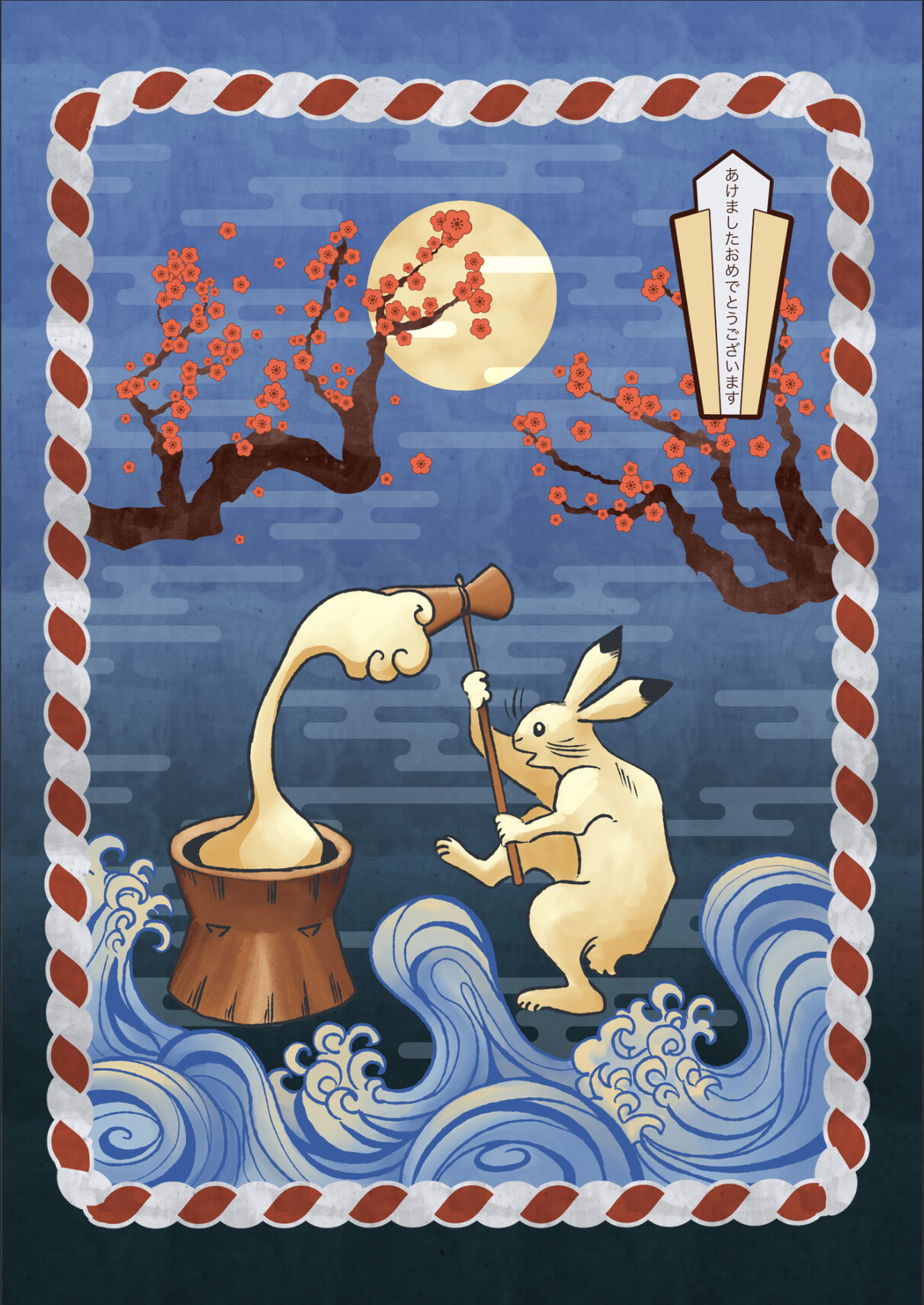
🎍明けましておめでとうございます!🎍
Happy New Year! 2023 is year of the water rabbit. Japan celebrates with the Gregorian calendar, which is why you might see a bunch of Japanese rabbit art earlier than other East Asian cultures.
🌊🐇🌕
Phillip Winn
boosted






No one challenged me to a duel when I was in high school
I feel like student councils in anime are somewhat exaggerated
- Pronouns
- he/him
- Pronounce
- like "Quinn"
Love conquers fear
#nerdery #books #puzzles #ttrpg #anime #Christian #feminist #antiracist #photography #sudoku #golang #python #OpenWeb #AIart #GenshinImpact #tfr
Joined Nov 2022
