

R. A. Dehi @radehi@qoto.org
I read a lot. Sometimes I learn things. I like making things. I think reading and doing are complementary.
Joined Nov 2022
R. A. Dehi
boosted

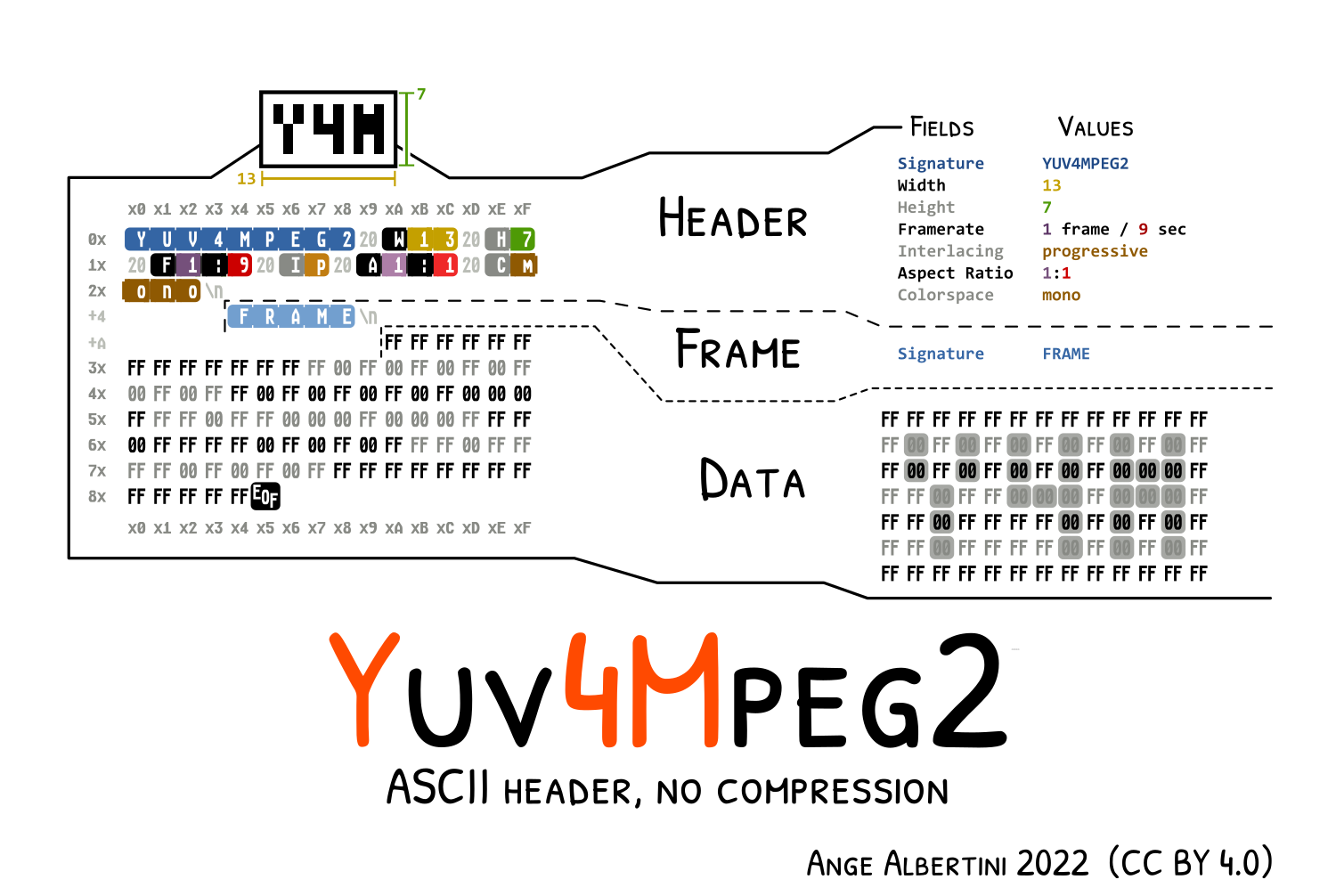
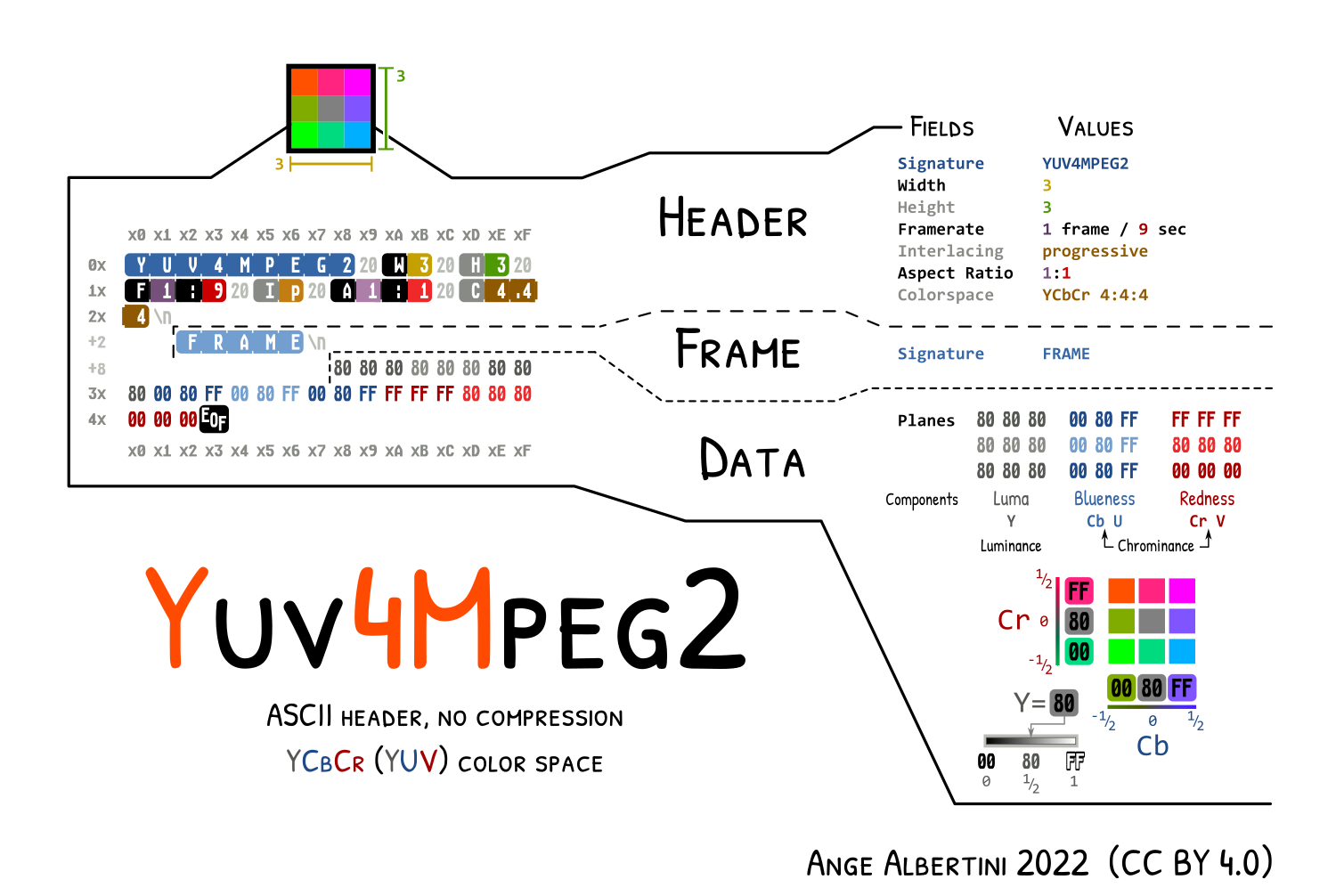
The Yuv4Mpeg2 format (.Y4M) is a simple video format w/ an ASCII header and no compression.
I dissected a grayscale Y4M to first show the file structure, then a YUV (4:4:4) with a tiny 3x3 YUV plane for Y=0.5 as a small introduction to the YUV color space.
R. A. Dehi
boosted
@chribonn @NorCal_Lynne @jeffjarvis @tomwatson Your analogy is wrong.
You don't need to understand PAL-M to watch TV usefully, but you do need to understand that different TV channels are operated by different companies, which are granted government monopolies on transmitting on those channels, and that they're heavily regulated and mostly ad-funded.
If you're sharing photos of mass graves in Ukraine or taking part in protests in Iran, you probably need to know if your instance is run by the Russian, Ukrainian, or Iranian government. You definitely need to understand that it's a possibility, and that the instance owner can read your DMs, trace your IP address, and take over your account.
Keeping activists, journalists, and their sources safe is more important than being appealing to the masses.
R. A. Dehi
boosted

Well, finally after all these years, someone's got an intuitive explanation of the moves required for Rubik's cube!
RT @jagarikin@twitter.com
あの伝説のルービックキューブをさらにわかりやすくしました
🐦🔗: https://twitter.com/jagarikin/status/1593771091738374144
R. A. Dehi
boosted

As Harvard tax-law prof Mandi Matlock told Simon Fondrie-Teitler, Angie Waller, and Colin Lecher, this #DataValdez is the "almost inevitable consequence of relying on for-profit companies to handle a government requirement. It’s a process that provides users little choice but to hand over their data to Facebook if they want to comply with the law."
11/
R. A. Dehi
boosted

birdsite
Just seen Twitter described as $8chan and now I can’t unsee it.
(H/t @gossithedog)
Just now it occurred to me that optimizing a social network for engagement is almost precisely the same thing as trolling: showing people the things that are most likely to react strongly to.
The only difference is that trolls write their content themselves, while social networks promote content written by others.
R. A. Dehi
boosted

This looks like an important report:
Against Parasite Publishers: Making Journals Free
https://zenodo.org/record/7212922/files/Against_Parasite_Publishers__Making_Journals_Free.pdf
It's interesting that in 1886 the Berne Convention said articles "may be reproduced in original or in translation in other countries of the Union, unless the authors or publishers have expressly forbidden it." But in 1908 the rule was flipped - so that articles "may not be reproduced in the other countries without the consent of the authors".
R. A. Dehi
boosted

Excited to share the Complex AutoEncoder (CAE):
✨ The CAE decomposes images into objects without supervision by taking inspiration from the temporal coding patterns found in biological neurons. ✨
Now accepted at TMLR!
📜 arxiv.org/abs/2204.02075
with @phillip_lippe, Maja Rudolph, and Max Welling
1/5
R. A. Dehi
boosted
You can define operations on [-∞,∞) depending on a positive real number called the 'temperature' 𝑇 in such a way that:
1) for any 𝑇 > 0, you get a rig isomorphic to [0,∞) with its usual + and × . (A 'rig' is a ring without negatives.)
2) in the limit 𝑇→ 0, you get a version of the 'tropical rig', where addition is min and multiplication is + on [-∞,∞).
Yeah, the terminology is bad: the 'tropical rig' is a low-temperature limit! They should have called it the 'arctic rig'.
(1/n)
R. A. Dehi
boosted

Need a disposable root server for quick experiments? `ssh root@segfault.net` (password: segfault).
@RaphaelWimmer @thc you might also like https://sadservers.com/ - you get tossed into a shell of a malfunctioning server and need to figure out the problem.
R. A. Dehi
boosted
For anyone curious here is the very first toot I ever made on QOTO:

 🇳🇱
@freemo@qoto.org
🇳🇱
@freemo@qoto.org
Some of my own work photographing and documenting the Orion Nebula. Old but a favorite. #Astronomy #astrophotography
@enkiv2 We were talking about standoff markup formats the other day, right? Have you looked at the representation of toots in ActivityStreams/ActivityPub?
R. A. Dehi
boosted

R. A. Dehi
boosted

hi friends, there will be a memorial for Peter Eckersley at the Internet Archive in SF on March 4 2023: https://www.facebook.com/events/2366523486831491/. please spread the word to his friends who aren't on Facebook!
R. A. Dehi
boosted
war in Ukraine, nuclear war
Apparently a single AP reporter had enough power to singlehandedly convince most of the world that Russia had fired two missiles into a NATO country, nearly drawing NATO into an Article 5 war against Russia?
James LaPorta is like the Stanislav Petrov of Bizarro World: instead of singlehandedly preventing a nuclear holocaust, he almost singlehandedly caused one.
https://www.thedailybeast.com/ap-fires-reporter-behind-retracted-russian-missiles-story
R. A. Dehi
boosted
@rmerriam @shriramk Some concepts don't transfer across many languages (in Fortran, what's the equivalent of a Prolog logic variable, a Pure rewriting rule, or a Forth IMMEDIATE word?) and even concepts that transfer across many languages don't transfer across all (what's the equivalent of a `while` loop in Coq, a type declaration in Forth, a struct in Fortran 66, or a closure in C?)
I think the concepts that *don't* have an equivalent in languages you're familiar with are usually the most valuable, because sometimes give you powerful new ways to solve problems, and you can always implement them in your programming language of choice with enough effort, writing an interpreter if necessary.
R. A. Dehi
boosted



Did you know that #Mastodon supports #RSS feeds?
That means you can follow your favorite people and topics right inside of Thunderbird!
→ Just add ".rss" to the URL ←
For example, our Mastodon URL "https://mastodon.online/@thunderbird"
becomes
"https://mastodon.online/@thunderbird.rss"
What about #hashtags? YEP!
Let's look at #OpenSource. From our instance, it is: "https://mastodon.online/tags/opensource"
So, we just append .rss and it works!
"https://mastodon.online/tags/opensource.rss"
REALLY useful if you don't want to miss a thing!
Thanks to some experiments with @ambihelical, we've characterized the particular way #Qoto's Markdown support is broken with respect to code blocks.
Its Markdown mode is exactly backwards with respect to newlines: are ignored inside code blocks, but inside normal paragraphs newlines are treated as `<br>`. But another bug in Markdown support partly cancels this out if the code block is at the beginning of the post, because then, treats the code block as a normal paragraph.
This suggests a straightforward, if inconvenient, workaround: instead of using a code block, use a normal paragraph, but wrap each line within the paragraph in `` ` ``. Unfortunately, due to a third bug in Markdown support, this doesn't actually work; the first line is fine, but the typewriter text on subsequent lines incorrectly fails to be recognized:
`def main():`
` print('hello')`
` print('world')`
A fourth bug means that newlines after the first one are ignored, perhaps because are incorrectly parsed as being part of another code block; I think in a case like this you don't have that problem:
def main():
print('hello')
print('world')
R. A. Dehi
boosted
@allenholub We always do at least subconscious estimates because there are always more likely improvements than we have the time to make.
Consider [this now-obsolete extreme example from xkcd](https://xkcd.com/1425/). Wouldn't have been reasonable to equally prioritize working on both of these possible features; an afternoon or a week spent on the bird-recognition feature would have been only wasted.
In less extreme cases, an hour or two of estimation work can tell us whether a feature is more likely to take two days or a month. Many features that are worth trading off two days of other features for are not worth trading off a month of other features for.
Unfortunately, almost no companies have incentives set up to reward doing that estimation work, so formal estimates add little more value than subconscious ones.

I read a lot. Sometimes I learn things. I like making things. I think reading and doing are complementary.
Joined Nov 2022
