

…or unless you're a client of the smaller business who would suffer disruption, stock shortages or lack of customer support unless the conglomerate rescues the company.
…or unless you're a user who would improve their user experience when the smaller business becomes part of a larger conglomerate and streamlines its products.
…or unless you're a worker at the smaller business who gains in stability, working conditions, and/or income by becoming an employee of a much robust organisation.
…or unless you're a consumer who would benefit from a marginal reduction in prices as a consequence of increased productivity after consolidation.
…
@tripu I flat out disagree with all of that, acquisitions are anything but an increase in stability for workers -- there is no guarantee that the business survives or is well managed after acquisition, and is likely entirely purchased in order to eliminate competition, ultimately resulting in fewer opportunities, higher prices, less stock, etc.
There are cases where this works out, but at most, its temporary, and after enough time, it ends
I think we'll have to look at some numbers. Otherwise it's personal impression vs personal impression.
In any case: even if, say, 75% of all mergers or takeovers of small companies by huge companies result in a net negative for society, and 25% in a net positive, why alienate clients, consumers, workers and small business owners by accusing all those in favour of such operations of being predatory or selfish?
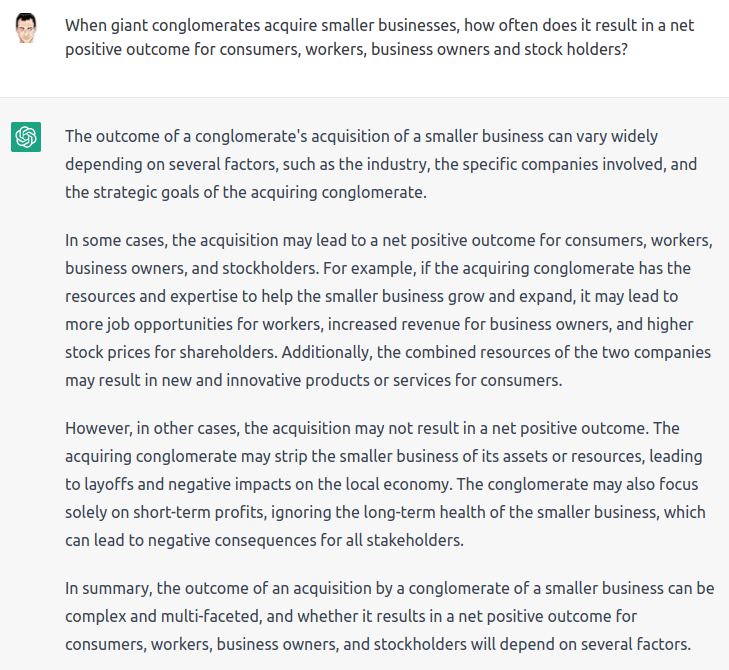

@caitp
…or unless you own a bit of that giant conglomerate (ie, you are one of hundreds of thousands of stock holders) and see your retirement plan improve a little bit after the merger (that's hundreds of thousands of saving plans improving a little bit).