
Debt Ceiling Politics
The debt ceiling has become increasingly political every year. How terribly the GOP did electing the speaker of the house does not bode well for raising the debt ceiling in earnest. As usual, regular people will suffer.

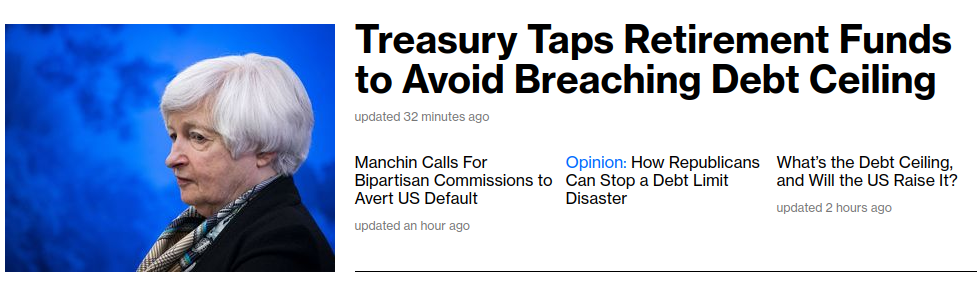
Keep in mind that there's a well-known strategy that presidents have often employed where they will choose to shut down high-profile things like national parks and blame Congress for it, all to get the public to turn against legislators, forcing them to bow to the president's demands.
This is a case of that.
If the Treasury doesn't have the money to continue spending on all of the executive branch's programs, then it chooses for itself which ones to pull back on.
If the Treasury is tapping retirement funds instead of, I don't know, the defense budget or travel budgets, then that's on them.
It's a political stunt that the president is engaging in, and we all need to keep that in mind.
@volkris That's not how the debt ceiling works. It's a self imposed limit created by congress, not the president.
No, the US Constitution assigns authority to borrow to Congress, as we want to be really sure that there's general consensus among the population before we're all obligated for generations to work to pay off those debts.
The debt ceiling is merely the total amount of borrowing that Congress has authorized.
It wasn't self imposed, but was built directly into the framework of the US government because that borrowing was seen as such a critical thing to include in the checks and balances.
The video is based on some accounting hoops that don't have real world meaning, and it also gets some of its facts wrong about what money is and how it works.
Mainly, if I trade $5 to you for a hamburger, it doesn't matter in the slightest whether I'm trading you $5 in $1 coins or a Federal Reserve Note even though those would be treated differently in his accounting.
Because his description of money is unrealistic, even if technically correct as for legal abstraction.
The "all money is debt!" argument is not only factually wrong, but also irrelevant to how money is used in the real world.
No, the Treasury mints money without a debt obligation.
Congress is free to authorize the minting of money whenever it wants without borrowing from anyone to fund that.
Such facts disprove the "all money is debt" claim.
As for the $5, Why do you care where it came from when I buy the hamburger from you? Heck, I could have even minted the $5 myself, and so long as my forgery was perfect it would have the same value to you.
And this perfectly illustrates the folly of going down those practically irrelevant rabbit holes.
On a related note, it doesn't matter how many books a person may write, if his argument is so clearly false then it's false no matter the messenger's history.
@volkris You are right that the government doesn't need to sell bonds to fund itself. But even if the government mints coins, they have no value unless there is a debt attached. The debt would be taxes owed which people need the coins to pay.
Behind money, there is debt and the gun to enforce it.
You really wouldn't accept $100 bill unless you thought there was debt attached to it?
No, people accept currency based on whether they believe other people will value it for future trade. When the government mints money there absolutely is no debt attached to it, and yet we still trade dollars.
@volkris Literally the existence of the $100 bill is because someone took out a loan. See https://www.bankofengland.co.uk/quarterly-bulletin/2014/q1/money-in-the-modern-economy-an-introduction
Bank of England does a good job of explaining.
No, the Constitution gives Congress the authority to authorize the minting of money without any requirements that it be associated with any loans.
So it's just outright just factually false that debt is required for the US to make money.
The federal government is free to make all the money at once out of thin air without any debt involved.

@volkris You do know who David Graeber is right? He wrote "Debt the first 5000 years". A huge, well researched book about debt and money. I highly recommend reading it. His research went into how money is used throughout history. To suggest he is wrong would require a lot of evidence.
That $5 dollars you got to buy the hamburger, where did IT come from? Coins are also created from debt.