volkris @volkris@qoto.org
I think the most pressing and fundamental problem of the day is that people lack a practically effective means of sorting out questions of fact in the larger world. We can hardly begin to discuss ways of addressing reality if we can't agree what reality even is, after all.
The institutions that have served this role in the past have dropped the ball, so the next best solution is talking to each other, particularly to those who disagree, to sort out conflicting claims.
Unfortunately, far too many actively oppose this, leaving all opposing claims untested. It's very regressive.
So that's my hobby, striving to understanding the arguments of all sides at least because it's interesting to see how mythologies are formed but also because maybe through that process we can all have our beliefs tested.
But if nothing else, social media platforms like this are chances to vent frustrations that on so many issues both sides are obviously wrong ;)
Joined Dec 2022
volkris
boosted

Maybe someone can send @Ryan Barrett some data on #Zot to add that to the comparison.
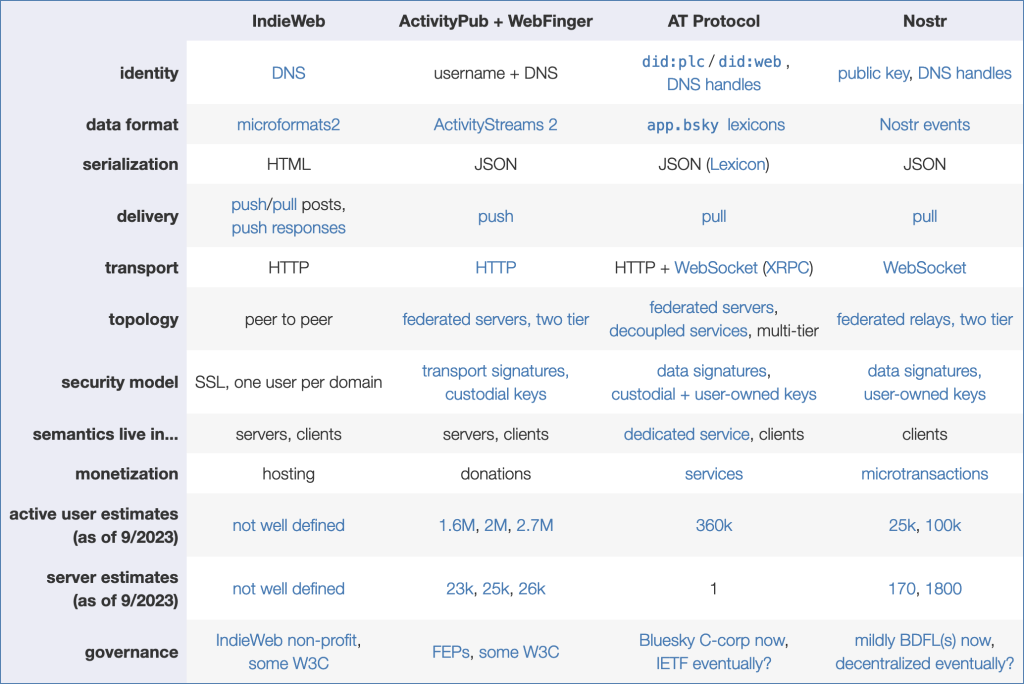
Ryan Barrett wrote the following post Tue, 05 Sep 2023 10:28:02 +0200 Threw together a comparison of the four decentralized social protocols I know best: IndieWeb, ActivityPub, ATProto, Nostr. Obviously oversimplified, hopefully still useful! Preview below, click through for full table with links.
I tried to focus on how these protocols are currently deployed and used in the real world. For example, identity in ActivityPub is technically URL-based, but in practice the fediverse uses WebFinger
Feedback is welcome!
Ryan Barrett wrote the following post Tue, 05 Sep 2023 10:28:02 +0200 Threw together a comparison of the four decentralized social protocols I know best: IndieWeb, ActivityPub, ATProto, Nostr. Obviously oversimplified, hopefully still useful! Preview below, click through for full table with links.
I tried to focus on how these protocols are currently deployed and used in the real world. For example, identity in ActivityPub is technically URL-based, but in practice the fediverse uses WebFinger
user@domain identifiers more or less universally, so the table reflects that.Feedback is welcome!
You mention half decade ago, and I'd reply by pointing out that concepts like PKI, Web of Trust, and other technologies that would enable nomadic identity have been around since the 80s at least.
These ideas were around for decades.
I really get the sense that ActivityPub developers were so focused on today's web technologies that they didn't go back and learn from past bodies of work that could have made a huge difference.
@z428 I'm very critical of ActivityPub for not having such features, and I have two thoughts about it.
Firstly, as far as I can tell there was a conscious decision to focus on instances. Many people very strongly embrace the patterns that arise out of the instance focus, the moderation, community, and inter-instance blocking stuff.
This human organization side of things is so obvious that I can't believe it wouldn't have been considered during standardization.
Secondly, when you look at the parts of the ActivityPub standard, things like use of http and certificates, it shows developers with a certain background grabbing certain pieces off the shelf that may not have been the most innovative parts to bring together.
Nomadic identity would have required a bit more thought than what ended up in ActivityPub. It raised some harder questions.
AP itself is inefficient and lacks anything groundbreaking. It's composed of off-the-shelf pieces that were cobbled together.
Frankly, AP seems to have been put together lazily, and the lack of portable identity reflects that.
But many of us would rather agency over instance moderation.
I'm always focused on giving users as much control as possible over their own experiences, so shifting the balance to them and away from instance moderation is inline with my preferences.
Different people have different preferences in that question, but for a lot of us, such a shift is what we'd rather.
Twitter WAS worth $44B, to Musk, since that's what he paid.
His payment reflected how much it was worth to him.
The value of Twitter goes beyond advertising.
Twitter was always a cesspool, though, and it continues to stumble along, relevant as ever today.
Twitter was never great. It's not great today. But Musk is enjoying all the attention he got from his purchase, so I guess, good for him.
Ha, I suppose for some definition of small.
Dozens of people? Spanning various platforms?
I mean, we keep in touch, but we don't get tied down to any particular platform, and I'd suggest to others that they take the same approach.
Use platforms as tools, but don't rely on anything being provided by others, always keep in mind the alternatives because at any moment any platform may be shut down.
At that point it comes down to what you mean by "Fediverse", then.
When many people use that word they mean specifically projects using ActivityPub.
So what do you mean by that word?
Yep, and I'm completely OK with that.
In fact, I'd extend what I said above to be about my social graph: my whole network moves when the service gets bad, just as we'd stop meeting at a restaurant when they nosedive, and we find another.
It's just not a big deal for us, so I wouldn't lose my social graph. The whole thing just picks up and moves on.
That might be part of why we don't have to care about that concern. We're never beholden to any platform, always assuming all platforms will eventually end, and always one bad experience away from picking up and moving on.
When talking about the McConnell legacy we NEED to address the misinformation that kept him in office, and interfered with so much other functioning of the Senate, from SCOTUS nominations through legislative progress.
**Under Senate rules, not even the majority leader has free hand to dictate what happens.**
We've had a generation of this myth that McConnell had such power, when he absolutely didn't. BUT, it was a win-win-win-win to promote that myth.
D's got to blame McConnell for their own failures, and fundraise off of his specter, R's had McConnell get them out of tricky votes, the press got a ton of sensational stories out of the whole thing, and McConnell himself gained reelection without challenge.
All because we overlook that a simple majority of senators can override McConnell, just like any other senator, if they really wanted to.
It's been sad to watch. Can we finally tear him, and the leader position, down now?
Ah, it sounds like I misunderstood the original post then.
I thought you were saying you didn't understand why people went to the other platforms, when really it's that you don't understand why they have those particular weighings of values.
I think I got it now.
Me, I'm on their side. I really don't care who's running the system so long as it provides value, and the moment it stops providing value I'm gone.
Just like I don't care who's running the restaurant I go to, or who's running my doctor's office: no matter who's in charge, I'll go there for good service and not go there for bad service.
I think this, and other internal fighting, illustrates how the GOP isn't one homogeneous group but rather a coalition of groups with often very different approaches to the world.
So it's not really right to say Republicans are the problem for an instance like this since it's an attack on a Republican.
I don't know if Ann Coulter identifies as a conservative, but if anything it's more like conservatives are the problem. Not all Republicans are particularly conservative.
But really I think it's more that shock jock commentators like Coulter are the problem as they lob these grenades to get attention.... which we give to them, playing into their games.
@chris the protocol underlying the Fediverse, ActivityPub, is centered around instances as part of its core design.
It's like how the protocol for the web, http, is centered around web servers.
So a person can't build a system without instances and engage with fediverse. It's incompatible. Every message in the system would begin with, "So, what instance do we talk to to reach you?"
This is why alternatives like BlueSky and Nostr are in different worlds: their underlying protocols work in incompatible ways.
@caffetiel I don't know about either of these people, but I was just amused at @aral seeming to prove @B2Spirit's point without realizing it.
Right, and through thermodynamics that heat can go all sorts of places ranging from effective sequestration on the planet through (most importantly) being shipped offworld into space through radiation.
And it can be moved around in ways to make that heat rejection more efficient.
Thermodynamics says this heat WANTS to get up into the cold of space, and there are ways we can move it around to help it get there faster!
Well, did you find their answers confusing, or in what other way were they insufficient to clarify why they were using it?
@mike well, have you discussed it with some of the actual people joining Bluesky?
You say you find it perplexing, and I don't think the best way to figure that out is to talk to the people around here who are largely opposed to making that choice.
I would say, though, that users don't control this platform either, so that isn't really a differentiating point.
You're the one who asked why people were still using Twitter.
It's funny that you'd react this way to someone touching on an answer to your question.
Of course, maybe you didn't actually want to know the answer, you were just throwing mud, but then see @B2Spirit s mention of self-righteousness...
The thermodynamics are more complicated than that, though.
For example, concentrated heat may be more effectively bled off into space, as thermal radiation increases at the fourth power.
No, I'm not saying this is the solution to it all, but only that it's more complicated than just moving heat.
Doesn't fediverse still accept replies and allow discussion regardless of whether the original instance accepts replies?
If I reply to a post from one of their RSS feeds, or boost or share it, doesn't that all show up on timelines open for discussion regardless of whether they reject them?
I think the most pressing and fundamental problem of the day is that people lack a practically effective means of sorting out questions of fact in the larger world. We can hardly begin to discuss ways of addressing reality if we can't agree what reality even is, after all.
The institutions that have served this role in the past have dropped the ball, so the next best solution is talking to each other, particularly to those who disagree, to sort out conflicting claims.
Unfortunately, far too many actively oppose this, leaving all opposing claims untested. It's very regressive.
So that's my hobby, striving to understanding the arguments of all sides at least because it's interesting to see how mythologies are formed but also because maybe through that process we can all have our beliefs tested.
But if nothing else, social media platforms like this are chances to vent frustrations that on so many issues both sides are obviously wrong ;)
Joined Dec 2022
volkris's choices: