It's #Monday or #Mōnandæg [ ᛗᚩᚾᚪᚾᛞᚫᚷ ] - Mōna or Mōnē's day, the Day or the Moon God, his name is rooted on the old proto-germanic word for "to measure". It also the root of the word "mæl" (meal today) and #Mōna is the root of the word #mōnaþ [ ᛗᚩᚾᚪᚦ ] or Month.

There is very little written evidence left about Mōna, apart from his name being given to the word for today. However, as he is cognate to #Mani (Norse Moon #God) who is attested in Prose #Edda and the Poetic Edda.

I for one however, like to look at Mōna how the Germanic tribes might have, and let us create our own stories and traditions. That is how storytelling works -- nothing is made up, just remembered differently.

The #Moon was what was used to mark time, he travelled the heavens, guiding us forward, from the cradle to the grave. That is why some people believe he was also the protector of Children and life.

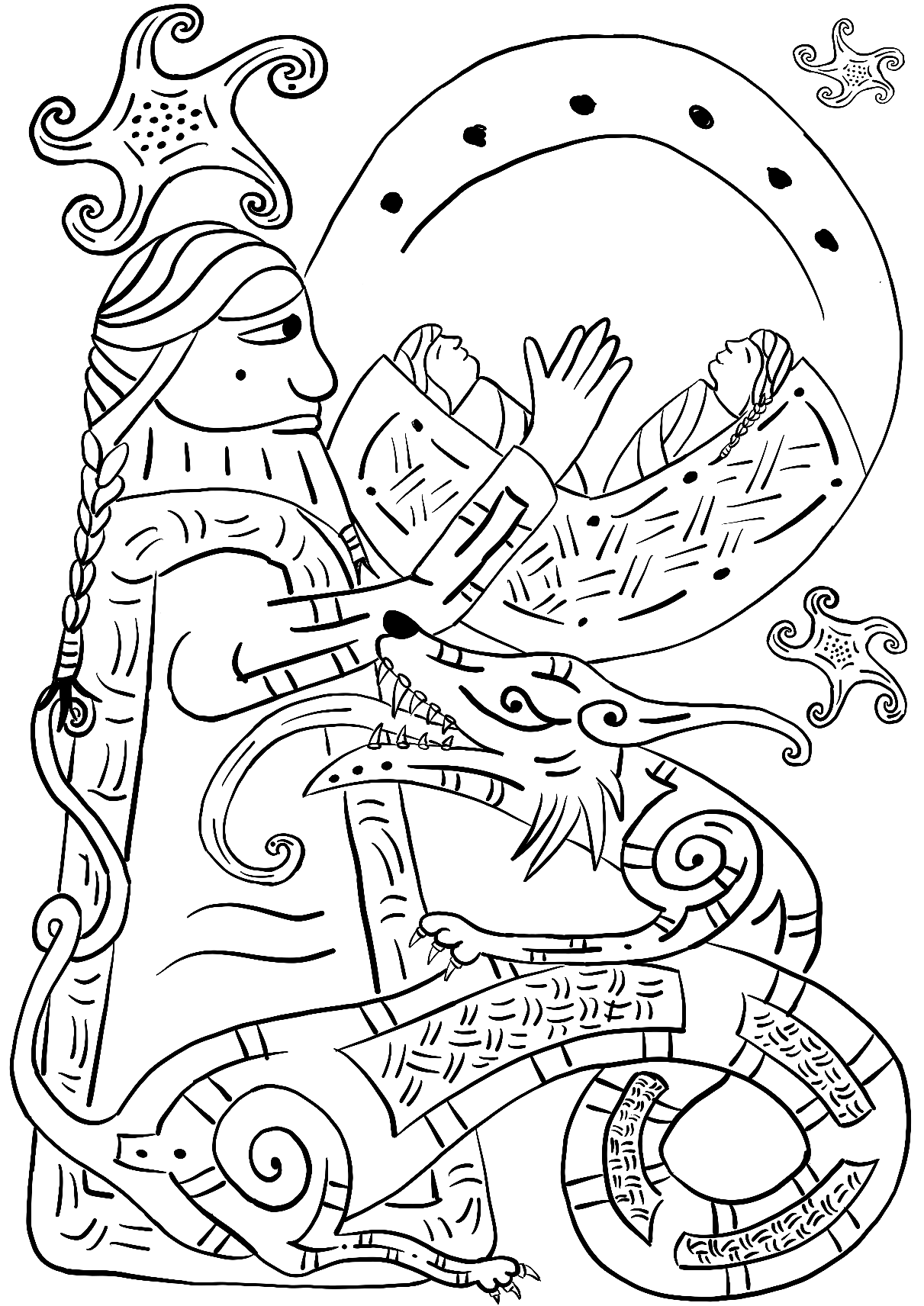
This piece of art, that I drew shows Mōna, cradling the children that he protects as he crosses the night sky and the passage of their lifetime. It is done in the Early Medieval Style

#History #Histodons #Folklore #Storytelling #Histordon #AngloSaxon #Jutes #Jutish #Art #AngloSaxonArt #MedievalArt

@folklore @histodons

Follow

@wihtlore

Was this deity definitely seen as male? For a Moon figure, that seems unexpected...
@folklore @histodons

@ceoln that is correct, the Moon was seen as a God and the Sun (Sigel or Sunna) was female (Sunnandæg) — Sunday.

@ceoln @wihtlore @folklore @histodons
I'm not sure it's that weird. We tend to think of the Moon through our languages (French lune is feminine, Italian luna, etc.) and the Greco-Roman heritage of the goddess Diana/ Artemis/Selene.
But we know of other male gods associated to the Moon in other cultures, like the Hindu god Soma/Chandra. And the word for moon is not feminine in all European languages (see German der Mond).

@hist_myth

Very interesting, thanks! My knowledge is only that of an interested amateur in the West, taking for granted the whole "moon == menstrual cycle == female" thing.

@wihtlore @folklore @histodons

@ceoln @hist_myth I can see the reason why and the popularisation of Wicca and other such Neo-pagan ideas probably help popularise that. Not saying it’s wrong or anything. I’m pretty relaxed about these sorts of things.

@hist_myth
Exactly and the German has the same Priti-Germanic root as Moon or Mōna (In old English)

The moon representing the feminine is absolutely not universal, it just depends on what lens you see it through. We get the term “Man in the Moon” directly from the old Godnof the moon. So in actuality, in English, the moon being seen as a Feminine deity might be thought of as strange (if you look into the etymology and history of it)

What is weird to one or normal to another :)

Sign in to participate in the conversation
Qoto Mastodon

QOTO: Question Others to Teach Ourselves
An inclusive, Academic Freedom, instance
All cultures welcome.
Hate speech and harassment strictly forbidden.