
 🇳🇱
🇳🇱
I saw the following question on FB where I answered it Thought I'd share teh question and answer here:
How long it takes to absorb and re-emit a photon when an electron's trajectory gets changed?
----------------------
After a free electron in space is effected by a photon it will, as you suggested, accelerate. But after taht point it is no different than any other electron with a constant velocity moving through space.
Now for starters there is a fundemental mistake in your thinking. Free electrons can not absord a photon, not in the usual sense. The only way an electron can be effected by a photon is through compton scattering, in which case the electron will absorb part of a photon, change its wave length and the energy absorbed will cause some degree of recoil, so the electron will accelerate. After that point, as I said the electron will be no different than any other electron moving at constant velocity through space.
To answer your question as to when they will emmit a photon, well, just as they can not absorb photons in the free space, they also can not spontaniously emit them. What can happen however is inverse compton scattering. This is where a very fast (usually relativistic) electron interacts with a low energy photon and imparts some of its energy to the photon increasing the energy of the photon and ultimately slowing down the speed of the electron.
So the answer to your question is, never, or whenever the right photon comes by, whichever applies to the circumstances.
@Pknagraj
Yes it does, and short answer is it depends. In somecases a very long time (glow in the dark stuff) in other cases very short time

@freemo
Why does this electron behaves differently from the electron in free space?
@Pknagraj So here is the thing.. why questions are hard to answer in physics, at least fully.. we know what we have observed and came up with logical models that explain what we observe, but why... thats another matter...Are you sure its "why" that you want to know?
@freemo
I just wanted to know the theory which explains the behavior of electrons under photon bombardment. I was naive to think it would be explained in a Mastodon toot without going into the nitty gritty of Q.M. Can you point me to a specific theory which talks about this difference in the tendency of e-(in an orbital vs in free space).Btw,i have only high school level understanding of physics. Sorry if the question is dumb.
@Pknagraj Yes I can, it is the electron transition energy which determines the energy of a photon an electron can absorb (it cant just absorb any photon). I linked to it below.
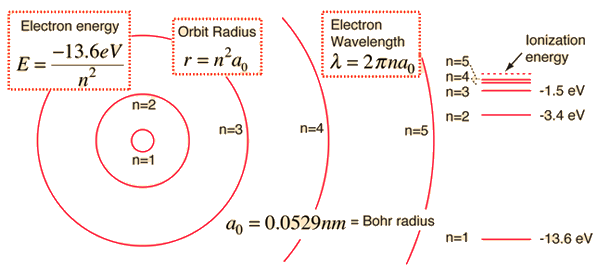
In simple terms each high orbital in an electron-proton pair requires less and less energy to jump to from the previous orbital (see attached image). Its this reason that for an electron to become a free-electron there is a finite energy threshold representing escape velocity.
When we look at an atom and all the different orbitals an electron can jump to you would notice there is a list of various energies that would accomplish each jump. Not just any energy level will do. This is why we see spectral lines on a spectroscope rather than a continuous spectrum.
Anyway the closer and closer an electron gets to being a free electron the less and less energy the photon needs to be to get it there. Since it trends towards 0 it is reasonable to conclude a free electron threrefore can not absorb photons directly at all.
For this reason free-electrons undergo different processes for their interaction as they are not in orbitals, namely compton scattering. Meaning a cloud of electrons in space wouldnt show spectral lines like a cloud of hydrogen would. but it would **shift** the frequency of light passing through it, which may cause a color shift int he spectral lines one sees coming from behind a cloud of free electrons in that case.
@freemo
Thanks Sir, for an amazing and lucid explanation. It has increased my appetite for learning more about the subject,I'll check out the Compton scattering next.
@Pknagraj
Keep in mind this is basic level qm, there are cutting edge theories which actually invalidate some of what i said.

@freemo
What about an electron in an atomic orbital?Does this electron absorb photon,if yes, then how long before it emits it out?