

l'empathie mécanique @dpwiz@qoto.org
- Monad m
- m a -> (a -> m b) -> m b
- Previously
- https://mastodon.social/@dpwiz
- Making games
- https://haskell-game.dev
- Games made
- https://icrbow.itch.io
Toots as he pleases.
Joined Apr 2022
https://academic.oup.com/mnrasl/article/483/1/L80/5195537
> For more massive stars, the habitable zone is more distant and habitable zone planets have wider Hill spheres. Large moons can therefore survive on more distant orbits and have larger Hill spheres such that submoons can exist on wider orbits where submoon–moon–planet tidal evolution is far slower, as compared with lower mass stars.
(Yes, the Moon could have had a submoon.)
l'empathie mécanique
boosted

Who called it "malloc()" and not "see_you_later_allocator()" ?
@meejah Rust and Elixir are certainly going to teach you a thing about ownership and message-passing concurrency.
Haskell gives more clarity in more fields overall.
So, yeah, a tour of Rust and Elixir, then a dive into Haskell.
@mia :vkcube:
- Mom, I want wa ch zod ahaaskes rea.
- We have wa ch zod ahaaskes rea at home.
Wa ch zod ahaaskes rea at home:
@newt @amiloradovsky it's totally possible. The super duper richness is still peanuts for a moderately successful government. Exactly the same thing is safeguarding their wealth. Otherwise, expropriation in 3..2..1...
(And I've seen an article explaining how it is totally possible to cash out on those vanity numbers)
@newt @amiloradovsky otoh, lottery has strictly negative net expected value for the buyer (on the pain of being unsustainable and/or non-interesting to organize for the seller).
Lots of business crash and burn, but at least a negative outcome isn't guaranteed.
@newt @amiloradovsky ah, yes, the trickle-up economy
l'empathie mécanique
boosted

A five year old Reddit post just helped me solve a knotty problem.
I hate to think how much useful info is being lost in ephemeral services like Discord, Slack, and IRC.
@cancel Holy f...
l'empathie mécanique
boosted

MarkovJunior is a probabilistic programming language where programs are combinations of rewrite rules and inference is performed via constraint propagation.
@freeschool The "inside" part is a riff off the original "inside the country".
But you really can treat it as a real thing and move towards it.
The problem is (at least) two-fold:
1) Own what you are. Personal identity management, private keys and metadata, stuff like this. A modern solution here are hardware tokens, esp. with on-device cryptography processing. A bit forward into future and we'll start seeing implantable stuff. Yes, we have implantable NFCs and stuff like that, it's just not particularly capable/interesting.
2) Own what you have. The bulk data storage question. You can't implant a few dozen TBs. But this can be reclaimed with pervasive connectivity when aided by (1). And we also have at least preliminary solutions here with p2p tech.
With a bit of effort you can commit your private keys to your meat memory. Then walk with your stuff through any country border without it getting noticed. The only problem would be Alzheimer's. And a need for external trusted cryptography hardware to actually run the algos.
Arguably the #GNUnet project has some capabilities for both 1 and 2. It "just" needs to gain more traction.
@freeschool The problem is not that user data is placed in a corporate data center in a "wrong" country. Moving data across the borders is not a solution for users' problems. A user still has no say in where their data is located and on what terms. Some people wouldn't trust their "countries" to hold a glass of water for them and certainly would not let their "digital footprint" into a country that has an adversarial stance to its minorities.
@meejah Haskell, this time for real 
l'empathie mécanique
boosted


> The core idea of “digital sovereignty” is that the digital exhaust created by a person, business or government should be stored inside the country where it originated
Fuck countries, all of them. The data should be stored inside the person themselves.
l'empathie mécanique
boosted

l'empathie mécanique
boosted


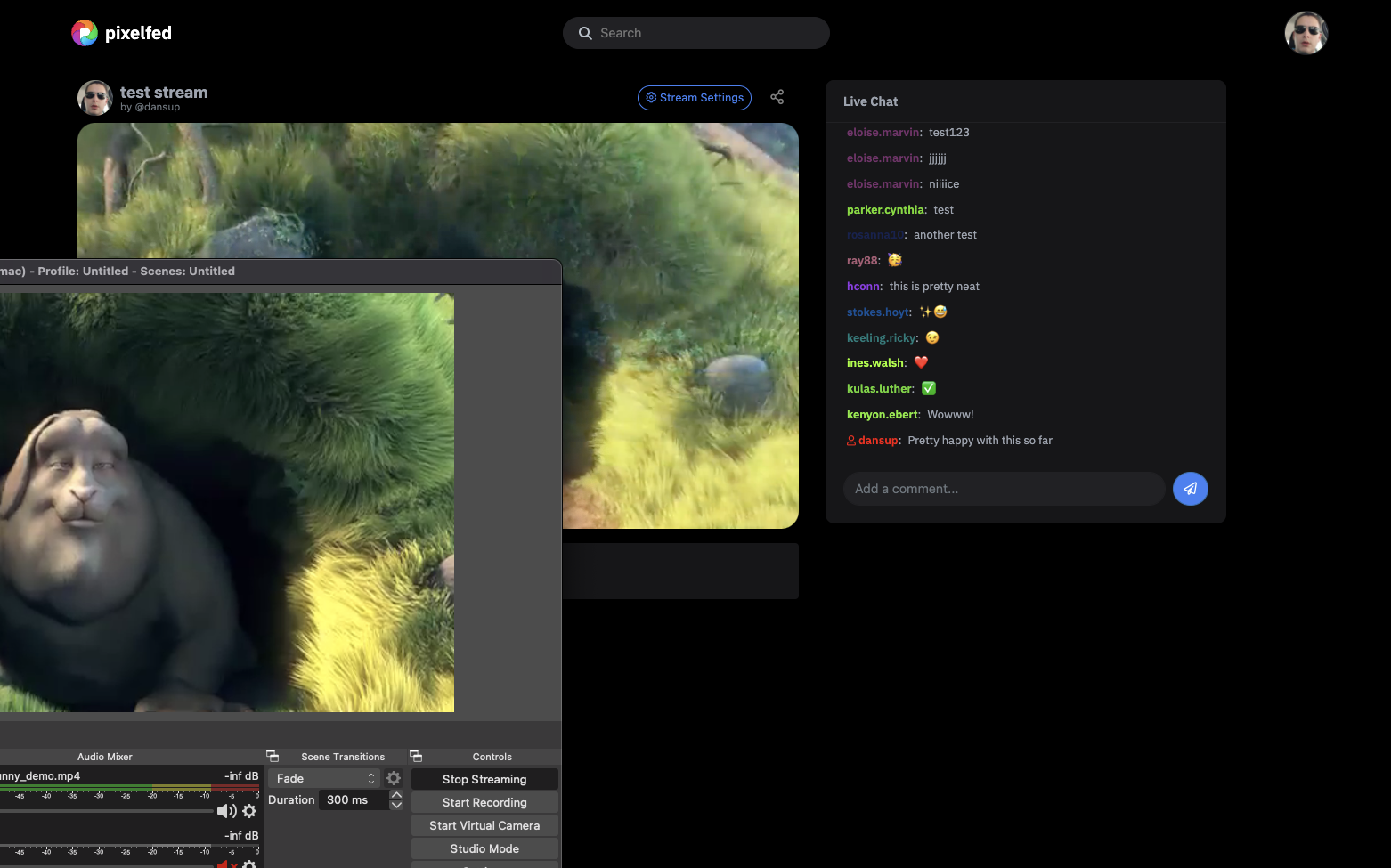
Pixelfed Live - simple live-streaming
✨ Easy to use
⚡ OBS supported
✨ Optional live chat
⚡ Fedi + mobile api support
✨ Advanced admin config (limit broadcasts to users w/ 500+ followers, disable replays, etc)
⚡ Simple setup that scales, from a mono deployment to dedicated streaming servers
Shipping soon! #pixelfed #pixelfedLive
- Monad m
- m a -> (a -> m b) -> m b
- Previously
- https://mastodon.social/@dpwiz
- Making games
- https://haskell-game.dev
- Games made
- https://icrbow.itch.io
Toots as he pleases.
Joined Apr 2022
