

Nick has moved to Mathstodon @internic@qoto.org
- Pronouns
- he/him/his
Moved to Mathstodon.xyz
Theoretical physicist by training (PhD in quantum open systems/quantum information), University lecturer for a bit, and currently paying the bills as an engineer working in optical communication (implementation) and quantum communication (concepts), though still pursuing a little science on the side. I'm interested in physics and math, of course, but I enjoy learning about really any area of science, philosophy, and many other academic areas as well. My biggest other interest is hiking and generally being out in nature.
Joined Nov 2022
Nick has moved to Mathstodon
boosted

A novel technique for automating bypasses of LLM guardrails, also known as jailbreaking:
"New research from Anthropic, one of the leading AI companies and the developer of the Claude family of Large Language Models (LLMs), has released research showing that the process for getting LLMs to do what they’re not supposed to is still pretty easy and can be automated."
https://www.404media.co/apparently-this-is-how-you-jailbreak-ai/ by @emanuelmaiberg via @404mediaco
Nick has moved to Mathstodon
boosted

One of my papers got declined today by the journal I submitted it to, with a polite letter saying that while they found the paper interesting, it was not a good fit for the journal. In truth, I largely agreed with their conclusions, and the paper is now submitted to a different (and hopefully more appropriate) journal.
Rejection is actually a relatively common occurrence for me, happening once or twice a year on average. I occasionally mention this fact to my students and colleagues, who are sometimes surprised that my rejection rate is far from zero. I have belatedly realized our profession is far more willing to announce successful accomplishments (such as having a paper accepted, or a result proved) than unsuccessful ones (such as a paper rejected, or a proof attempt not working), except when the failures are somehow controversial. Because of this, a perception can be created that all of one's peers are achieving either success or controversy, with one's own personal career ending up becoming the only known source of examples of "mundane" failure. I speculate that this may be a contributor to the "impostor syndrome" that is prevalent in this field (though, again, not widely disseminated, due to the aforementioned reporting bias, and perhaps also due to some stigma regarding the topic). So I decided to report this (rather routine) rejection as a token gesture towards more accurate disclosure. (1/2)
Nick has moved to Mathstodon
boosted

Report: Hospitals Rarely Advise #Doctors on How to Treat Patients Under #Abortion Bans
—
Doctors described #hospital lawyers who “refused to meet” with them for months, were hard to reach during “life or death” situations and offered little help beyond “regurgitating” the law, according to a Senate Finance Committee #report.
#News #Health #Law #USPolitics #Government #Healthcare #Pregnancy #Patients
Nick has moved to Mathstodon
boosted

#TIL #Python has a module, shlex, to safely build and parse #POSIX #shell commands. Useful, for example, when you want to automatically write #bash #scripts or `ssh` commands to execute more complex commands on remote machines.
#programming #subprocess
Nick has moved to Mathstodon
boosted

Happy Launch Anniversary JWST!
Also, thanks to Ariane Space for the great ride and for putting cameras on the Ariane 5’s upper stage so we could all say goodbye and good luck as JWST began it's 1.5 million km journey to L2.
Nick has moved to Mathstodon
boosted

Any of you open source people come across Latta AI? A tool that claims to want to help developers fix bugs in open source projects.
Someone suggested a patch generated by this tool for a feature request on my project. The patch is a poor implementation of the request (unusable), it breaks two existing features (i.e. adds two bugs), and leaves redundant code. Not exactly impressive.
I hope we're not gonna get a ton of AI bots making BS pull requests to repos now?
Nick has moved to Mathstodon
boosted

Man, corporations really want to put a stop to libraries:
https://www.cbc.ca/news/canada/ottawa/ottawa-library-e-books-queues-1.7414060?cmp=rss
"Depending on the title, public libraries may pay two or three times more for an e-book than they pay for its print edition. In some cases, the e-book may be up to six times the price, librarians told CBC."
"Those publishers ... will often license copies of e-books for just 12 or 24 months. Once that licence expires, libraries must repurchase access to the same book." #canada #cdnpoli #books
Nick has moved to Mathstodon
boosted


So look, I’m not really a believer, and my wife is into a totally different pantheon of deities, but we go to church on Christmas Eve every year with my folks and our kids and it is kind of a nice tradition.
Nick has moved to Mathstodon
boosted

apropos of nothing, here's an interesting article: https://en.wikipedia.org/wiki/Streisand_effect
have a lovely day y'all
--sf
Nick has moved to Mathstodon
boosted

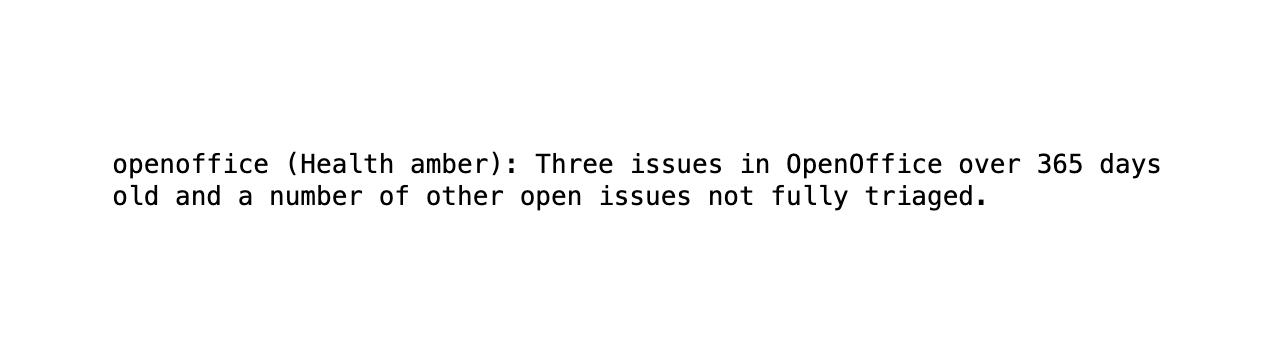
OpenOffice has multiple unfixed security issues, over a year old, as this image from the Board report says. And no new committers since 2022, and no major release since 2014. Maybe the FOSS community can ask the Apache Software Foundation to finally put it in the Attic, and stop leaving users vulnerable: https://www.apache.org/foundation/contact
Nick has moved to Mathstodon
boosted

My kids are more than a decade past the point of needing them, I have no history of buying them at this address, and I have YouTube history off, Adblock on all my devices except for the iOS ones and “personalized ads” turned off on all of those, and a relative with a one-year-old who still uses diapers was here for dinner and now half an hour later YouTube is showing me diaper ads.
They didn’t even use my wifi.
I hate this shit so much.
@adamshostack I don't use it, but from observing others use it, it seems like it really is just not very usable (or really designed only be used in a very limited set of ways that Meta prefers).
I am told you can use the "favorites" feature to get a chronological feed of content from specific people (the ones you've favorited).
@frankie Yeah, this seems like a pretty good option, now that I've looked at it. The crypto seems solid (to me as a non-expert, but it's also been audited) and it's cross-platform with even Android and iOS implementations. It seems like it offers something functionally pretty similar to Tomb (the other option several people suggested) but in a more user-friendly package.
Nick has moved to Mathstodon
boosted
I have some financial files (like old tax returns) on my computer that I seldom access and would like to have an extra layer of confidentiality for, so i was looking into how I could easily have an effective separately-encrypted folder for those on my #LinuxMint system.
Obviously I could create a separate dm-crypt partition, but since it's probably a small number of files and the total volume I want long term is not very well known (e.g. I might also want to add things like images of important official documents), that doesn't seem like the ideal solution. It seemed like maybe ecryptfs could be the way to go, but I know the use of that for encrypted home directories was deprecated by #Ubuntu a while ago and looking at Launchpad it sort of seems abandoned (the last recent revision listed is from 2017). Does anybody know the status or have a better suggestion?
Nick has moved to Mathstodon
boosted

New, by @lorenzofb, @carlypage and myself: Here is our annual compendium of all the cybersecurity stories that TechCrunch's security desk were jealous of this year, from our friends and colleagues at competing publications.
@demofox @dougmerritt @AmenZwa They are definitely commonly used in attitude control systems on, e.g., spacecraft. In fact, it's so common that people sometimes speak of "quaternions" and the "describing attitude" part is just understood to be implied.
Nick has moved to Mathstodon
boosted

Two WordPress plugins required by the premium WordPress WPLMS theme, which has over 28,000 sales, are vulnerable to more than a dozen critical-severity vulnerabilities.
@dougmerritt @maxpool Many brands at this point use tea bags that are mostly or entirely synthetic. The ones that are approximately tetrahedrons come to mind. This leads to better infusion but at the cost of drinking a bunch of microplastics.
Nick has moved to Mathstodon
boosted

Diversity innovation paradox: "demographically underrepresented students innovate at higher rates than majority students, but their novel contributions are discounted and less likely to earn them academic positions"
Source:
https://www.pnas.org/doi/10.1073/pnas.1915378117
Thanks to Needhi Bhalla, shared on bsky!

- Pronouns
- he/him/his
Moved to Mathstodon.xyz
Theoretical physicist by training (PhD in quantum open systems/quantum information), University lecturer for a bit, and currently paying the bills as an engineer working in optical communication (implementation) and quantum communication (concepts), though still pursuing a little science on the side. I'm interested in physics and math, of course, but I enjoy learning about really any area of science, philosophy, and many other academic areas as well. My biggest other interest is hiking and generally being out in nature.
Joined Nov 2022
