

Lup Yuen Lee 李立源 @lupyuen@qoto.org
- Pronouns/Gender/Sexuality
- He/Him/They, Bisexual/Asexual 🇸🇬
- Date of Birth
- 1969
- Articles
- https://lupyuen.org
IoT Techie and Educator / Apache NuttX PMC
Joined Jan 2020
Lup Yuen Lee 李立源
boosted

@tasket @lupyuen 1. To avoid extra controllers (cost, mobility); 2. To integrate with other services like online monitoring (not specifically cloud but dependant people); 3. To facilitate free market (user's freedom) . The other side is the why not? BLE is widely supported and in continuous improvement. Does a non standard or privative technology guarantee full security (protected against malicious people, in this case) on well-being devices?
"2023 showcased the power and perils of #OpenSource"
https://techcrunch.com/2023/12/26/the-eternal-struggle-between-open-source-and-proprietary-software/
Lup Yuen Lee 李立源
boosted

@lupyuen Maybe not true now, but one thing I discovered about the dbus-daemon, when I studied it years ago for a company project, was that it could block the root user from using D-Bus. That might have unexpected side-effects.
"Software Developers must continually Learn in order to keep up with the fast-paced changes in the field"
Emulating an iPod Touch 2G using #QEMU (ARMv6)
"Croquet was originally implemented in Squeak ... derived from Apple Smalltalk-80"
Lup Yuen Lee 李立源
boosted

@lupyuen I'd have to question why anyone's insulin pump is controlled by an android device OR bluetooth.
Mapping the Virtual Memory for #NuttX Apps ... With #RISCV Sv39 Page Tables
Article: https://lupyuen.codeberg.page/articles/mmu.html#user-levels-1-and-2
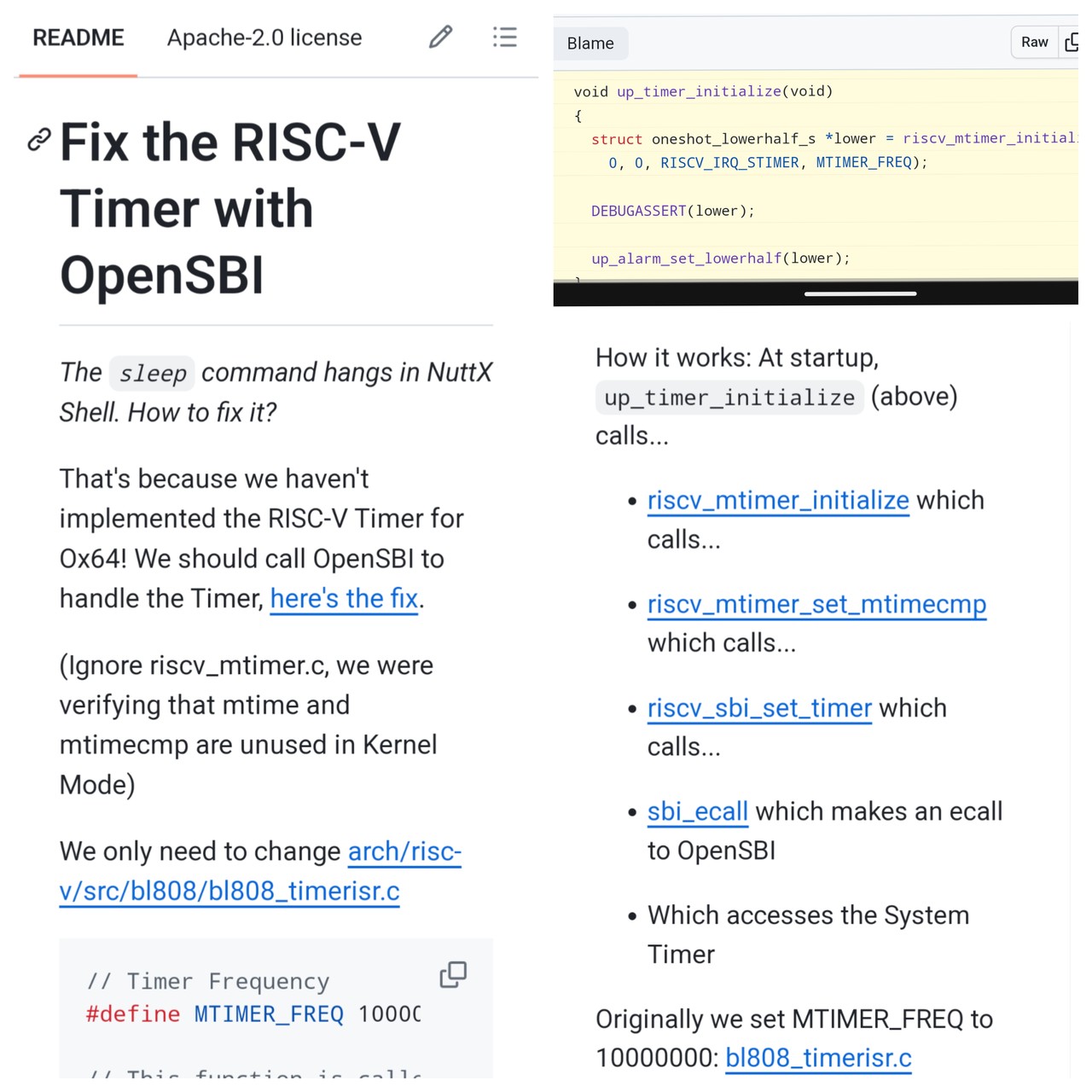
Fixing the #RISCV Timer in Apache #NuttX RTOS with OpenSBI
Source: https://github.com/lupyuen/nuttx-ox64#fix-the-risc-v-timer-with-opensbi
Lup Yuen Lee 李立源
boosted


@lupyuen that’s a beautiful way to show release notes! Hope more projects include a similar approach
"People using Bluetooth-enabled Hearing Aids and Heart Rate Monitoring tools also reported disruption, which could put their well-being at risk"
#Linux Commands to try when you’re bored
riscy-business: #RISCV Virtual Machine for Code Obfuscation
Lup Yuen Lee 李立源
boosted


@lupyuen did you compile it on device, cross-compile or didntjey have binaries readily available?
I remember a few years back running their bootstrap script to compile it.
Fun fact also, their original compiler implementation was written in Pascal!
I remember a few years back running their bootstrap script to compile it.
Fun fact also, their original compiler implementation was written in Pascal!
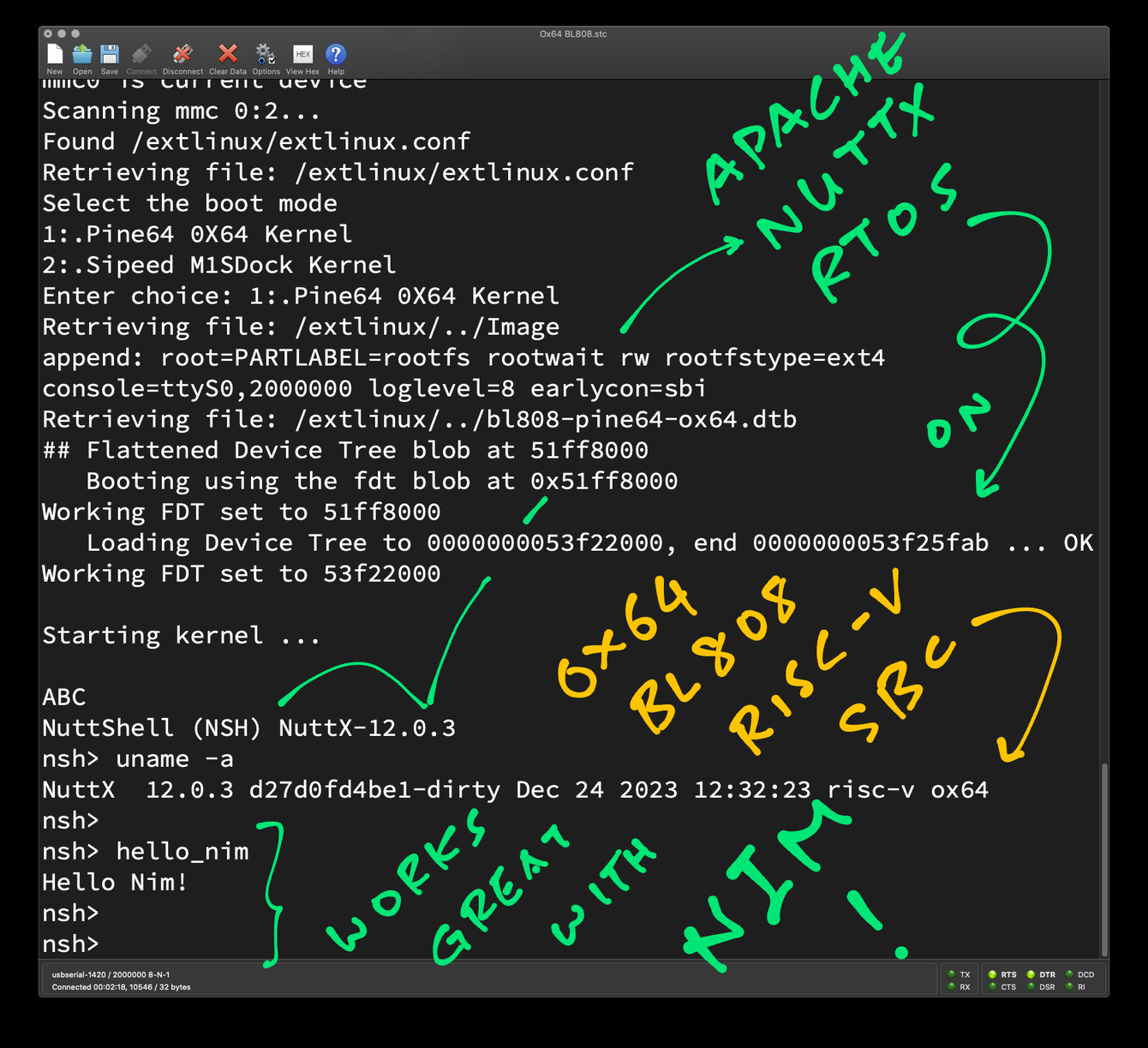
#NimLang works great on #Ox64 BL808 #RISCV SBC with Apache #NuttX RTOS 🎉 ... Maybe Nim should Blink an LED 🤔
Source: https://github.com/lupyuen/nuttx-nim#nim-on-apache-nuttx-rtos-and-ox64-bl808-risc-v-sbc
"Before We Say Goodbye" by Toshikazu Kawaguchi
Here's how we map the Sv39 Virtual Memory for #RISCV Apps in Apache #NuttX RTOS
Article: https://lupyuen.codeberg.page/articles/mmu.html#user-level-3

Every Google Nexus phone ever made
https://www.androidpolice.com/google-nexus-phones-retrospective/#google-nexus-6
- Pronouns/Gender/Sexuality
- He/Him/They, Bisexual/Asexual 🇸🇬
- Date of Birth
- 1969
- Articles
- https://lupyuen.org
IoT Techie and Educator / Apache NuttX PMC
Joined Jan 2020
