

Mark Tomczak @mtomczak@qoto.org
- My Page
- https://fixermark.com
Career software engineer living something approximating the dream he had as a kid.
Joined Apr 2022
Happy New Year!
Now's your chance to craft that epic tale of Quincy Morris hiring Sherlock Holmes to assist on the Dracula affair completely free of copyrght entanglements.
The rules for good function design and good dieting are pretty analogous.
Good dieting:
* Eat food
* Not too much
* Mostly plants
Good function design:
* Pass context
* Not too much
* Mostly immutable
So I'm in Blender and I'm generating asteroids using the Add Mesh -> Rock Generator tool (part of the "Add Mesh: Extra Objects" add-on) with an Asteroid template.
(*click* new asteroid)
Each of these rocks is created using a few overlapped mathematical algorithms. The math is pure math, procedurally understood, with no hidden-node neural network in play.
(*click* new asteroid)
The results are sufficient to serve the purpose of putting a rock in a game or image with maybe a little polish. The whole script is here at https://svn.blender.org/svnroot/bf-extensions/contrib/py/scripts/addons/add_mesh_rocks/rockgen.py
(*click* new asteroid)
I can click this button ten thousand times and get ten thousand convincingly-different distinct blobs of rock, suitable for inclusion in a game or visual artwork.
(*click* new asteroid)
I couldn't tell you, precisely, if it's kosher that the author of this plugin made this plugin. He credits a tutorial at blenderguru that is a dead-link (probably because the site was re-organized, but the likely tutorial is easy to find by search at https://www.blenderguru.com/tutorials/how-to-make-a-realistic-asteroid; a quick jog around the FAQ and other info doesn't suggest the author has created this tutorial for the purpose of creating an automated tool to obviate the need for the tutorial.)
(*click* new asteroid)
The author also credits this tutorial (http://saschahenrichs.blogspot.com/2010/03/3dsmax-environment-modeling-1.html), which also has no obvious information on whether or not the author is okay with someone creating an automated tool to obviate the need for hand-building rocks. Broadly speaking though, both tutorials show the user how to wire up a procedural algorithm in to create the rocks by transforming numbers; the plugin mostly scripts the process of recapitulating that pipeline and then adding some constrained random numbers as input. The "artistry" is in the connection of the pipeline pieces and the choice of RNG constraints to make something 'sandstone' vs. 'asteroid' by modifying the height of peaks, the depth of holes, and the frequency of their repetition.
(*click* new asteroid)
And, of course, my input to this process, which is when I stop clicking this button because I'm happy with this asteroid being *my* asteroid, for *this* game.
(*click* Oh, that's not bad.)
Where am I going with all this? not exactly sure. The questions it raises for me are around art and automation as a microcosm, obviously, for the larger discussion around Stable Diffusion and DALL-E. Taking this as perhaps an exemplary problem, we could ask questions like:
* Does it matter that the script author extracted the essence of these tutorials without explicit consent of the tutorial authors, or does "tutorial" imply that it doesn't matter how they're used?
* In some sense, I'm now "competing" with those artists because I can crank out 100,000 asteroids a second... But I'm not? Because I don't want to, I just want one? Has work been 'stolen' from them because I can now crank my own out on my laptop instead of commissioning one of them to make me one? But if so, why write such tutorials?
* Is the real issue with computer automation the use of other people's work without their consent, or was consent given to something like this without thought of how a machine could extrapolate learning a style to a pushbutton process? Because if the only issue is consent, what happens when someone builds DALL-E on top of a thousand paid artists... And those are the last artists ever paid for that kind of art?
* Is the real issue with computer automation that I'm not really an artist if I'm just clicking a button? And who cares if I'm really an artist if my goal isn't to compete with Picasso, it's to get a lump of pixels that a game player will see as "space rock" and behave accordingly?
These questions aren't discrete; all of these technologies exist on a continuum that we've been walking since Ada Lovelace hypothesized that a machine that transforms numbers can transform notes. I don't think we find happy answers on a path that precludes us from using those machines, but I don't think we find happy answers ignoring the question of what it means when humans "make art" either.
In any case, I think I have my space rock.
(*click* file saved)
Mark Tomczak
boosted

When you ask people with ADHD why they agreed to take on so many projects, commitments, and/or hobbies.😭😭
What we should all keep in mind this holiday season is that the story of Joseph and Mary at the inn is really a story of a husband failing to plan ahead for a trip he knew was coming forever.
---
"What do you MEAN there's no room at the inn? Didn't you have a reservation?"
"Didn't make one."
"Didn't.... How, on Earth, could you not make a reservation when you knew EVERY PERSON IN THE COUNTRY was going to have to go to their hometown for this damn census? You've known about this trip for MONTHS, Joseph!"
"I dunno! It was a government-mandated trip, I just... Assumed they'd handle it."
"Assu~ WHY WOULD YOU ASSUME THE GOVERNMENT WOULD HANDLE IT, JOSEPH?! YOU'RE A CARPENTER! Did you notice the local Romans offering sweet jobs to fabricate some new inns where we came from? No? Any idea why that might be Joseph?"
"I DON'T KNOW MARY! I really feel like you're putting a lot of blame on me right now."
"GEE JOSEPH, THAT MIGHT BE BECAUSE I'M PUTTING A LOT OF BLAME ON YOU RIGHT NOW! BECAUSE YOU DIDN'T THINK TWO MONTHS AHEAD AND NOW YOU'RE WIFE'S GONNA GIVE BIRTH WHILE STARING AT A HORSE'S ASS! AND ALSO THE BUTT OF A HORSE ACROSS THE ROOM!!!"
#vscode Is there a configuration option somewhere to make the Explorer stop jumping to show the file open in a tab when you bring that tab to the foreground?
Nine times out of ten, I'm clicking on that tab because I want to select which subpanel to pop a new file open in, not because I want that tab.
If you're writing an online game, do yourself a favor and use the same language for client and server.
You'll thank you later.
Open question:
With modern technology, what stops a landowner from buying up 20, 30, maybe 50 lots in a town and installing unmanned gas stations? Just a couple of pumps and some security cameras, all wired to one dispatch building (which could even just be the owner's home). Employ only enough staff to handle the refueling trucks for a couple hours every other day, use the cameras and internal diagnostics of the pumps to know when maintenance is needed, and otherwise just sit back and collect revenue?
Are the margins so close on gas stations that you need the convenience store to make up the difference? If so, how much of that gap can you cover with a bank of vending machines?
Mark Tomczak
boosted

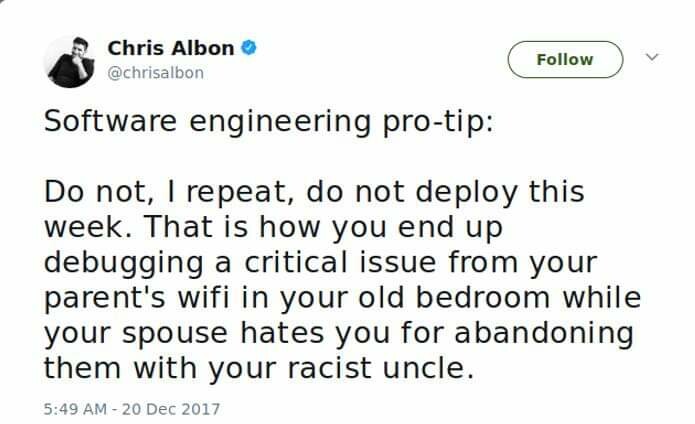
This this is the annual plea to fake a QA or testing emergency that delays your release until January.
Type systems and unit tests have something in common: they are both in the category of 'documentation', alongside comments.
They differ from coments in that they are designed to be machine-interpretable, but like comments they do not modify the behavior of the code if stripped out. This is the key principle of documentation: it's additional information in a program that does not modify the behavior of the program when it is stripped out.
They are vital for ensuring the correctness of the program. But 'correctness' is a human concept; programs do not care.
The fact that #dwarffortress releasing on Steam has made the developers overnight millionaires by selling over 300,000 units is great for them and not surprising.
the game has been amazing for years, with the largest problem with it being that the ASCII user interface made it damn near impenetrable for a vast swath of potential players. Jumping that final hurdle not only popped the floodgates on a known tranche of potential players for whom graphics were table-stakes, it skyrocketed it past the rest of the indirect-control colony simulators on the market, because none of them can boast what DF boasts...
... two *decades* of development and refinement.
Writing a small multiplayer game with Boardgame.io and Phaser.
Things I have not written:
* any unit tests
Things I have written:
* a "DevHooks" file to make it easy to consolidate quick e2e test patches on top of the regular game flow
* Lots and lots of exploratory code that got torn up and replaced right after it was written, which would have taken twice + change as long if I'd written unit tests
#Wednesday (the Netflix series, not the day), quick review:
Cast 10, book 3.
I haven't finished the whole series yet (and I intend to), but as far as I've gotten: I rarely see such talented actors and actresses animating such a shambling carcass (which, I suppose, is very on-brand for an Addams property). Ortega and Myers are fun as hell, their characters really contrast delightfully, and every moment they're on screen is wonderful---as with the rest of the cast as well.
It's just a shame they're stuck in this tropey Hogwarts-adjacent CW high school drama. It's like someone pitched a live-action Monster High series, got shot down, and salvaged the pitch by gluing Wednesday Addams upside-down to an existing plot. I know; that sounds like it should be perfect! It is not.
If you can turn your brain off and enjoy every scene without asking inconvenient questions like "Where is this going?" or "Why are these characters doing this?" I can recommend it. And it still has time to pick up on the back end. But I'm not sure I should get my hopes up.
A lot of discussion on how AI-generated art will impact the artist community and art-making in general. I'm encouraged to see artists starting to organize around what happens next.
It will be a difficult near-future for anyone who doesn't want anything to do with these technologies. They're pretty solidly as transformative as the synthesizer, if not the camera. And they're pretty irrevocably here. So what happens next?
One angle I've seen some convincingly-pleasing presentations on is challenging the legality of how these tools were constructed. I think that's a pretty vertical cliff to scale (hard to draw a clean line that kills this tech without also killing other transformative uses of other people's work that are already accepted as non-infringing of copyright).
For the sake of argument, I'm going to assume that such legal challenges carry the day and Stable Diffusion / OpenAI are dismantled / banned from any legal use.
What I need people to understand is it won't be enough, and the next part is much harder.
There is a problem that I call the Balder problem. There is, I'm sure, a better term for it in the literature around collective labor action, but I cop to my ignorance of the space. In Norse legend, when Balder was slain, an opportunity was given for him to come back to the realm of the living... If every living being expressed their sorrow at his passing. One single giant, Thokk, did not. As a result, Balder would be kept in the underworld until Ragnarok.
If the current set of tools are found to be illegally-generated, the *next* set won't be. It will be more than worth it for every major media and advertising company to pay scads of cash to a small subset of artists to generate seed material for their own diffusers. The big ones could *easily* afford to make a hundred or even a thousand artists *lifetime-career-rich* for exclusive rights to their art.
The only way to stop that front is for every visual artist out there to say no to that money unless the money comes with solid guarantees that the livelihood of every artist is preserved.
That's a hell of a temptation, and it will be dangled in front of every visual artist in the world. I'm an optimist, but the odds of all artists standing together with one voice and demanding a right to survive on their talent that doesn't exclude other artists are poor.
But if I could think of any one demographic in this country at least that I have the highest hope for pulling it off, it's them. My optimism knows no bounds.
Spent a good ol' chunk of the day chasing down that when the Phaser game engine has camera zoom set, it doesn't immediately update its transform matrix so `getWorldPoint` doesn't give the right answer.
Game engines are great, but they don't remove the need for good old-fashioned debugging.
Twaining an AI to undewstand what "harmful information" is turns out to be reawwy hard, UwU.
I'm going to have to put more butter on this popcorn while I watch this Musk/Apple dust-up.
Musk is accusing Apple of hating free speech.
They won't, but I really want Apple to respond with "Yeah bro. Have you even heard of us? We're the OG walled garden. The *vertical* monopoly. Our whole *deal* is 'Pay us to think for you.' Our *vibe* is "safety and comfort." Our *unofficial logo* is the rounded rectangle. You think you're a problem for us? Our users *pay us money* to deal with *problems like you.* *For them.* *Efffffff* your frozen peaches."
... they won't say it.
...**But they could.**
My head-canon is that Solomon had, like, ten trials lined up for the baby case but the one woman failed so hard on the first one that he ended up with a whole free-ass day, just... Calendar cleared.
"We'll cut the baby in half and... What? You said what? Wow. I... Okay. You know what? There was going to be a whole philosophical journey I was going to take you on here, comparing and contrasting property and people, responsibility to ownership, culminating with recognition of the mystery of soul and the supremacy of G~d in all things, but... No! I don't care who the biological mother is. Give the baby to the woman who *doesn't think it's okay to cut babies in half!* Case closed praise YHWH!"
Discussions of AI-generated art that try to cut the tech off at the knees by invoking copyright regarding training the generators on artists' work without their consent are fine, but short-sighted and won't stop the economic shift.
If these tools prove valuable for generating sufficiently-novel, sufficiently-controllable input, advertising companies and entertainment companies *will* pay fifty artists for their labor to generate the seed data to create fifty million images.
These technologies, should they prove viable, will become a permanent tool in the toolbox.
Mark Tomczak
boosted

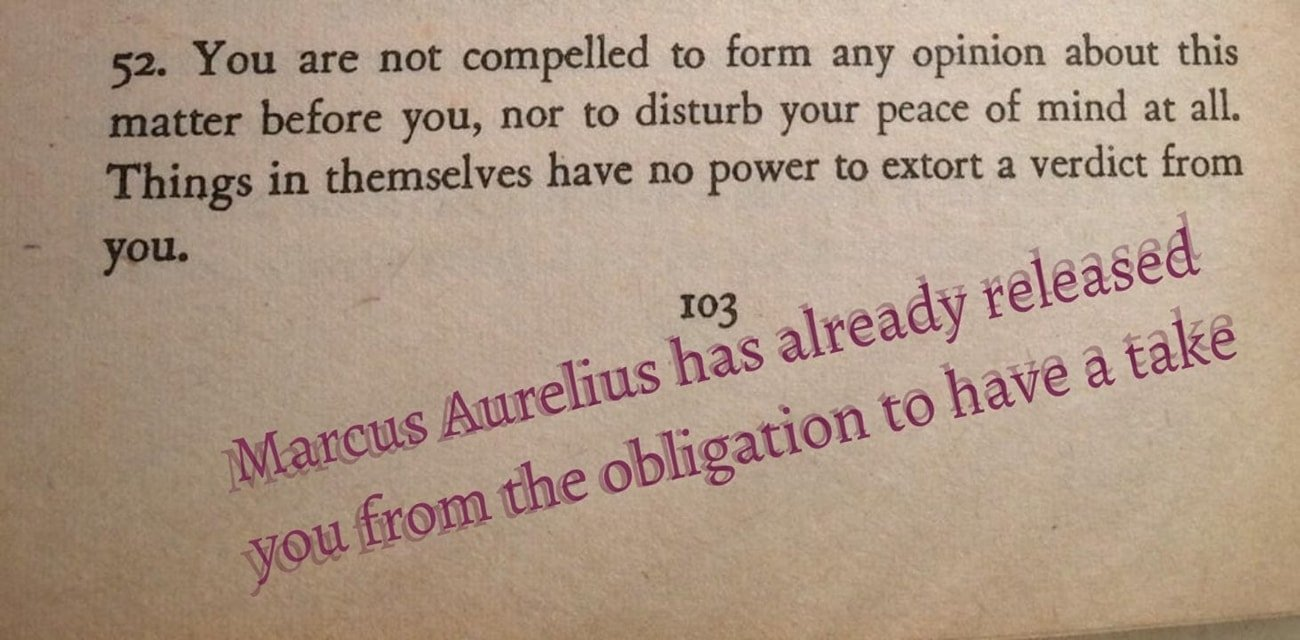
Some days I look at the timeline and think about getting this tattooed on my back:


- My Page
- https://fixermark.com
Career software engineer living something approximating the dream he had as a kid.
Joined Apr 2022
