

Michael Piotrowski @true_mxp@qoto.org
Associate professor of digital humanities, University of Lausanne, Switzerland
Professeur associé en humanités numériques, Université de Lausanne, Suisse
Joined Nov 2022
Michael Piotrowski
boosted

Careful, mentioning the wisdom of our ancestors can get you defenestrated.
Michael Piotrowski
boosted

Fantastic project by @mfenner ! Check it out:
An Archive for Scholarly blogs
DOIs for scholarly blog posts!
Michael Piotrowski
boosted

Professur "open rank" für Geschichte der Frühen Neuzeit https://www.infoclio.ch/de/professur-open-rank-fu%CC%88r-geschichte-der-fru%CC%88hen-neuzeit?utm_source=dlvr.it&utm_medium=mastodon #infocliojob

Michael Piotrowski
boosted

So OpenAI just released a detector of AI-generated text, I assume because of concerns in education / homework.
https://openai.com/blog/new-ai-classifier-for-indicating-ai-written-text/
Maybe this is good?
No, it's very bad.
They claim 26% true positives, 9% false positives. Assume 10% of submitted homework is chatgpt generated, you get the classic counterintuitive outcome of poor predictive power: if a homework is flagged, there's a 3:1 chance it's *human* generated.
This is going to cause a lot of harm. It should be immediately recalled.
Michael Piotrowski
boosted
DIZH-Brückenprofessur für Digital Cultures and Arts https://www.infoclio.ch/de/dizh-br%C3%BCckenprofessur-f%C3%BCr-digital-cultures-and-arts?utm_source=dlvr.it&utm_medium=mastodon #infocliojob
Michael Piotrowski
boosted

All right, folks, here are some great links about #ChatGPT (espeically for educators)
tl;dr: Don't panic
* Sarah Elaine Eaton's talk "Academic Integrity and Artificial Intelligence: Implications for Plagiarism and Academic Writing" is available on YouTube: https://www.youtube.com/watch?v=9QNNPVSC24w
* Nature has a word for publishers: https://www.nature.com/articles/d41586-023-00191-1
* The ultimate link list to English language sources (and soon French): https://pupp.uqo.ca/en/artificial-intelligence-and-plagiarism/
Michael Piotrowski
boosted
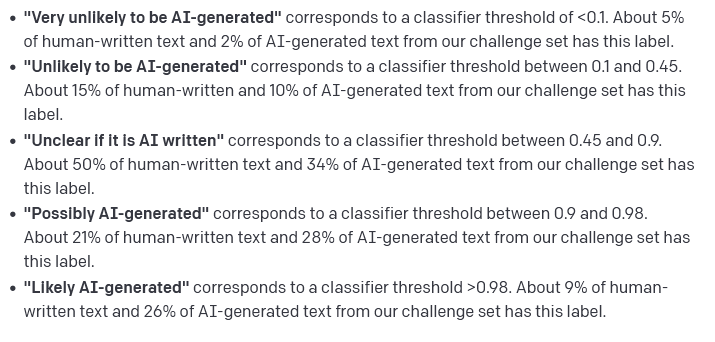
OpenAI released a tool which purports to detect AI-generated text. At the highest end of detection, it labels text "possibly" or "likely" AI-generated. 21% of human-written text falls under "possibly" and 9% of "likely" does. That's 3 in 10 students being defamed and/or harmed.
Just like other providers of academic surveillance software, OpenAI states that their detector "should not be used as a primary decision-making tool".
It will be, though. And harm will follow.
https://openai.com/blog/new-ai-classifier-for-indicating-ai-written-text/
Michael Piotrowski
boosted

Important @garymarcus on the "uncanny cognitive valley" in which seemingly good enough AI leads to neglect and inattention https://garymarcus.substack.com/p/the-cnet-fake-news-fiasco-autopilot
Michael Piotrowski
boosted

For the morning crew, we posted @eastgate’s talk last night, a history of Early #ToolsForThought
Michael Piotrowski
boosted

"As generative media gets better, we have this notion that at any point, you're gonna be able to turn on the future equivalent of Netflix and watch a show perpetually, nonstop as much as you want."
#AI #entertainment #media
https://entertainment.slashdot.org/story/23/01/31/206257/nothing-forever-is-an-endless-seinfeld-episode-generated-by-ai?utm_source=feedly1.0mainlinkanon&utm_medium=feed
Michael Piotrowski
boosted

It has become increasingly clear to me that the wide availability of AI-based text generation tools coupled with the "publish-or-perish" incentive of the current scientific publishing system is a dangerous mix, which puts academia on a straight path to becoming a cargo cult. So I wrote an essay about it. Below is a short summary: 1/
https://lookalikes.substack.com/p/publish-or-perish-and-chatgpt-a-dangerous
#scicomm #academia #llm #chatgpt #publishing #science #research #writing
Michael Piotrowski
boosted

NLProc Mastodon verse: to all CL/NLP people out there, out of curiosity, ---given you {are working
|do research|are educated} in Computational Linguists or Natural Language Processing: do you have a preference?
Michael Piotrowski
boosted

New preprint:
Explainable prediction of catalysing enzymes from reactions using multilayer perceptrons
- Explain reaction classification using DRFP, DeepSHAP
- Viz with SmilesDrawer
- Predict enzyme catalysts for any reaction
Dank aan @maxkemman voor de efficiënte samenwerking! Ik kijk uit naar de publicatie van onze paper.
Michael Piotrowski
boosted

Commissioned by the British consul Daniel-Fitzgerald Barton, Victoria Hall in #Geneva was built between 1891 and 1893 to plans by Swiss architect John Camoletti. It was inaugurated in 1894.
Michael Piotrowski
boosted

📢Join a team of linguists from USI Lugano, Basel University, University of Lausanne, and University of Neuchatel to work on #opendata in the study of #talkininteraction. Part-time assistant position, M.A. or PhD 🗓 04/2023-09/2024 📩Apply before February 15!
📋Project description:
The research assistant will contribute to the project “Data-sharing skills in corpus-based research on talk-in-interaction” short title: CHORD-Talk), which is part of the Open Research Data (ORD) program currently promoted by SwissUniversities and involves USI (leading house, coordinator: Johanna Miecznikowski) and the universities of Basel (Lorenza Mondada and Martin Luginbühl), Lausanne (Jérôme Jacquin) and Neuchâtel (Simona Pekarek). Audio-video recorded and transcribed corpora of spoken language in interaction are collected by a diversity of disciplines in the social sciences and the humanities. They are particularly complex and offer several challenges to ORD practices. The project aims at identifying the conditions that must be fulfilled in order to prepare and treat audio-video corpora of spoken language in interaction as ORD in a meaningful way. The project team members will analyse and assess existing ORD practices related to audio-video interactional data by reviewing the relevant literature, critically reflecting on their own practices, and organising workshops with international experts from leading data-hosting institutions. The team will explore possibilities to improve ORD practices, with a particular focus on researchers’ data-sharing skills and on the Swiss situation. It will engage with the concerned disciplines and communities, e.g. in the fields of interactional linguistics, conversation analysis and dialogue-oriented argumentation studies, and evaluate procedures to disseminate relevant knowledge in these communities in the future.
@linguistics @dh #linguistics #EMCA #corpuslinguistics #jobopportunities
@utsavratti Thanks, right, that’s a a potential issue—but I’m using silicone only, so I think I can exclude it.
Michael Piotrowski
boosted

Really interested in a post-doc who'd like to spend 2 yrs at @BrownCSDept teaching programming languages w/ me 1 sem and doing research rest of year. Any interested PhD students graduating in the near future? [Legalese: not a formal job posting, that will follow later.]





Associate professor of digital humanities, University of Lausanne, Switzerland
Professeur associé en humanités numériques, Université de Lausanne, Suisse
Joined Nov 2022
