
@8petros @lightweight I am less inclined to recommend #moodle, even if it is a wonderful solution. Instead, your might consider a #Wordpress based Learning Management System (LMS) as a less expensive, slimmed down option. More info https://www.mguhlin.org/2022/05/update-on-choosing-lms-bryanalexander.html

 🇳🇿
🇳🇿
@mguhlin @8petros to be fair, we similarly don't use Moodle as an LMS - here's a paper on our digital learning setup: https://www.irrodl.org/index.php/irrodl/article/view/5763/5600
@lightweight @8petros Yes, agree with main points. There is a necessity to put content behind a wall, and LMSs do that. But if it’s not needed, ensuring people own their info is better. @mackiwg Wsyne may have some thoughts, provided I tagged the right Wayne 🙃

@ed_beck @lightweight @8petros @mackiwg Ed, while I don't disagree Moodle (everything plus the kitchen sink kind of experience) offers many features that heighten interaction, my experience with #LearnDash (and what I've seen of it's competitors) is that adding interaction is a plug-in away.
For adult learning not in a "I must take grades setting, but I do need to safeguard an institution's intellectual property since I'm selling it to users"), a Wordpress-based LMS offers sufficient features.
Of course, my point is simply that it's worth exploring. The needs of the organization and those it is serving are the deciding factors. Not every problem is a nail in need of a hammer like Moodle, which is still in wide use and beloved.

@ed_beck @mguhlin @lightweight @8petros That's a good point and I agree. No point in trying to get a CMS to behave like an LMS. In our case we use WordPress as a low cost CMS. Interaction is distributed using, for example, Mastodon, Discourse, Hypothesis and now we're integrating other fediverse apps like Pixelfed, Writefreely etc.
@ed_beck @mguhlin @lightweight @8petros I'm more interested in building a federated ecosystem so learners retain access and control to their artifacts of learning. That is the Indieweb POSSE concept -- Publish (on your) Own Site, Syndicate Elsewhere
@mackiwg @mguhlin @lightweight @8petros That’s my pie in the sky dream. As a Domain of One’s Own school, we are trying to set students up with online, public portfolios that they can share artifacts of learning. There are so many steps involved with that process, including getting buy in from faculty on creating more authentic assignments that hold meaning beyond the class. Working with a cohort of 10 faculty on this next semester.
@ed_beck @mguhlin @lightweight @8petros We should have a chat - we can help your school achieve that goal 😇
@lightweight One of the balances I am always trying to figure out is the ease of entry into a digital ecosystem vs the independence of setting it up for yourself.
I spent a semester working with faculty where the course and every student had WordPress blogs... I spent another semester where we set up a WordPress Multisite using CBOX OpenLab so that students and faculty could get started quicker, had templates, and blogs were already linked together.
@ed_beck @lightweight Yes, getting students up to speed on a vanilla WordPress site is not easy. We're planning to prototype one of the fediverse blogs (Writefreely or Plume) for students, which we think may be easier for new bloggers.
@ed_beck @lightweight Ed, have you been syndicating learner blogs? If so, how have you been doing this?
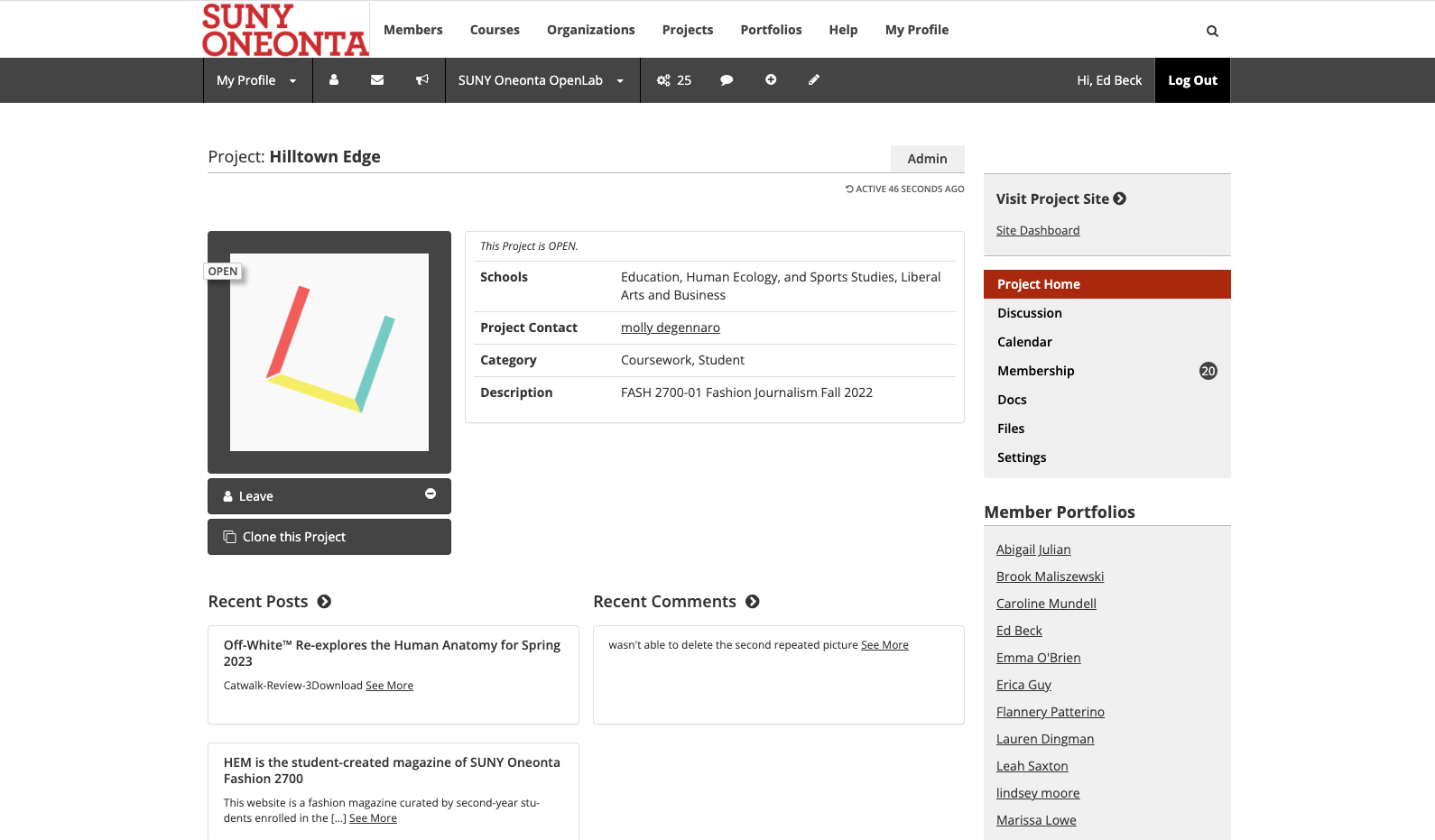
Not exactly. Our central hub is oneonta.sunycreate.cloud which is a WordPress Multisite. The Multisite hub allows sites to be connected as courses, projects, organizations, or portfolios.
Each site has a project page that has feeds coming in from our discussion boards, blog feeds, links to member portfolios.
We use BuddyPress, so individuals can friend and follow each others portfolios and get internal notifications or email alerts from new posts.
@ed_beck Nice!
We use Multisite for course materials. Learners can register their blog URL for harvesting tagged blog posts into our course feed which syndicates forum posts, hypothesis annotations, Mastodon posts etc. @lightweight Has coded a handy blog feed finder. See: https://tech.oeru.org/oeru-blog-feed-finder
@ed_beck I'm of the opinion setting up and managing web services *without* employing a 'simplified' system (e.g. yunohost, sandstorm, etc.) is way easier than the vast majority of people think. I've tried to lay out the logic of it in many tutorials here: https://tech.oeru.org - there are a few common approaches are largely replicated across all #FOSS services.
So my institution pays for a service where I can give Shared Hosting accounts that faculty staff and students can manage their own cPanel- install applications like Moodle, WordPress, Omeka, Scalar, Drupal.
It's limited to LAMP applications. But its strengths are that I can foot the bill, manage accounts, impersonate users, help with troubleshooting, but focus on teaching the basics.
If I could manage users and support docker, I'd be interested to grow beyond LAMP.
@ed_beck For what it's worth, I ran a company that provided those sorts of services for 14 years until I sold it about 10 years ago. We weren't education-focused, although we did only work with #FOSS. We also did a lot of bespoke development, mostly Drupal and Ruby-on-Rails. Since then, I've moved to container-based deployment using Docker (I previously used virtualisation and used LXC for a while). It's a powerful model.
I think of our approach in tiers- The lowest is providing or using web tools, tier 2 is getting a website or homepage for your project, tier 3 is taking over the backend management of a simple LAMP environment, tier 4 is where you live, in containerized, modern infrastructure.
Right now we manage around 1,000 sites, evenly split between tier 2 and tier 3.
@mguhlin @ed_beck @lightweight @8petros We are planning to implement the concept of 'federated' courses where institutions each have their own WordPress course site instances with interactions of learners around the world distributed across the fediverse. Some interaction tools hosted by institutions and others forming part of a shared FOSSDLE Commons. These interactions will be syndicated into a course feed on each course site.

@mguhlin @lightweight @8petros @mackiwg
I wrote a blog post on this topic 2 years ago... Since then, one of my main points has disappeared with MoodleNet's ability to share content between servers, but I think people spend a lot of time and energy trying to make WordPress behave more like an LMS, and I just wish the Open Community spent the same time and energy to make the most popular LMS a better open publishing tool.
https://ed-beck.com/moodle/why-moodle-should-be-the-next-great-oer-tool/