
> _“You cannot however use science alone to take it.”_
Challenge accepted!
> _“You must first of all decide whether wealth transfer or social intervention are things that should be done, that is, if you think it is a moral and acceptable thing.”_
**Economics**: a (social) science. It studies the allocation of scarce resources (in this case, money), and in doing so provides answers to the eternal conflict between _efficiency_ (economic growth) and _equity_ (redistribution) — which is at the root of my hypothetical scenario. Necessary here.
**Moral philosophy**: a (soft) science. The study of ethics. Definitely helpful for this example too, to help disentangle questions of “is vs ought” that Economics alone can't resolve.
**Political science** (it's in the name): concerned with systems of governance and power (redistribution is implemented within those systems).
**History**: a (soft) science studying the past, and change. Because redistribution measures have been proposed or implemented before. (How did they work, what happened?)
**Medicine** (focused on physical health) and **psychology** (because individuals react to the status quo, and to proposed policies). We're trying to optimise human well-being here, after all. **Sociology** too, because _societies_ as a whole react to the status quo and to proposed policies also.
Underpinning it all: **mathematics** (especially **statistics**). **Chaos theory** to better understand market dynamics under the proposed changes.
Throw into the mix also **computer science** (to run simulations of public policies and changes in incentives). Heck, even the systematic study of **literature** [would provide useful inputs here](https://en.wikipedia.org/wiki/Project_Cassandra_(literature)).
These are all “sciences” (admittedly, under a lax definition of “science”) — in any case, definitely closer to the realm of science than to any of the other epistemic systems we've mentioned (tradition, intuition, religion, etc).
There you are. What else do you need to work on this problem and come to a solution, other than #science?


@tripu @rastinza @ImperfectIdea History is not science. It may use empirical tools, but it's goal is not scientific. The purpose of history is to document and develop narratives of the past, specifically about human events. It does not purport to try and understand humans themselves (psychology), society as a whole (sociology), or even predict future human events (economics, political science, game theory, etc).
Sure, history can be used in scientific ways, but calling history a science dilutes the meaning of science and conflates science as the end all be all of knowledge (scientism).
@tripu @rastinza @ImperfectIdea a couple of other notes:
1) Chaos theory would not be a good tool for analysing these types of problems. Discrete simulations would be better, or even stochastic differential equations. Chaos theory deals with deterministic nonlinear differential equations with sensitive initial conditions.
2) Despite the name, computer science is not a science, and literature is most definitely not.
3) Your question "What else do you need to work on this problem and come to a solution, other than #science?" shows that you do not know the purpose of science which is to understand nature, not come up with solutions.
Honestly, this toot illustrates a native understanding of science and reeks of scientism.
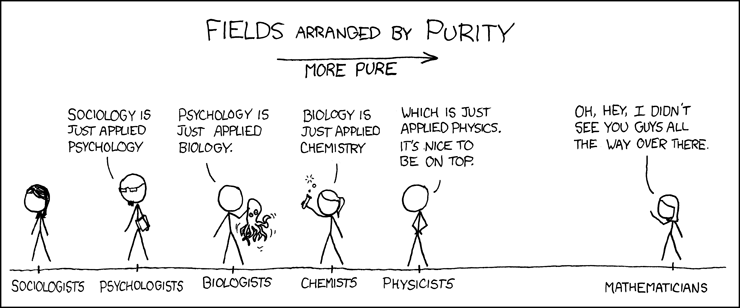
Come on, we are talking degrees here. We all know [there is only one pure science](https://xkcd.com/435/), and everything else is more or less a farse :)
@rastinza @tripu @ImperfectIdea
I'd clarify a little more: science uses inductive reasoning while mathematics uses deductive reasoning. I wouldn't entirely classify mathematics as philosophy due to mathematics' rigor, but yes, I would not clarify mathematics as a science.
