
> _“You cannot however use science alone to take it.”_
Challenge accepted!
> _“You must first of all decide whether wealth transfer or social intervention are things that should be done, that is, if you think it is a moral and acceptable thing.”_
**Economics**: a (social) science. It studies the allocation of scarce resources (in this case, money), and in doing so provides answers to the eternal conflict between _efficiency_ (economic growth) and _equity_ (redistribution) — which is at the root of my hypothetical scenario. Necessary here.
**Moral philosophy**: a (soft) science. The study of ethics. Definitely helpful for this example too, to help disentangle questions of “is vs ought” that Economics alone can't resolve.
**Political science** (it's in the name): concerned with systems of governance and power (redistribution is implemented within those systems).
**History**: a (soft) science studying the past, and change. Because redistribution measures have been proposed or implemented before. (How did they work, what happened?)
**Medicine** (focused on physical health) and **psychology** (because individuals react to the status quo, and to proposed policies). We're trying to optimise human well-being here, after all. **Sociology** too, because _societies_ as a whole react to the status quo and to proposed policies also.
Underpinning it all: **mathematics** (especially **statistics**). **Chaos theory** to better understand market dynamics under the proposed changes.
Throw into the mix also **computer science** (to run simulations of public policies and changes in incentives). Heck, even the systematic study of **literature** [would provide useful inputs here](https://en.wikipedia.org/wiki/Project_Cassandra_(literature)).
These are all “sciences” (admittedly, under a lax definition of “science”) — in any case, definitely closer to the realm of science than to any of the other epistemic systems we've mentioned (tradition, intuition, religion, etc).
There you are. What else do you need to work on this problem and come to a solution, other than #science?

That's debatable: (good modern) moral philosophy tries to derive statements rationally from a parsimonious set of axioms (yes, there are axioms at the root of it, but as we said that's true of _any_ discipline).
But I'm willing to drop that one for the sake of making progress in the debate.
My question stands: what else do you need to work on this problem and come to a solution, other than #science?
/cc @ImperfectIdea

It is not, it's the founding base of science.
If you know nothing about the philosophy of science then you can not do science, because you don't know what you're doing.
If you're working in a scientific environment and you don't know nothing about this, I'm sorry, but you will have to reconsider your position and your competencies.
Either way, if you want to discuss about science you should know what science is and on what philosophical base it is founded on, so you should know what are the various theories regarding the philosophy of science.
It appears that you know nothing about it, thus start from here and branch out learning about the various things.
https://en.m.wikipedia.org/wiki/Philosophy_of_science
@tripu
@ImperfectIdea
I mean, there's a whole branch of philosophy dedicated to defining science and how it works.
If you work in science you should at least know what that is about; this is my opinion.
In my opinion, if you don't know that stuff then you are a bad scientists and I have a low esteem of you.
It's what I consider the base of the scientific method.
While you can do science without knowing the scientific method, I do believe it is proper to know what it is and how it works in order to conduct good research.
@tripu

@tripu @rastinza @ImperfectIdea History is not science. It may use empirical tools, but it's goal is not scientific. The purpose of history is to document and develop narratives of the past, specifically about human events. It does not purport to try and understand humans themselves (psychology), society as a whole (sociology), or even predict future human events (economics, political science, game theory, etc).
Sure, history can be used in scientific ways, but calling history a science dilutes the meaning of science and conflates science as the end all be all of knowledge (scientism).
@tripu @rastinza @ImperfectIdea a couple of other notes:
1) Chaos theory would not be a good tool for analysing these types of problems. Discrete simulations would be better, or even stochastic differential equations. Chaos theory deals with deterministic nonlinear differential equations with sensitive initial conditions.
2) Despite the name, computer science is not a science, and literature is most definitely not.
3) Your question "What else do you need to work on this problem and come to a solution, other than #science?" shows that you do not know the purpose of science which is to understand nature, not come up with solutions.
Honestly, this toot illustrates a native understanding of science and reeks of scientism.
> _“Computer science is not a science.”_
I happen to be a “computer scientist” (and also a “software engineer”).
It's debatable, and I understand your reasons for saying so. I myself have struggled with that question often.
At the same time, if computer scientists aren't scientists, _physicists and chemists aren't scientists either_:
> _“**Computer science has, by tradition, been more closely related to mathematics than physics, chemistry and biology.** This is because mathematical logic, the theorems of Turing and Godel, Boolean algebra for circuit design, and algorithms for solving equations and other classes of problems in mathematics played strong roles in the early development of the field. Conversely, computer science has strongly influenced mathematics, many branches of which have become concerned with demonstrating algorithms for constructing or identifying a mathematical structure or carrying out a function. […] For these reasons, some observers like to say that **computing is a mathematical science**.”_
— Peter Denning, “Computer Science: The Discipline” (2000).
> _“Literature is most definitely not.”_
I know, I know… I was applying the concept in a lax way…
> _“The purpose of science […] is to understand nature, not come up with solutions.”_
Uh?
If vaccines are not a “solution”, what is?
Does a researcher stop “doing science” the moment they complete their postdoc and focus on making a pacemaker slightly easier to maintain? Pacemakers are solutions, too. And more reliable, safer, smaller pacemakers are solutions to whatever shortcomings the previous solutions had.
Even a mathematician working on a better cake-cutting algorithm is working on a solution to something very specific and of human interest — and not so much in understanding natural phenomena.
_Of course_ #science is concerned with modifying reality (for the better!) as well as with understanding reality.
Human well-being is the ultimate magnitude of the natural world that anyone would want to optimise for, and science is the main tool we have for that.
@tripu @rastinza @ImperfectIdea
*Engineer sitting in the corner*: Am I a joke to you?
Reminded me of this joke as well:
https://www.neatorama.com/images/2008-12/mad-scientist-mad-engineers.jpg
All silliness aside, scientists can (and sometimes should) work on solutions for specific real world problems, but their work is no longer the textbook definition of science; that falls under engineering.
Your example of cake cutting problems falls under mathematical optimization, which although has a lot of real world applications, can be studied on its own.
> _“Scientists can (and sometimes should) work on solutions for specific real world problems, but their work is no longer the textbook definition of science; that falls under engineering.”_
If a physicist working on evaluating the impact of different interventions to tackle climate change, a psychologist proposing improvements to an existing type of therapy and a biologist manipulating genes to make a certain crop more nutritious are _not doing science_ according to that “textbook definition” of “science”, I'd say that definition is useless in practice.
> _“Your example of cake cutting problems falls under mathematical optimization, which although has a lot of real world applications, can be studied on its own.”_
I have the impression you are doing all kinds of contortions to avoid acknowledging the common-sense meaning of “science” that the vast majority of us have in our minds, especially when contrasted with other areas of knowledge or epistemic systems that are obviously _outside_ the purview of even the most loose concept of “science” imaginable (religion, tradition, intuition, authority, etc).
@tripu @rastinza @ImperfectIdea
According to Wikipedia ( https://en.m.wikipedia.org/wiki/Science ):
"Science is a systematic enterprise that builds and organizes knowledge in the form of testable explanations and predictions about the universe."
For engineering ( https://en.m.wikipedia.org/wiki/Engineering ):
"Engineering is the use of scientific principles to design and build machines, structures, and other items, including bridges, tunnels, roads, vehicles, and buildings. The discipline of engineering encompasses a broad range of more specialized fields of engineering, each with a more specific emphasis on particular areas of applied mathematics, applied science, and types of application."
I will admit that not all applications of science are engineering, but in general they are.
The examples you provide are applications of scientific knowledge. The physicist example falls under policy, not science (i.e., the physicist is not testing any hypothesis or expanding the field), and the psychologist example is actually closer to psychiatry (practioners of psychology, i.e., doctors).
Science has a very clear definition, and saying that its "common-sense" meaning is different is not helpful.
🙄
OK, you win. By exhaustion of the opponent. 😆
Please know that, from now on, wherever I use the loose word “science” I'm actually referring to “‘science’ plus ‘applications of scientific knowledge’ plus ‘engineering’”.
I don't even remind why we were splitting hairs like this.
Ah, yes. Let me rewrite once again:
> What else do you need to work on this problem and come to a solution, other than _science plus applications of scientific knowledge plus engineering_?
Coming back to my initial claim, my point is that:
* All those fields are quantitative, they rely heavily on math; and they at the very least _try_ to be evidence-based, to use reason, and to aim for objectivity.
* Wherever one draws the boundaries of “science”, all those fields are parsecs away from entirely different sets of tools that people often use for decision-making, both at the individual level and as a society (once again: religion, tradition, intuition, authority, etc).
* With the possible exception of moral philosophy, no extra ingredient is necessary, or even desirable, to improve the world or to aid in individual decision-making.
Come on, we are talking degrees here. We all know [there is only one pure science](https://xkcd.com/435/), and everything else is more or less a farse :)
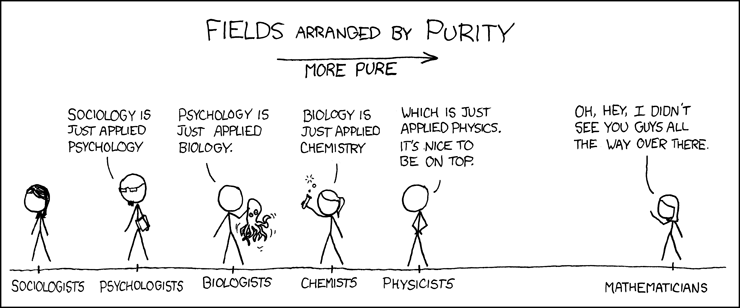
@tripu
Btw, I would not classify mathematics as science.
It's much more a branch of philosophy, definitely doesn't follow the scientific method.
@sojournTime @ImperfectIdea
Definitely the words “science” and “scientific” are not helping in this debate.
I suspect each of us thought the meaning of those words was clear, and that everybody else would agree with those definitions. Unfortunately, it's clear that they mean different things to different people and that we draw the boundaries in different places.
Let's try to move forward without relying on that specific word.
I stand by [my initial claim](https://qoto.org/@tripu/108376014503251403) slightly edited as so:
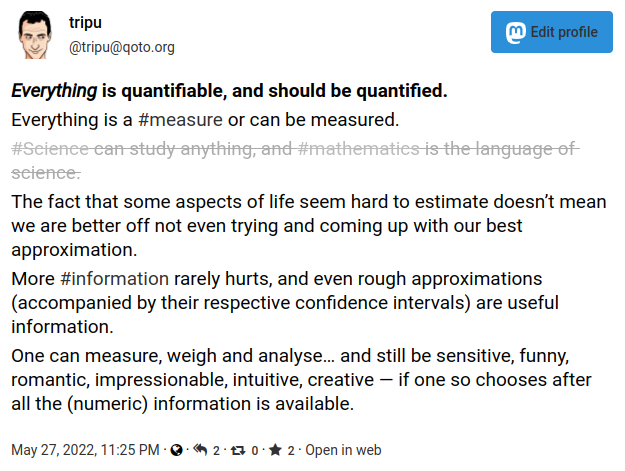
@tripu @rastinza @ImperfectIdea
Alright, let's start with a simple example where scientific reasoning fails (I'll assume that mathematical reasoning falls under this discipline). Suppose I proposed a choice: I give you $100 dollars guaranteed, or I flip a fair coin and if it lands on heads, I give you $200. Decision theory tells me that the expected value for both choices are $100 (1*$100=$100 vs. 0.5*$200=$100). So, there's no reason for me to choose either choice: they are both equally valued.
Now, suppose I changed the values to $1,000,000 and $2,000,000 respectively. Decision theory still tells me that both decisions are equally valued, but I would assume most people would choose the $1,000,000. Nothing in decision theory would have told me to make that choice. Yet it's pretty obvious why: $1,000,000 is life changing and risking a coin flip to get $2,000,000 is not worth the additional $1,000,000. Sure, maybe behavioral economics might be able to provide a better explanation, but it is definitely difficult to give a quantitative answer.
Now, let's change the prompt a little bit. Suppose instead there is a sinking ship, and a life boat has a maximum capacity of 100. If 200 people board the life boat, there is a 50% chance it will sink before it gets to safety. What decision should be made for the people on the ship? Again, decision theory states that both decisions are equivalent, but philosophically, they are not equivalent. I would argue no additional measurements or quantities would help make a more informed decision. This clearly falls into the realm of moral philosophy, not science.
Very interesting questions. Indeed those interest me especially (because I'm a rationalist, an utilitarian, and an effective altruist).
First of all, and most importantly: even if I were paralysed by those quandaries and were unable to offer a single helpful comment, that would _not_ prove that #SPAOSKPE (“science plus applications of scientific knowledge plus engineering”) don't suffice to solve them — it's much more likely that I personally lack the knowledge, training, intelligence or time to make any progress.
Still, some ideas about how a purely “scientific” mind could proceed:
The concept of risk can be studied and modelled mathematically. Mathematicians working for insurance companies and quants working in Wall St do that routinely.
Even if the expected value is constant in your scenarios, the risk is clearly not. It makes total sense that one always chooses the path that minimises risk, ceteris paribus. I think that criterion alone would “solve” these scenarios.
Now, I agree with you that “it is definitely difficult to give a quantitative answer”. Your scenarios are easy because the expected value is constant. It becomes more tricky if you say that 300 people boarding the life boat risks a 50% chance of everyone dying. Then the expected value changes, and we can't look at risk alone to break the tie.
I don't know how this gets modelled formally. But I do know that there are ways, and I very much doubt that risk departments in banks, nuclear safety agencies, public transport regulators and those tasked with allocating limited resources for public health rely mostly on their gut, scripture or prescient dreams.
@tripu @rastinza @ImperfectIdea
I don't know about banks, nuclear safety agencies, or public transport regulators, but I do know that public health most definitely uses moral philosophy and ethics to resolve resource allocation. This was very acutely applied during the pandemic:
https://qz.com/1821843/ethicists-agree-on-who-should-get-treated-first-for-coronavirus/
@sojournTime our only point (if I'm not mistaken about @tripu's argument) is that the best way to understand why moral philosophers and ethicists "agree on who should get treated first", and the best way to find out if that's actually the best answer or if there are better options, is by expanding our knowledge of the universe and of our brain through science and technology. I argue that moral philosophy is simply an infant science of human well-being.
@rastinza
@ImperfectIdea @tripu @rastinza
"An infant science of human well being" 😆
Tell me you don't understand moral philosophy without telling me you don't understand moral philosophy...
@sojournTime tell me you don't understand my argument with a laughing emoji. Let's leave it here, thanks.
@tripu @rastinza
I don't deny the valuable input provided by ethics as perhaps the only exception to my initial claim. And even so, as I said before, good modern moral philosophy tries very hard to be rational, evidence-based, objective, parsimonious, coherent and accurate (there's a lot of math there, in the form of estimates, stats, probability, logic, etc). Those traits may not suffice to qualify as “science”, but it surely gets much closer to “scientific” than “all the other stuff” (pre-modern philosophy, religion, hunches, tradition, etc).
In this article, there are nine mentions of “survival/dying odds/chance”, and a few references to “potential years of life” and to the age of the patients. All those are nothing but numbers: either well-known figures, estimates, probabilities, or approximations taken from actuarial tables.
Also, I want to highlight that the article mentions three different moral theories (utilitarianism, contractarianism, and deontology) and three people to represent or defend each… and the conclusion is that for all of them, it makes sense to give priority to those who are more likely to benefit from treatment over those with worse odds.
It's almost as if ethicists mostly agreed and had very little to contribute, once that consensus is reached.
Where is room for progress? In the numbers. Get more accurate analysis and thus better diagnoses, more precise survival chances, better estimations of the effects of different treatments… and the priority queue gets closer and closer to perfect.
@sojournTime
"no additional measurements or quantities would help make a more informed decision"
What do you mean? Knowing how many people are able to swim to safety or float long enough to be rescued would definitely help, for example...
@tripu @rastinza
Ah, yes. That too. I forgot to object to that sentence.
Expanding on what @ImperfectIdea said: as long as one can
* refine the model,
* consider more variables,
* measure more parameters,
* measure the same parameters but more accurately,
* run more simulations,
* find more instances of the same phenomenon in the past,
* or even survey more experts in the field,
definitely additional measurements would help.
@rastinza @tripu @ImperfectIdea
I'd clarify a little more: science uses inductive reasoning while mathematics uses deductive reasoning. I wouldn't entirely classify mathematics as philosophy due to mathematics' rigor, but yes, I would not clarify mathematics as a science.

@tripu
These are not sciences, since not all of those follow the scientific method.
Defining moral philosophy as science is laughable.
@ImperfectIdea