

Lup Yuen Lee 李立源 @lupyuen@qoto.org
- Pronouns/Gender/Sexuality
- He/Him/They, Bisexual/Asexual 🇸🇬
- Date of Birth
- 1969
- Articles
- https://lupyuen.org
IoT Techie and Educator / Apache NuttX PMC
Joined Jan 2020
#NuttX App compiled in Web Browser ... Runs OK with NuttX Emulator in Web Browser 🎉
Source: https://github.com/lupyuen/tcc-riscv32-wasm#nuttx-app-runs-in-a-web-browser
Accessing the #Pinecil UART with RP2040 probe (#RISCV BL706)
https://danielmangum.com/posts/risc-v-bytes-accessing-pinecil-uart-picoprobe/
"Unprivileged attackers can get Root Access on multiple major #Linux distributions in default configurations by exploiting a newly disclosed local Privilege Escalation (LPE) vulnerability in the GNU C Library (glibc)"
TCC Compiler in #WebAssembly compiles a #NuttX System Call ... In #RISCV Assembly! 👍
Here's how we enable Strong Ordering for Memory Mapped I/O ... On #Ox64 BL808 and T-Head C906
Article: https://lupyuen.codeberg.page/articles/plic3.html#enable-strong-order
Rules for Writing a Technical Book
"#HomeAssistant is now available on Apple CarPlay"
https://www.home-assistant.io/blog/2024/01/29/companion-app-for-ios-20241-carplay/
KDE Plasma 6 Test Week: "anyone can help ensure changes in Fedora #Linux work well in an upcoming release"
https://fedoramagazine.org/contribute-at-the-kde-plasma-6-test-week/
"#Purism announced they are facilitating a first public offering of shares ... They are aiming to raise money at a $75 million USD valuation"
Testing the #RISCV Lichee Console 4A (T-Head TH1520 / C910)
"#Amazon and iRobot mutually agreed to call off their planned Acquisition"
Why is TCC #RISCV Compiler hitting "Unknown Relocation Type 60"? 🤔
Source: https://github.com/lupyuen/tcc-riscv32-wasm#fix-missing-printf-in-nuttx-app
"The Rigor of Angels: Borges, Heisenberg, Kant, and the Ultimate Nature of Reality" by William Egginton
Inside the Memory Management Unit of #Ox64 BL808 SBC ... And how it controls Strong Ordering
Article: https://lupyuen.codeberg.page/articles/plic3.html#memory-management-unit
@popolon That's very helpful, thanks for the tip! :-)
Lup Yuen Lee 李立源
boosted


@lupyuen I don't know if this can help, but "li" assembly mnemonic is a pseudocode that can be converted to several real RISC-V mnemonics, including addi rd,x0,imm. on the other side, gnu objdump and gdb (that use objdump to disassemble) disassemble addi rd,x0,imm as li rd,imm by default:
objdump -d <binary>
To display real instruction, the option -M no-aliases is needed:
objdump -d -M no-aliases <binary>
on a x86_64/armv8 etc...:
riscv64-elf-objdump -d -M no-aliases <binary>
or
riscv32-elf-objdump -d -M no-aliases <binary>
Depending on target binary. Sadly, didn't found this option in gdb disassemble command.
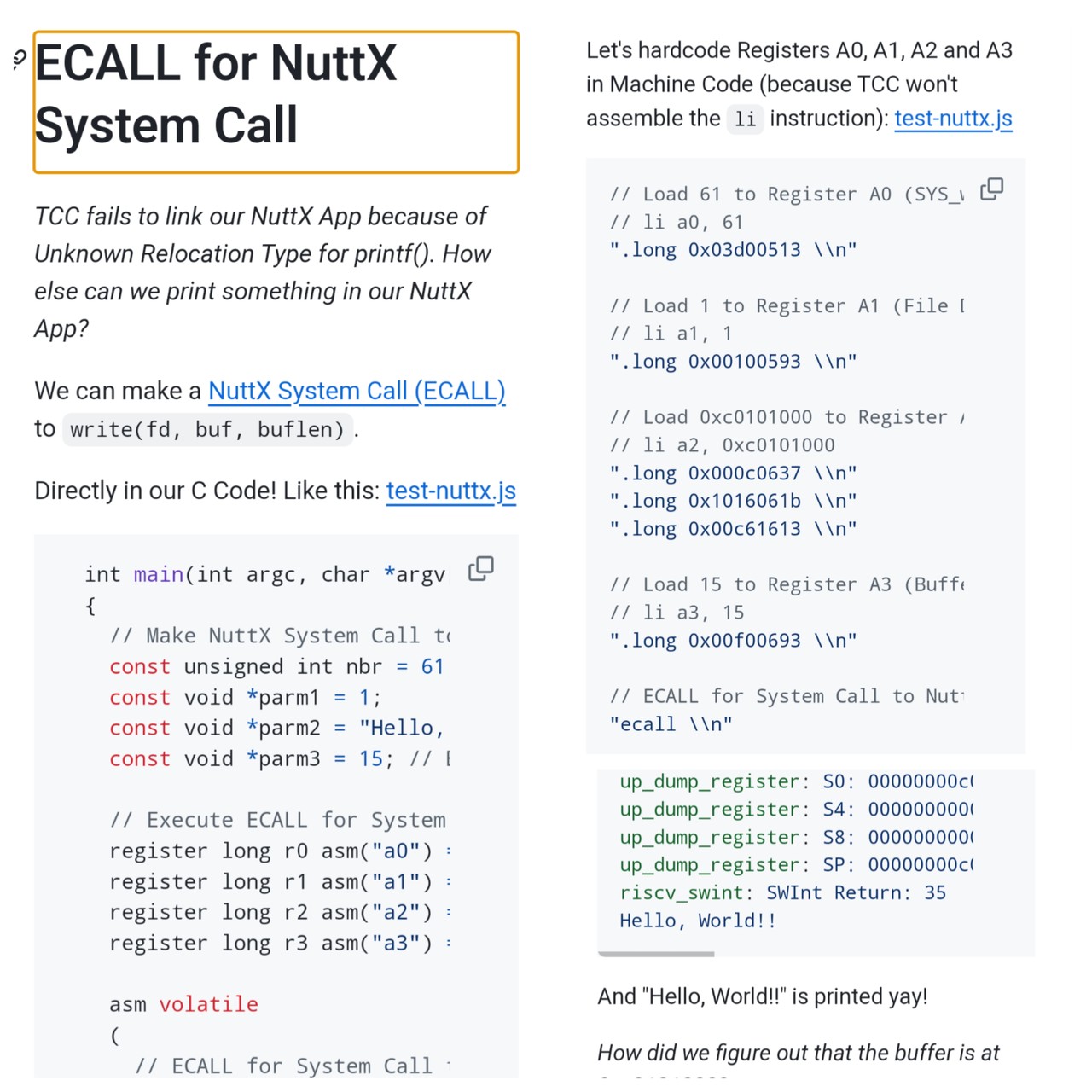
TCC Compiler Output (from #WebAssembly) prints "Hello World" in Apache #NuttX RTOS! 🎉 ... But needs painful #RISCV Assembly 🤔
Source: https://github.com/lupyuen/tcc-riscv32-wasm#ecall-for-nuttx-system-call
Here's how Apache #NuttX RTOS links a NuttX App
Source: https://github.com/lupyuen/tcc-riscv32-wasm#how-nuttx-build-links-a-nuttx-app

TCC Compiler in WebAssembly has generated a #RISCV ELF ... Let's run it on Apache #NuttX RTOS!
Source: https://github.com/lupyuen/tcc-riscv32-wasm#test-tcc-output-with-nuttx

- Pronouns/Gender/Sexuality
- He/Him/They, Bisexual/Asexual 🇸🇬
- Date of Birth
- 1969
- Articles
- https://lupyuen.org
IoT Techie and Educator / Apache NuttX PMC
Joined Jan 2020
