

rastinza @rastinza@qoto.org
Italian, MSc in chemistry specialized in cheminformatics and QSAR.
I'm interested in cooking and building stuff.
I love traveling, I lived in India, China, Slovenia, Poland and Spain.
Currently working in Spain in the field of genomics; and doing a PhD in Drug Development using Quantum Mechanics and Artificial Intelligence.
Don't take what I say as an insult, I have no bad intentions and I'm open to talk about it.
Don't star my toots, I find that often useless: if you liked it send a reply.
Consider boosting the toots, it's the only real way in which stuff is propagated through mastodon.
Joined Feb 2022
@fr @ndocist Scholar communications are thought for experts. People who are not experts in the field might misunderstand them or fail to see the bigger picture.
I'm not saying it should be forbidden to the common people to read the articles, that is in fact useful; but an expert explaining the findings is not just added value, it's almost necessary to understand the findings themselves.
That, unless you suggest everyone should become an expert on any topic discussed.
As an example: say they discover a new method to produce ammonia, which is cheaper than the Haber-Bosh process.
I wouldn't suggest people to read articles about that, but rather an expert to explain what it is and why it's important.
That's because to understand the importance of an improvement over the Haber-Bosh process one would first have to read such article, which would be a highly technical physics and chemistry paper, this paper would probably use methodologies developed in other papers, thus to fully understand it you'd have to read some other 10-20 articles, then get informed about the amount of ammonia produced in the world, understand how this ammonia is used, estimate what would be the price to produce the ammonia and how big is the improvement etc. etc.
This is possible, but it is unrealistic to expect everyone to do it. A much better alternative, in my opinion, is having an expert explain all these things; and then if you're interested take a look at the paper to see how this new method works.
rastinza
boosted

@rastinza @erinnacland @MatteoCarandini @academicchatter
Yes indeed, it is a long road until researchers take back the whole of their publishing activity. Yet, there is hope. For instance, in France, almost two thirds of the papers published in 2020 are open, and it is growing.
You can find all the details here, in French and in English : https://barometredelascienceouverte.esr.gouv.fr/
@fr @ndocist I don't believe the language to be the major problem to solve in the communication between scholars, citizens and decision makers.
Generally citizens and decision makers listen to scientists from their country, which will translate the scientific consensus into their language. This is a good way regarding how the information is provided, much better in my opinion than decision makers and citizens reading the articles themselves; which is what you seem to be implicitly suggesting.
Might help a little bit, I'm unsure this little improvement is worth the effort.
@fresseng @erinnacland @MatteoCarandini @academicchatter Indeed, but it's still unclear how it would work on a large scale and how it would substitute commercial publishers.
The fact that it has been theorized and applied in some occasions still doesn't make it an alternative.
Sci-Hub is currently an alternative to commercial publishers.
Openscience is hopefully what's going to substitute this system, but the path to reach that is unclear.
@mattjhodgkinson @erinnacland @MatteoCarandini @academicchatter Indeed the second one is what I meant.
@erinnacland @MatteoCarandini @academicchatter Sci-Hub has allowed this to happen, now we have to find a viable alternative to Sci-Hub.
@sladner @rhgrouls @qui_oui @erinnacland There is a function in Zotero to do that semi automatically.
rastinza
boosted

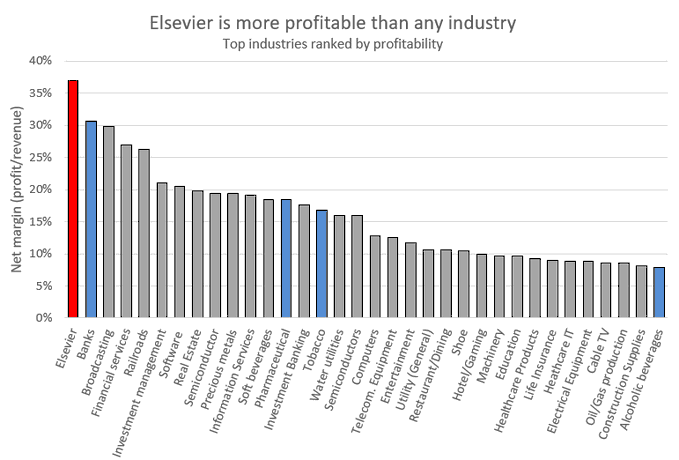
Starting 2023, four universities are pausing or ending their Elsevier subscription due to exorbitant pricing.
Elsevier's subscription was costing them ~10% of their Libraries' entire budget.
"Elsevier’s prices have increased each year and have outpaced inflation"...this is despite Elsevier having the highest profit margins of virtually any other industry or publisher.
via https://www.dailyemerald.com/news/pressing-pause-on-elsevier-subscription/article_93c07dec-9120-11ed-8ce9-abbca97ab954.html
Figure via @MatteoCarandini
#OpenScience #AcademicPublishing #Science @academicchatter
@marghera Looks interesting, I'll see if I can find something like this. Right now I don't wish to invest a bunch of money in this, as long as they grow it's fine, but if I stumble on something like this I'll think about it.
rastinza
boosted

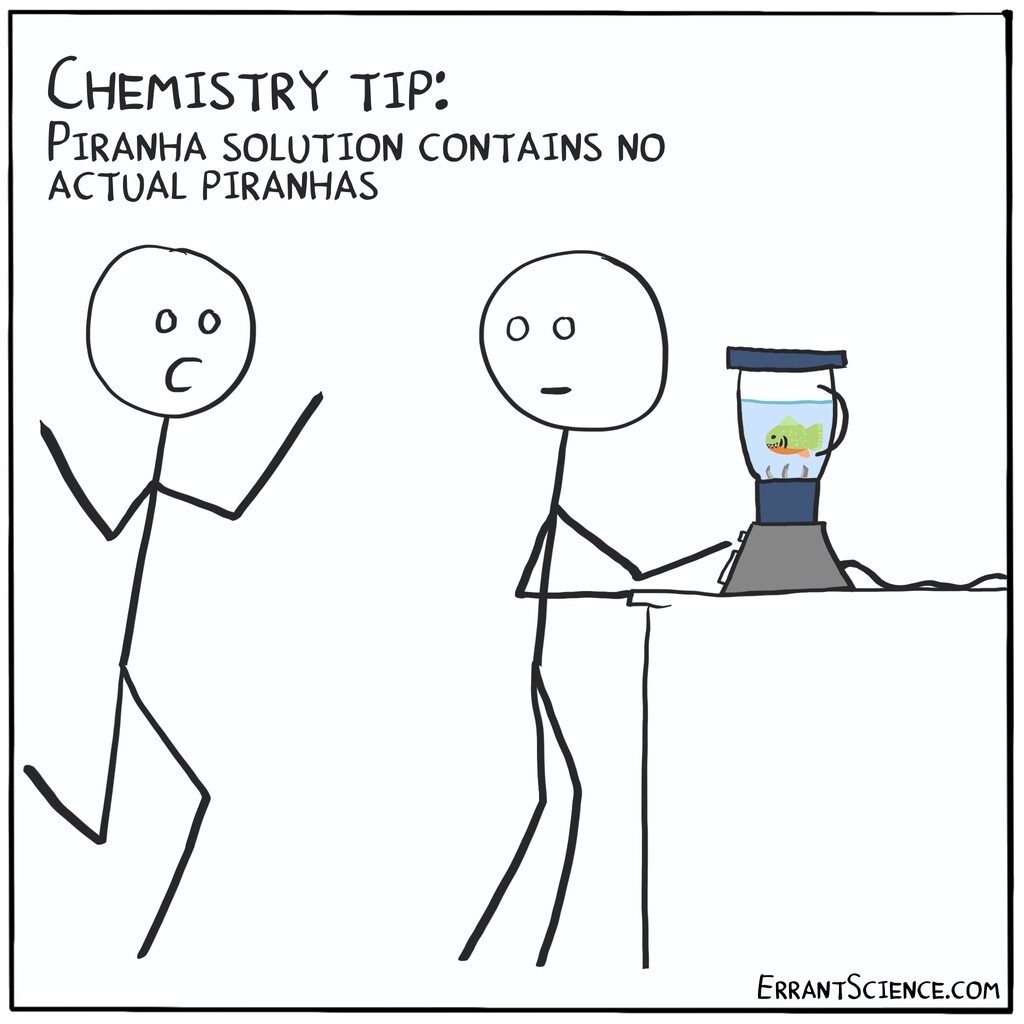
@errantscience Until you start dissolving piranhas in piranha solution.
@marghera I got some oyster mushrooms.
I guess I could just buy a plastic box and use that to control the environment, but I'm quite unsure how an heated pad might help since it would still need ventilation and the room containing it is not heated.
Outside temperature during the day is around 10°C and I guess room temperature might be slightly above that.
Do you believe it may grow at these temperatures? I'm not really aiming for the best yield, as long as I get something out of it it's fine.
@Rajumisra @Lost_World Originally it was to feature much more green areas and a well though out service distribution over the territory.
They had to change that because of the growing population and the big problem of Barcelona being that it is surrounded by mountains and thus cannot expand its dimensions.
@libreleah I like rsync very much for backups, but for actual syncing I prefer unison which simplifies a lot the procedure.
@Durruti Why was she accused of forming a criminal association?
Being antifascist doesn't relieve you from crimes: if you organize squads to go find and beat up fascists, I would argue that is a criminal association in fact.
My apartment is quite humid, thus I decided to buy some mushrooms to grow in here.
I'm hoping the temperatures will be high enough since I have not heating...
Let's see if I get to eat any!
@Rajumisra @Lost_World A pity they ruined the original plan... but still amazingly came out.
@lunascaped Is it just a timer?
rastinza
boosted

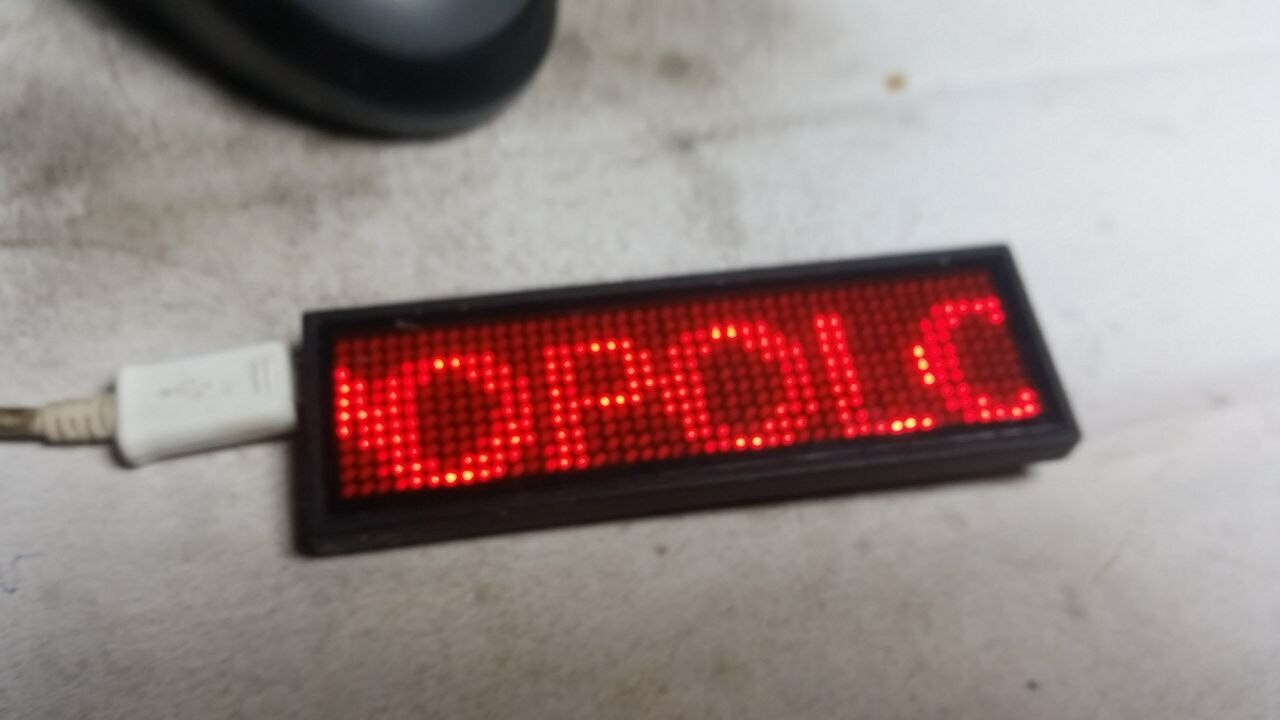
Qualche persona qui ha già provato a collegare a Linux un badge a led con testo scorrevole?
Ci si possono caricare 8 messaggi, ma il programmino che lo fa è solo per Windows.
Il comando lsusb lo identifica come
Bus 001 Device 007: ID 0483:5750 STMicroelectronics
Italian, MSc in chemistry specialized in cheminformatics and QSAR.
I'm interested in cooking and building stuff.
I love traveling, I lived in India, China, Slovenia, Poland and Spain.
Currently working in Spain in the field of genomics; and doing a PhD in Drug Development using Quantum Mechanics and Artificial Intelligence.
Don't take what I say as an insult, I have no bad intentions and I'm open to talk about it.
Don't star my toots, I find that often useless: if you liked it send a reply.
Consider boosting the toots, it's the only real way in which stuff is propagated through mastodon.
Joined Feb 2022
