
> _“You cannot however use science alone to take it.”_
Challenge accepted!
> _“You must first of all decide whether wealth transfer or social intervention are things that should be done, that is, if you think it is a moral and acceptable thing.”_
**Economics**: a (social) science. It studies the allocation of scarce resources (in this case, money), and in doing so provides answers to the eternal conflict between _efficiency_ (economic growth) and _equity_ (redistribution) — which is at the root of my hypothetical scenario. Necessary here.
**Moral philosophy**: a (soft) science. The study of ethics. Definitely helpful for this example too, to help disentangle questions of “is vs ought” that Economics alone can't resolve.
**Political science** (it's in the name): concerned with systems of governance and power (redistribution is implemented within those systems).
**History**: a (soft) science studying the past, and change. Because redistribution measures have been proposed or implemented before. (How did they work, what happened?)
**Medicine** (focused on physical health) and **psychology** (because individuals react to the status quo, and to proposed policies). We're trying to optimise human well-being here, after all. **Sociology** too, because _societies_ as a whole react to the status quo and to proposed policies also.
Underpinning it all: **mathematics** (especially **statistics**). **Chaos theory** to better understand market dynamics under the proposed changes.
Throw into the mix also **computer science** (to run simulations of public policies and changes in incentives). Heck, even the systematic study of **literature** [would provide useful inputs here](https://en.wikipedia.org/wiki/Project_Cassandra_(literature)).
These are all “sciences” (admittedly, under a lax definition of “science”) — in any case, definitely closer to the realm of science than to any of the other epistemic systems we've mentioned (tradition, intuition, religion, etc).
There you are. What else do you need to work on this problem and come to a solution, other than #science?


@tripu @rastinza @ImperfectIdea History is not science. It may use empirical tools, but it's goal is not scientific. The purpose of history is to document and develop narratives of the past, specifically about human events. It does not purport to try and understand humans themselves (psychology), society as a whole (sociology), or even predict future human events (economics, political science, game theory, etc).
Sure, history can be used in scientific ways, but calling history a science dilutes the meaning of science and conflates science as the end all be all of knowledge (scientism).
@tripu @rastinza @ImperfectIdea a couple of other notes:
1) Chaos theory would not be a good tool for analysing these types of problems. Discrete simulations would be better, or even stochastic differential equations. Chaos theory deals with deterministic nonlinear differential equations with sensitive initial conditions.
2) Despite the name, computer science is not a science, and literature is most definitely not.
3) Your question "What else do you need to work on this problem and come to a solution, other than #science?" shows that you do not know the purpose of science which is to understand nature, not come up with solutions.
Honestly, this toot illustrates a native understanding of science and reeks of scientism.
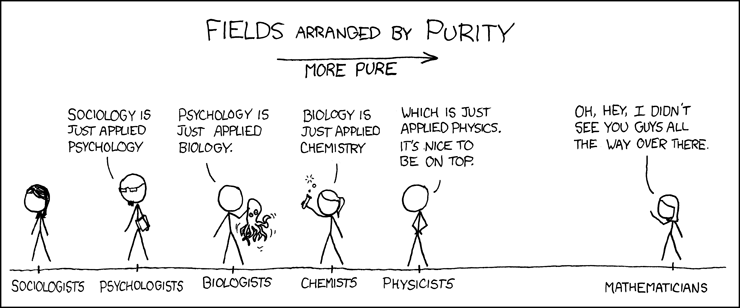
Come on, we are talking degrees here. We all know [there is only one pure science](https://xkcd.com/435/), and everything else is more or less a farse :)
@tripu
Btw, I would not classify mathematics as science.
It's much more a branch of philosophy, definitely doesn't follow the scientific method.
@sojournTime @ImperfectIdea
Definitely the words “science” and “scientific” are not helping in this debate.
I suspect each of us thought the meaning of those words was clear, and that everybody else would agree with those definitions. Unfortunately, it's clear that they mean different things to different people and that we draw the boundaries in different places.
Let's try to move forward without relying on that specific word.
I stand by [my initial claim](https://qoto.org/@tripu/108376014503251403) slightly edited as so:
@tripu @rastinza @ImperfectIdea
Alright, let's start with a simple example where scientific reasoning fails (I'll assume that mathematical reasoning falls under this discipline). Suppose I proposed a choice: I give you $100 dollars guaranteed, or I flip a fair coin and if it lands on heads, I give you $200. Decision theory tells me that the expected value for both choices are $100 (1*$100=$100 vs. 0.5*$200=$100). So, there's no reason for me to choose either choice: they are both equally valued.
Now, suppose I changed the values to $1,000,000 and $2,000,000 respectively. Decision theory still tells me that both decisions are equally valued, but I would assume most people would choose the $1,000,000. Nothing in decision theory would have told me to make that choice. Yet it's pretty obvious why: $1,000,000 is life changing and risking a coin flip to get $2,000,000 is not worth the additional $1,000,000. Sure, maybe behavioral economics might be able to provide a better explanation, but it is definitely difficult to give a quantitative answer.
Now, let's change the prompt a little bit. Suppose instead there is a sinking ship, and a life boat has a maximum capacity of 100. If 200 people board the life boat, there is a 50% chance it will sink before it gets to safety. What decision should be made for the people on the ship? Again, decision theory states that both decisions are equivalent, but philosophically, they are not equivalent. I would argue no additional measurements or quantities would help make a more informed decision. This clearly falls into the realm of moral philosophy, not science.
Very interesting questions. Indeed those interest me especially (because I'm a rationalist, an utilitarian, and an effective altruist).
First of all, and most importantly: even if I were paralysed by those quandaries and were unable to offer a single helpful comment, that would _not_ prove that #SPAOSKPE (“science plus applications of scientific knowledge plus engineering”) don't suffice to solve them — it's much more likely that I personally lack the knowledge, training, intelligence or time to make any progress.
Still, some ideas about how a purely “scientific” mind could proceed:
The concept of risk can be studied and modelled mathematically. Mathematicians working for insurance companies and quants working in Wall St do that routinely.
Even if the expected value is constant in your scenarios, the risk is clearly not. It makes total sense that one always chooses the path that minimises risk, ceteris paribus. I think that criterion alone would “solve” these scenarios.
Now, I agree with you that “it is definitely difficult to give a quantitative answer”. Your scenarios are easy because the expected value is constant. It becomes more tricky if you say that 300 people boarding the life boat risks a 50% chance of everyone dying. Then the expected value changes, and we can't look at risk alone to break the tie.
I don't know how this gets modelled formally. But I do know that there are ways, and I very much doubt that risk departments in banks, nuclear safety agencies, public transport regulators and those tasked with allocating limited resources for public health rely mostly on their gut, scripture or prescient dreams.
@tripu @rastinza @ImperfectIdea
I don't know about banks, nuclear safety agencies, or public transport regulators, but I do know that public health most definitely uses moral philosophy and ethics to resolve resource allocation. This was very acutely applied during the pandemic:
https://qz.com/1821843/ethicists-agree-on-who-should-get-treated-first-for-coronavirus/

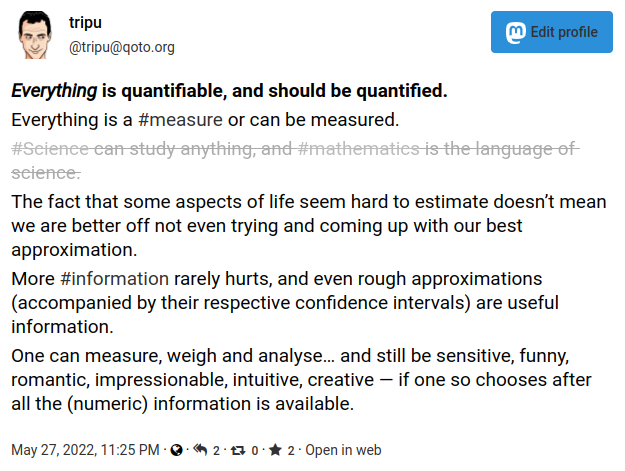
@ImperfectIdea @tripu @rastinza
"An infant science of human well being" 😆
Tell me you don't understand moral philosophy without telling me you don't understand moral philosophy...

@sojournTime tell me you don't understand my argument with a laughing emoji. Let's leave it here, thanks.
@tripu @rastinza