volkris @volkris@qoto.org
I think the most pressing and fundamental problem of the day is that people lack a practically effective means of sorting out questions of fact in the larger world. We can hardly begin to discuss ways of addressing reality if we can't agree what reality even is, after all.
The institutions that have served this role in the past have dropped the ball, so the next best solution is talking to each other, particularly to those who disagree, to sort out conflicting claims.
Unfortunately, far too many actively oppose this, leaving all opposing claims untested. It's very regressive.
So that's my hobby, striving to understanding the arguments of all sides at least because it's interesting to see how mythologies are formed but also because maybe through that process we can all have our beliefs tested.
But if nothing else, social media platforms like this are chances to vent frustrations that on so many issues both sides are obviously wrong ;)
Joined Dec 2022
Even if that's right, which is an enormous assumption, they would only collect back a portion of the money being used to buy other things.
The argument is that the states will lose funding as they make money through tax policies and loan servicing operations. Should the loans be forgiven, they will lose those revenues and take a hit to their budgets.
The lower court agreed with this, finding that the budgetary harm would give them standing.
This isn't a new challenge, though.
Democrats held Congress for years and didn't get around to addressing it, which was a major disappointment. Most of those who failed were reelected.
We can't just blame the GOP for this. We keep choosing to reelect representatives who have failed us.
@SteveLemson@mindly.social
Keep in mind that other lower courts have already made their rulings.
It's not just up to a single court in the US system.
One way people look at it is that the revenues being given up through forgiveness will have to be made up by other taxpayers. That's a common way to think about this sort of thing in the US.
In that sense, yes, those who paid off their loans are losers as they'll have to pay more while not receiving the benefit of forgiveness.
FWIW, I don't believe CWs should be routine but instead should be exceptional. Routine political posts shouldn't have CWs, though politeness would suggest a hashtag.
The reason I have this opinion is for the sake of empowering end users.
We can control how our feeds look by filtering on hashtags, and we can even make that precise through filters based on combinations of hashtags.
But CWs are blunt, harder to filter effectively, and give some control over the feed to the author's idea of what we do and don't want to see.
Make sense?
@Huck@mstdn.party @carnage4life
The official BLS numbers show significant numbers of people having stopped looking for work, having dropped out of the labor force.
WHY people have stopped looking for work is separate from the observation that they have.
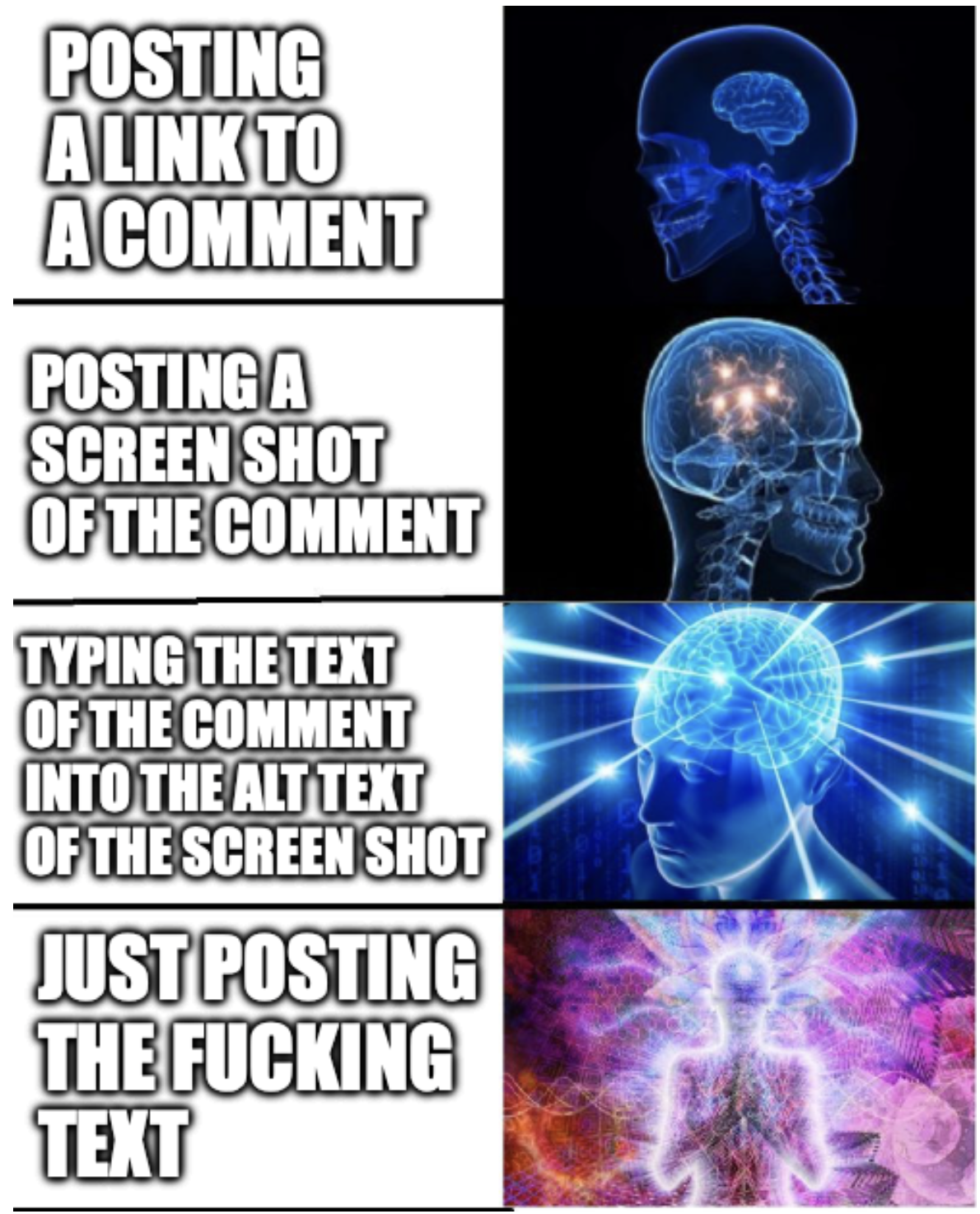
So we can read the text in the image?

The headline was about workers who were missing. Those that you cited are explained, not missing.
Articles like these, the legit ones anyway, have already factored in your points and note that there are still an awful lot of potential workers not in the labor force.
@Huck@mstdn.party @carnage4life
You're looking at the wrong statistic, though. The headline unemployment rate only counts people in the labor force, those who want to work, excluding those who've dropped out.
The more relevant statistic is the employment-population ratio, which does show fewer people in the laborforce than would be on-trend.
Basically, you were showing that people want to work by looking only at the people wanting to work and ignoring all of those who don't.
Also: that's not how inflation works.
But the article is talking about US workers, and the US BLS data show a significantly lower percentage of the population working.
Those aren't missing. We know exactly where they are... and they're not going anywhere anytime soon.
volkris
boosted

Last night the 11yo broke down the Google Slides middle school Chatroom for me:
1. At first they used a Google doc but the infinite scroll was too chaotic
2. In the slide deck each new slide is one “post”—some all text, some images, some both—
3. They use slides’ comments feature to “reply” to each other’s “posts”
4. This allows participants to easily flip between posts using the slide thumbnail navigation, so they can find the conversations they care about easily
5. He owns the file & if anyone spams it, deletes other people’s posts, or gets nasty, he can revert the file to its previous save state & remove the spammer’s access
6. He did share the file with me on purpose, I think because he was proud & wanted me to see what he’d made
Essentially they’ve created a chatroom with moderation in Google Slides, so they can get around the school’s ban on platforms like Discord. It’s kind of brilliant
It's not a very good argument for removing fares, though. The removal of fares would do no good outside of the accounting and rhetoric, leaving transit no better off under this argument.
It may be an argument to justify public spending on transit, but it doesn't say much about removing fares, which continue to have some positive impacts, just as do fees for roads.
@undefined @TCatInReality
I linked to the #CitizensUnited ruling above so that you can read directly from the Court that the case wasn't about caps or unlimited spending.
Like I said, there has been *so* much misreporting about this case over the years, leaving people so completely misinformed about what what it was about and what the ruling said.
To quote a one sentence summary from the intro:
"The Government may regulate corporate political speech through disclaimer and disclosure requirements, but it may not suppress that speech altogether."
So the #SCOTUS outright said government may regulate, and it's not about caps but about whether the #speech is to be disallowed completely.
Don't overlook the first half of the quotation that really emphasizes how government proposed to put up roadblocks to people trying trying to engage in the same speech that rich and powerful had either way..
It emphasizes that this wasn't about censorship of ideas but of individuals, which is squarely aimed at the administration's position that it would block speech based on the identity of the speaker.
The CU decision also emphatically and explicitly rejected the idea of completely unrestricted 1A freedom of speech. In the ruling the Court upheld restrictions!
You mischaracterized regulation of sources as regulation of ideas. They are not the same thing at all.
If the administration removes your, personal, ability to express yourself or my ability to listen to you, I would say that in itself is a problem, and that is what the ruling was ruling against.
The government may not censor you, it may not prevent you from speaking because of who you are.
The ruling was a very very clear that government can regulate campaigning in other ways. It just cannot censor based on identity of the speaker, choosing who is and isn't allowed to present their perspectives.
It's funny you say that when I found it striking how he left out that little voting thing that is practiced in the US.
So it was a summary of US Democracy that notably leaves out the Democracy part.
You did not.
I think the most pressing and fundamental problem of the day is that people lack a practically effective means of sorting out questions of fact in the larger world. We can hardly begin to discuss ways of addressing reality if we can't agree what reality even is, after all.
The institutions that have served this role in the past have dropped the ball, so the next best solution is talking to each other, particularly to those who disagree, to sort out conflicting claims.
Unfortunately, far too many actively oppose this, leaving all opposing claims untested. It's very regressive.
So that's my hobby, striving to understanding the arguments of all sides at least because it's interesting to see how mythologies are formed but also because maybe through that process we can all have our beliefs tested.
But if nothing else, social media platforms like this are chances to vent frustrations that on so many issues both sides are obviously wrong ;)
Joined Dec 2022
volkris's choices: