

Shamar @Shamar@qoto.org
Joined May 2019
Shamar
boosted

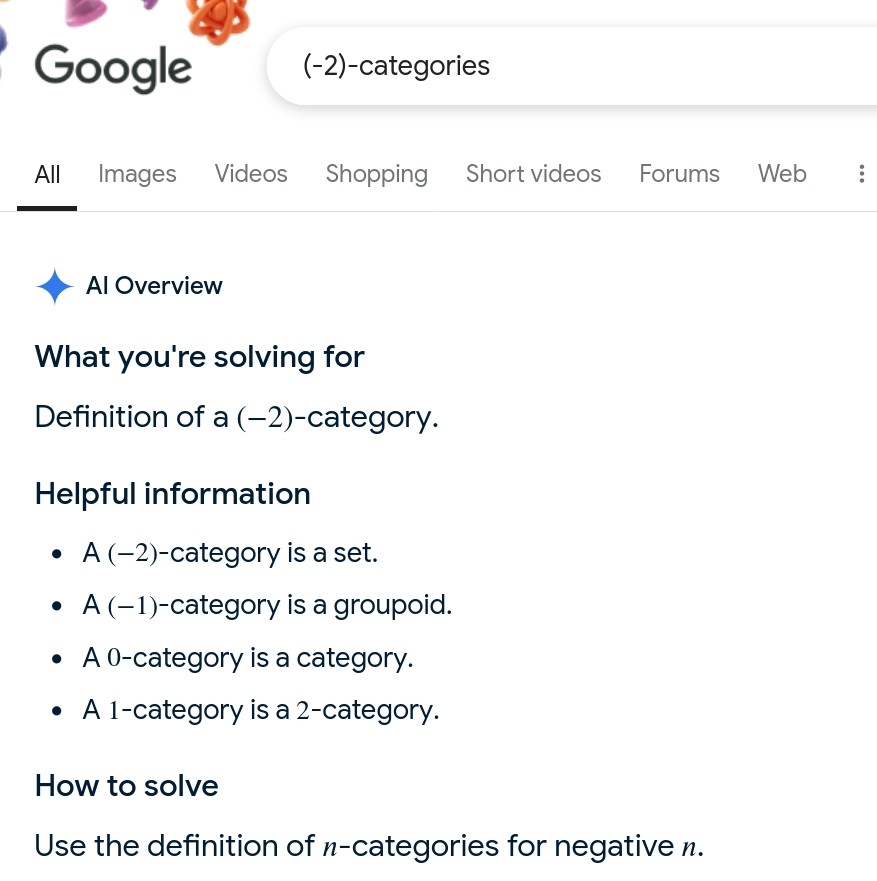
You also can't trust AI when it comes to n-categories!
In reality a 1-category is a category, a 0-category is a set, and James Dolan discovered that a (-1)-category is a truth value and a (-2)-category is a true truth value (of which there is only one: "true").
But my friend Allen Knutson asked Gemini, just for fun, and got this garbage. Clearly it's Russian propaganda.
(2/2)
Shamar
boosted
A test shows that all the leading AI chatbots have been infected by Russian propaganda created by an organization called the "Pravda network".
According to the American Sunlight Project, a failed attempt to protect democracy in the USA, the Pravda network put 3.6 million articles online in 2024. In a strategy called "LLM grooming", this network seems designed to manipulate AI models rather than directly influence people. It's mainly focused on spreading lies connected to the Ukraine war:
https://www.newsguardrealitycheck.com/p/a-well-funded-moscow-based-global
But on a lighter note...
(1/2)
Shamar
boosted

What is Manus? China’s World-First Fully Autonomous AI Agent Explained https://blog.quintarelli.it/2025/03/what-is-manus-chinas-world-first-fully-autonomous-ai-agent-explained/
Shamar
boosted


Abbandonare i servizi #Google per proteggere la #privacy e favorire gli sviluppatori indipendenti è possibile e auspicabile
Personalmente sono "Google free" da tempo, zero problemi e zero rimpianti
@itsfoss ha pubblicato una guida che si trova qui: https://itsfoss.com/leaving-google-ecosystem/
Ma a casa nostra abbiamo @lealternative (https://www.lealternative.net/), i @devol (https://devol.it/), @ufficiozero (https://ufficiozero.org/) che offorno o consigliano servizi alternativi, liberi ed etici
Let's switch over.
Shamar
boosted

Why people design a new #ProgrammingLanguage?
There are tons of good reasons of course. Some does that for fun or for curiosity, some for political or educational reasons, some to address shortcomings faced with existing one, either in specific use case or in general.To me, at least at the conscious level, it's completely a political issue.
I see how programming is a new political force (so much that I actively used it to fight #BigTech in Italy) and I see how people who cannot read (aka #debug) or write (aka #programing), are doomed to becomes second class citizens in a #cybernetic society.
I don't want this to happen to my daughters, so I want to teach them how to program and debug.
BUT mainstream programming languages are weird, full of accidental complexity and with over-complicated semantics.
As a nerd who can programs in most of them, I tend to get fun in the abstractions and details of, say, a #Haskell or an homoiconic macro in a #Lisp.
But while they are fun to a person grown (and selected to fit) within such a primitive computing environment, they are inheritely excluding people who cannot spend decades to grasp their subtle intricacies.
And how you can teach such languages to kids?
Sure they can learn and understand any programming language construct way better of an average adult, but at a first glance all they will only see is glibberish!
And while some will be fascinated by such esoteric language that can be used to create games, worlds and agents that serve their will (just like I was when I was a kid), most will find that complicated and thus boring.
On the other hand a language that is explicit and with simple semantics (such as say #Oberon) will seem verbose and boring to a professional programmer.
I love the simple clarity of a #snake implementation like this https://github.com/tmartiro/voc-snake/blob/main/Snake.Mod whose complexity is almost just the complexity of the task at hand.
And while I see little improvements I could add to such language to further simplify it's syntax and semantics, when I try to do so, I end with something that is less readable than the original, despite syntax and semantics being simpler (as in less rules and no exceptions or incoherence).
It was pointed out by @anzu@items.minimals.org: while I want to make the language easy to read and simple to understand, I subconsciously try to address the issues I faced in my ~25 years as a polyglot programmer.
And apparently I can't resist such impulse, like if I cannot escape my experience.
It's sad.
It makes me think of how the phonetic alphabet was invented by people who cannot read or write but were exposed to hierogliphs, and think that creating a democratic programming language is beyond my ability because of how my mind has been blent from the existing one.
@informatica@feddit.it @programmazione@feddit.it
@technology@lemmy.world
@programming_languages@programming.dev
Shamar
boosted

Shamar
boosted

Hoy un compañero de trabajo le ha puesto una transparencia en LaTeX a ChatGPT para ver si arreglaba una historia de numeración. El código sugerido eran el resto de texto de la presentación, que sólo había subido anteriormente a Overleaf de forma privada. Esto se suma a las evidencias de que ChatGPT se alimenta de repositorios privados de github.
Ahora mismo cualquier cosa en la nube de cualquier tipo es susceptible de haberse vendido a una IA generativa.
Para que lo tengáis en cuenta.
For some weird reason, the OVH server where @giacomo is running cannot connect to your host @mirabilos
Do you have any idea of why this might happen?
I can receive your toots so your server can reach my server, but apparently my server cannot reach your.
DNS resolution works fine (I get 92.205.130.109 from the server), but even curl cannot reach https://toot.mirbsd.org
Boosting from QOTO to reach you @mirabilos
Can you please check your HTTP logs (and maybe gotosocial logs) for a 599 response?
Shamar
boosted
Another interesting debug hint might obviously be the logs, that for the previous message show a
CC: @mirabilos@toot.mirbsd.org @grunfink@comam.es @informapirata@mastodon.uno
13:21:35 output message: sent to inbox https://toot.mirbsd.org/users/mirabilos/inbox (599 Unknown)
CC: @mirabilos@toot.mirbsd.org @grunfink@comam.es @informapirata@mastodon.uno
Shamar
boosted
Fine, I think it's time to evoke @grunfink@comam.es
Apparently @mirabilos@toot.mirbsd.org (running #GoToSocial) cannot receive my posts (from #snac2) while I can read his own and despite we follow each other.
Also, snac isn't linking his account when I mention him (I suppose this could be a good debug hint).
@informapirata@mastodon.uno
Apparently @mirabilos@toot.mirbsd.org (running #GoToSocial) cannot receive my posts (from #snac2) while I can read his own and despite we follow each other.
Also, snac isn't linking his account when I mention him (I suppose this could be a good debug hint).
@informapirata@mastodon.uno
bridging from QOTO
a weird thing is that snac2 does not link properly your @mirabilos account in my posts...
maybe this could be a debug hint for @grunfink ?
Shamar
boosted
@mirabilos@toot.mirbsd.org
I'm running latest snac2: https://codeberg.org/grunfink/snac2
@informapirata@mastodon.uno
I'm running latest snac2: https://codeberg.org/grunfink/snac2
@informapirata@mastodon.uno
Shamar
boosted
My new #fediverse home is @giacomo
Please, follow me there!
Thanks @mirabilos!
PS: sorry for the delay: these days I'm mostly active at my #snac instance at @giacomo
Shamar
boosted

Oooooh, this by @Shamar is also good:
There is no "learning" in "artificial neural network"
[…]
Such kind of virtual machines are composed of tiny devices that are improperly named "artificial neurons" or "perceptrons", but they are simply vector reducers […]
Such vector reducers can be easily composed in a variety of topologies and programmed in a variety of ways, so that a whole "artificial neural network" can be statistically programmed ("trained", in AI/ML parlance) to approximate one of the possible translations from a vector space to a different one.
Yet, there is no "learning" ongoing: just the iterative tuning of parametric vectors to approximate a certain output. […]
[…] In other words, an "artificial neural network" does not learn anything and it's not a network of neurons or anything like that. It does not understand anything about the data and the output vectors has no inherent meaning: its semantic is always attributed by humans according to their insights about the statistical program they uploaded into the vector mapping machine.
[…]
That's why it's statistical programming: you start with a source dataset (improperly named "training set" in the AI/ML parlance) and, after a compilation process that is specifically designed for that specific virtual machine, you get a binary that such machine can run.
While such binary is not constituted by a sequence of instructions, it's still just an algorithmic transformation of the original source that, despite being expressed as cryptic matrices, still contains all the relevant features of the sources.
The software run by a vector mapping machine is not a "model", since it does not give any insight about the relations it absorbed during its statistical programming. Instead it is just a software like any other that describes a rigorous (if unknown) process that a specific machine has to follow to automatically and deterministically compute (or rather approximate) a desired output from a given input.
The quotes are from the essay published by the author under this licence (which is nōn-FOSS, but it’s still worth a read).
Shamar
boosted

Copilot exposes private GitHub pages, some removed by Microsoft
Microsoft’s Copilot AI assistant is exposing the contents of more than 20,000 private GitHub repositories from companies including Google, Intel, Huawei, PayPal, IBM, Tencent and, ironically, Microsoft.
#microsoft #copilot #ai #privacy #surveillance #enshittification #tech #github #softwaredevelopment
Shamar
boosted


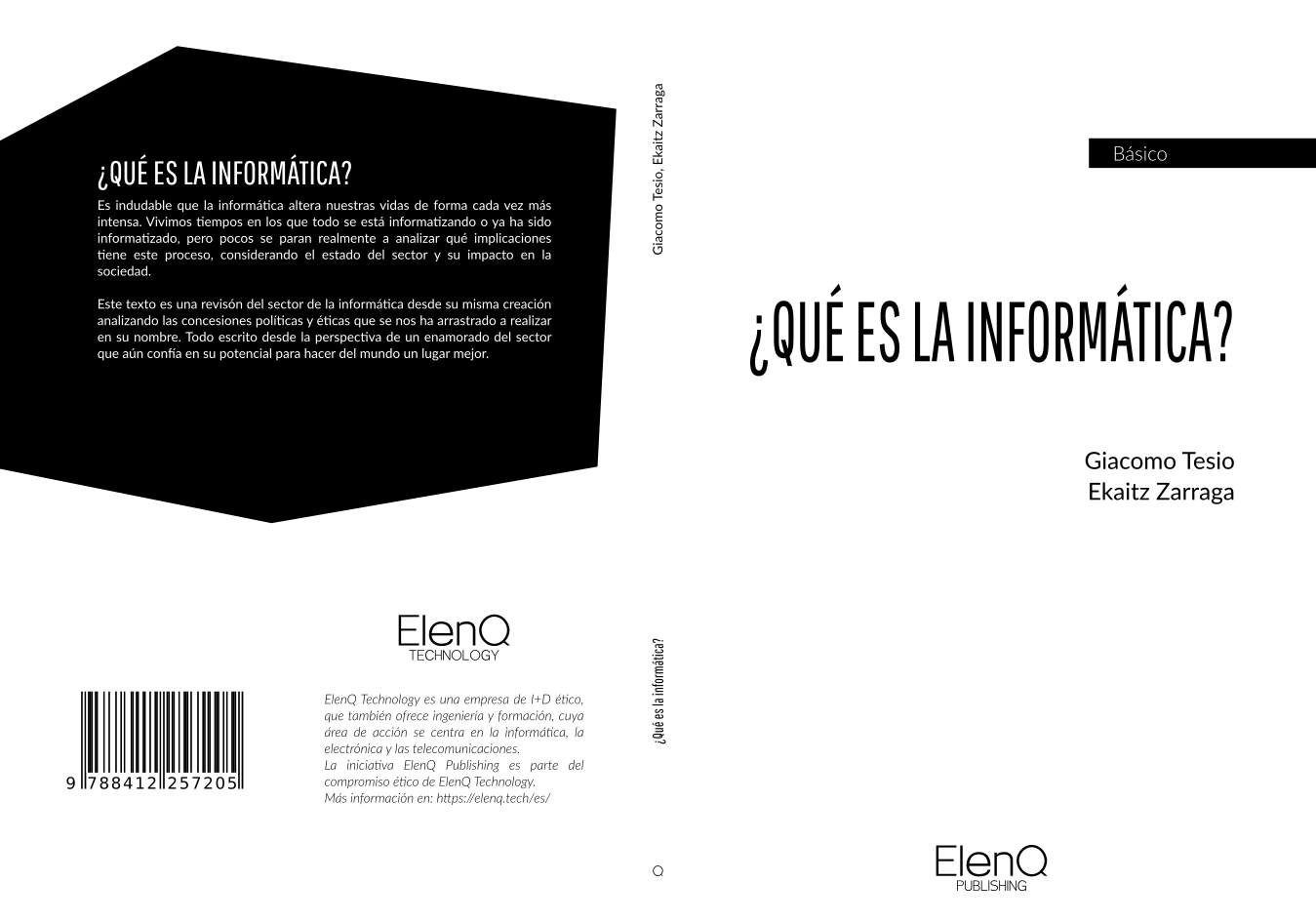
"Mientras que la matemática pertenece al dominio de la mente humana y es comunicable, cualquier concepto que pertenece a la matemática es información. Como tal, también pertenece al campo de la informática.
Lo contrario no es cierto: los errores están muy presentes en la informática pero no se dejan ver en el mundo de las matemáticas.
Como consecuencia, las matemáticas son parte de la informática, y no al contrario.
Aunque esta afirmación puede parecer una herejía al principio, no debería sorprendernos demasiado. Podemos observar que la informática altera cada aspecto de la vida humana. Este fenómeno tiene una explicación sencilla: transforma la forma en la que la humanidad piensa colectivamente. La información pertenece al dominio de la mente humana y, al compartirse con otros miembros de la comunidad, construye la cultura de dicha comunidad. Después, la cultura vuelve a la mente de los nuevos miembros de la comunidad a modo de información en un bucle infinito."
— Giacomo Tesio, Ekaitz Zárraga: ¿Qué es la informática?, p. 21
Joined May 2019
