

*banned 4 MarkDown love* @design_RG@qoto.org
- Blog W.Freely :
- https://write.tedomum.net/rgx/
- Glitch-Social :
- https://muensterland.social/@rgx
- Pleroma :
- https://fedi.absturztau.be/yann
- Cats ! :
- https://catgram.jp/@yann2
Books, Bicycles & Cats, Life is Good. Books, hardcover. Bikes, Classic sport and Touring ones. Cats, any colour or size. Aquarius with Virgo rising. INTJ.
STEM Lord, House of Ravenclaw.
I have moved -- please visit my other accounts.
* Follow my Main & Publishing account : https://muensterland.social/@rgx
* Cats photos, now posted at Catgram.Jp : https://catgram.jp/@yann2
* Pleroma Home is at FAB : https://fedi.absturztau.be/yann
Spoken & Written Languages : English. Español. Português.
Joined Nov 2019
Now working on my beloved laptop, there's no comparison; mobile for me is on the road only, much more limited.
Waterfox homepage is at https://www.waterfox.net/
There are TWO versions now:
- Classic is a custom build of FF, with all telemetry removed, it also supports lots of older Extensions which Mozilla has deemed no longer supported. I used this for years now.
- Currrent just launched, this Octover, and is based on current FF code, on the Aurora channel. Current version is 68.0a2 as listed above, and it's amazingly FAST and stable.
It has become my go to Browser, installed on my various systems and in my phone as well, the Android version.
@mngrif I think the Aussies pay for the best grade coffees. like the Europeans. Great coffees there, specially in Portugal. Spain, more expensive and lesser quality.
I imagine in Italy it must be top notch stuff too, although more expensive since salaries are higher there.
Here in Canada, I mostly do it at home, although some small Italian Cafés are very nice and have good espresso, which I can't match at home.
Thank you, I find it a great project. I imagine you do need to keep a close eye on things with editing being possible to anyone who simply registers an account, anonymous mostly.
We see reports of people doing edits and beign from IP ranges associated with Government or some times big businesses involved with the page's topic.
The other day someone from Environment Canada's domain did and edit and it was reported on the newspapers (a page about oil pipelines in Dakotas I believe).
@Full_marx
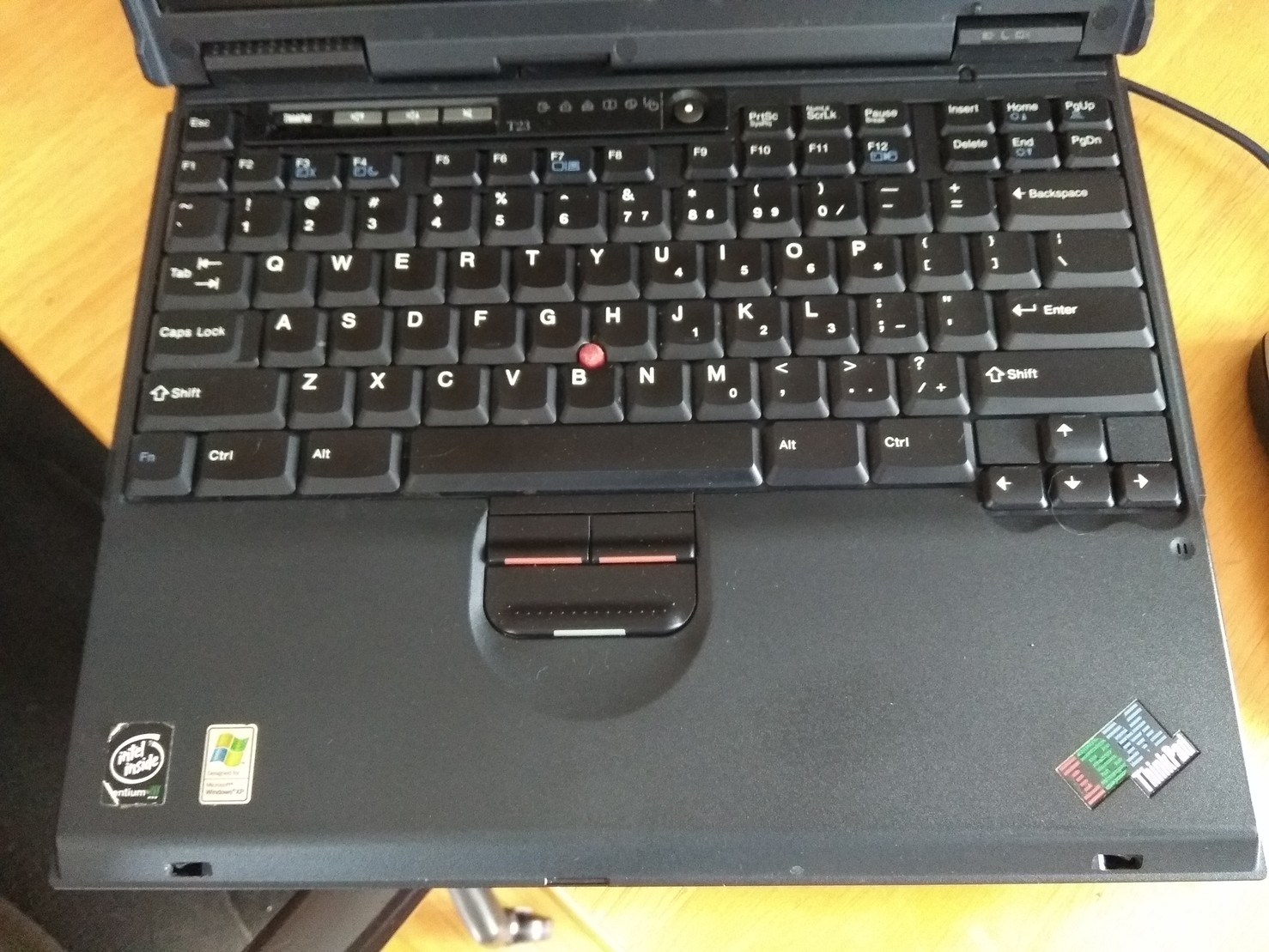
Another system photo. IBM ThinkPad, model T23, a powerful model at its time, I used it for ten years at work.
Still runs well, used it for some Cad work the other day, the version of AutoCAD I have won't run on newer opsys.
Maxed out with 1 GB of ram, 1.1 GHz PIII processor, single core. XP for Legacy systems os.
Photo by Xiao MI Red MI Note 5 Prime. Sys specs greatly outweigh the ThinkPad.
8 cores processor, 3 GB RAM, Arm 64 processor. Android 7.1.2,. MIUI 11.
Give me enough Tabs and the world is my Library... I actually have about twice as many shown in the picture, and the system is stable.
Waterfox Current, based on Firefox Aurora channel, v. 68.02a
No, not me. I use and support it with a donation once in a while, but have not edited any pages there.
Very long post!
@Full_marx
I think the robustness of Unix goes back to its roots, being developed by people working into smaller teams, concerned with getting the best possible performance.
They did Multi user systems back when the machine was less powerful than a low end cell phone today. And it worked.
It was refined over the years and got new functions, people built tools for functions they wanted, the users themselves were programmers, scientists, IT people, sys admins.
IBM did a nice job with OS/2, I was a user and supporter of that, remember buying a shrink wrapped copy of OS/2 Warp, version 3.0, in 1995 - just after seeing a leaked copy of Windows 95, coming out at the time, on a friend's home. (I wasn't too impressed)
IBM had contracts with MS since the early days of the PC, MS made itself after they got the contract to provide the op system for the new IBM PC, that was going to come out in 1981.
MS later worked in OS/2 as well, but at one point they decided to support their own in-house GUI environment. At first, Windows versions 1.0 to 3.11, which ran on top of the DOS opsystem. When Win95 came out, it was much more refined, technically, without an underlying DOS hidden by a pretty GUI.
Windows NT was really New Technology, the initials making up the name NT. It was a lot nicer and more sophisticated than W95, they had people working on development who came from DEC and other larger places.
I am very fond of NT Workstation v 4.0, loved it. Probably still have a memorable full screen shot of a newly installed machine, logged in and using only --- 18 MegaBytes of RAM. Yes, 18.
At the time when RAM was still expensive, a 32 MB machine was power user, a 64 MB one Leet. 😃
But both MS's and IBM's op systems were developed for single user, desktop machines, with different priorities than Unix.
Unix lives on, it's the beating heart on which Linux is based. Although Linux has been written from scratch to avoid infringing on ATT's copyrights, the whole architecture came from there, the tools made in the past are still around, the CLI is alive and well.
When I first used the Internet, in 1994 when I returned to Uni and got an academic account, you could not find consumer access. The only people having it were either in academia, or on larger business or government.
All the tools I learned to use to explore this new fangled network were command line.
I was one of the many users, with a home in a Silicon Graphics machine. Ours was called Sandcastle.
We had Irix running, and did ftp, email, text editing, maybe even a Gopher session to see other systems, still all text based and I accessed it mostly from home via modem dial in connection.
I was thrilled to find a system in Colorado that offered free Unix shell accounts, made myself a home there, and was able to have an email address and other perks even before I got official local uni student account (I dialed in and logged in with a friends account, then used telnet into the Colorado system to login there.)
I think that system might still be around, it was called Nyx10.
Yesm they are! https://nyx10.nyx.net/newacct.html
I remember the first time I used a WEb browser, at home, on my fast for the time 386 40 MHz computer. Via dial up, with Netscape pre version 1.0, probably, and it took forever to load a page.
Being used to command line use, I found that too slow, although it made things a lot easier.
Back in the days, you needed an education to be able to use the system and those tools. It wasn't made for the masses.
The WWW idea really simplified things a lot, and once access became easier to buy, and machines got more and more memory and processor power, it turned into a nice way to use networks resources.
@smj@mastodon.sdf.org
@mngrif That looks wonderful. 🎨 ☕
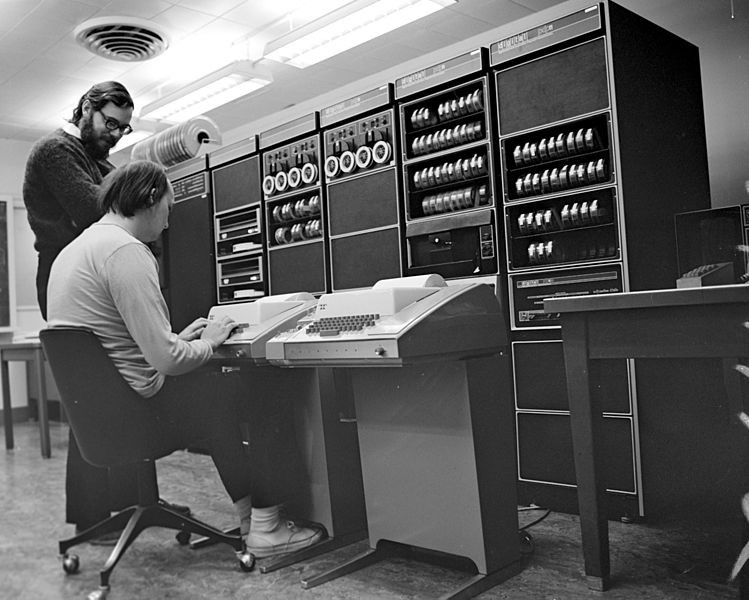
"Ken Thompson (sitting) and Dennis Ritchie working together at a PDP-11"
A Mini computer, made by DEC, Digital Equipment Corporation, one of the great names in American computing history that disappeared into mergers and acquisitions (bought by Compaq, I think)
@Full_marx Yeah, my memory was correct! :smile:
"Dennis Ritchie and Ken Thompson were the programmers at the Bell Labs computing and research department who worked on project MULTICS from start to end. Thompson found an old PDP-7 machine, and developed his own application programs and operating system from scratch, aided by Ritchie and others. This operating system was renamed UNIX.
In November 1971, the first version of UNIX was released along with a book called ‘The UNIX Programmers Manual’. This was the systematic development approach at that time – a product would be released with proper documentation so that researchers could read the manual and look at the OS details."
And from Wikipedia :
"Ken Thompson, a programmer in the Labs' computing research department, had worked on Multics. He decided to write his own operating system. While he still had access to the Multics environment, he wrote simulations for the new file and paging system[clarification needed] on it. He also programmed a game called Space Travel, but it needed a more efficient and less expensive machine to run on, and eventually he found a little-used Digital Equipment Corporation PDP-7 at Bell Labs.[4][5] On the PDP-7, in 1969, a team of Bell Labs researchers led by Thompson and Ritchie, including Rudd Canaday, implemented a hierarchical file system, the concepts of computer processes and device files, a command-line interpreter, and some small utility programs, modeled on the corresponding features in Multics, but simplified.[3] The resulting system, much smaller and simpler than Multics, was to become Unix. In about a month's time, in August 1969, Thompson had implemented a self-hosting operating system with an assembler, editor and shell, using a GECOS machine for bootstrapping.[6] "
https://en.wikipedia.org/wiki/History_of_Unix
@smj@mastodon.sdf.org
*banned 4 MarkDown love*
boosted

If you're looking to discover #Art follow @curator
If you're looking to discover #Photography follow @ambassador
If you're into tech keep an eye out for accounts on hackers.town and/or bsd.network
#FF #FollowFriday
If you're looking to discover #Photography follow @ambassador
If you're into tech keep an eye out for accounts on hackers.town and/or bsd.network
#FF #FollowFriday
@Full_marx I think those are an excellent plan! 
USPOL
@thegibson Obfuscation and making noise seems to be the method, at least from the White House.
Fox assists.
@Full_marx I can relate to that, having put in Full time wwork hours into it this past week.
But it's green great fun, entertaining, educational and so far none of the conflicts I always was worried about in twitter.
Posted more here in one week, this one, than in the birdsite account for the years I have had the account there.
As long as we stay out of conflict, I think your time is well spent.
@Full_marx A vintage DEC PDP-7, I believe a similar model was the first machine to ever run #Unix.
A little paper punched tape at foreground by the console.
*banned 4 MarkDown love*
boosted

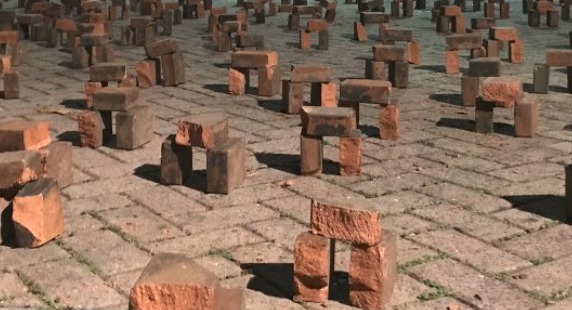
Hong Kong protesters' little stonehenges impede police cars
https://boingboing.net/2019/11/15/trilithons.html
(via @rhokilpatrick@twitter.com)
Feel like focusing and going for a Longer Read? This week's best at LongReads.com
*banned 4 MarkDown love*
boosted



Elon Takes Berlin: Plans for Tesla Plant Jostle German Car Industry https://www.spiegel.de/international/germany/elon-musk-seeks-equal-footing-with-german-tesla-factory-a-1296704.html#ref=rss
@Warhorse
He was an intellectual, very intelligent and curious man, a great scientist.
He was also a good administrator, leading the Manhattan Project thru the WWII years.
He had regrets on seeing the destrucitve use of their work and research, and started speaking his mind, ended up being investigated as a Communist and I think lost his security clearance.
The next stages of weapons development, the Fusion or Hydrogen bombs, were pushed ahead by other scientists with less qualms about their destructive power, like Leo Szillard.
- Blog W.Freely :
- https://write.tedomum.net/rgx/
- Glitch-Social :
- https://muensterland.social/@rgx
- Pleroma :
- https://fedi.absturztau.be/yann
- Cats ! :
- https://catgram.jp/@yann2
Books, Bicycles & Cats, Life is Good. Books, hardcover. Bikes, Classic sport and Touring ones. Cats, any colour or size. Aquarius with Virgo rising. INTJ.
STEM Lord, House of Ravenclaw.
I have moved -- please visit my other accounts.
* Follow my Main & Publishing account : https://muensterland.social/@rgx
* Cats photos, now posted at Catgram.Jp : https://catgram.jp/@yann2
* Pleroma Home is at FAB : https://fedi.absturztau.be/yann
Spoken & Written Languages : English. Español. Português.
Joined Nov 2019
