
Nicola Romanò @nicolaromano@qoto.org
- Pronouns
- he/him
Senior lecturer at Edinburgh University and Zhejiang-Edinburgh Joint Institute (ZJE).
Undergraduate Programme Organiser, Biomedical Informatics at ZJE.
I teach #imageanalysis & #dataanalysis with #RStats & #python.
My research is focused on how #heterogeneous behaviour in #pituitary (and other) cells shapes their function as a population.
I'm also very interested in #reproducibility and #openscience.
Joined Oct 2022
Nicola Romanò
boosted

🤣
“Landmark German ruling declares Google's AI Overviews are Google's own words and makes it liable for false answers”
👍
“A German regional court has ruled that Google is directly liable for false claims in its AI-generated search overviews.
“The court treated the AI overviews as Google's own content and rejected Google's argument that users were responsible for fact-checking the results themselves.”
Nicola Romanò
boosted


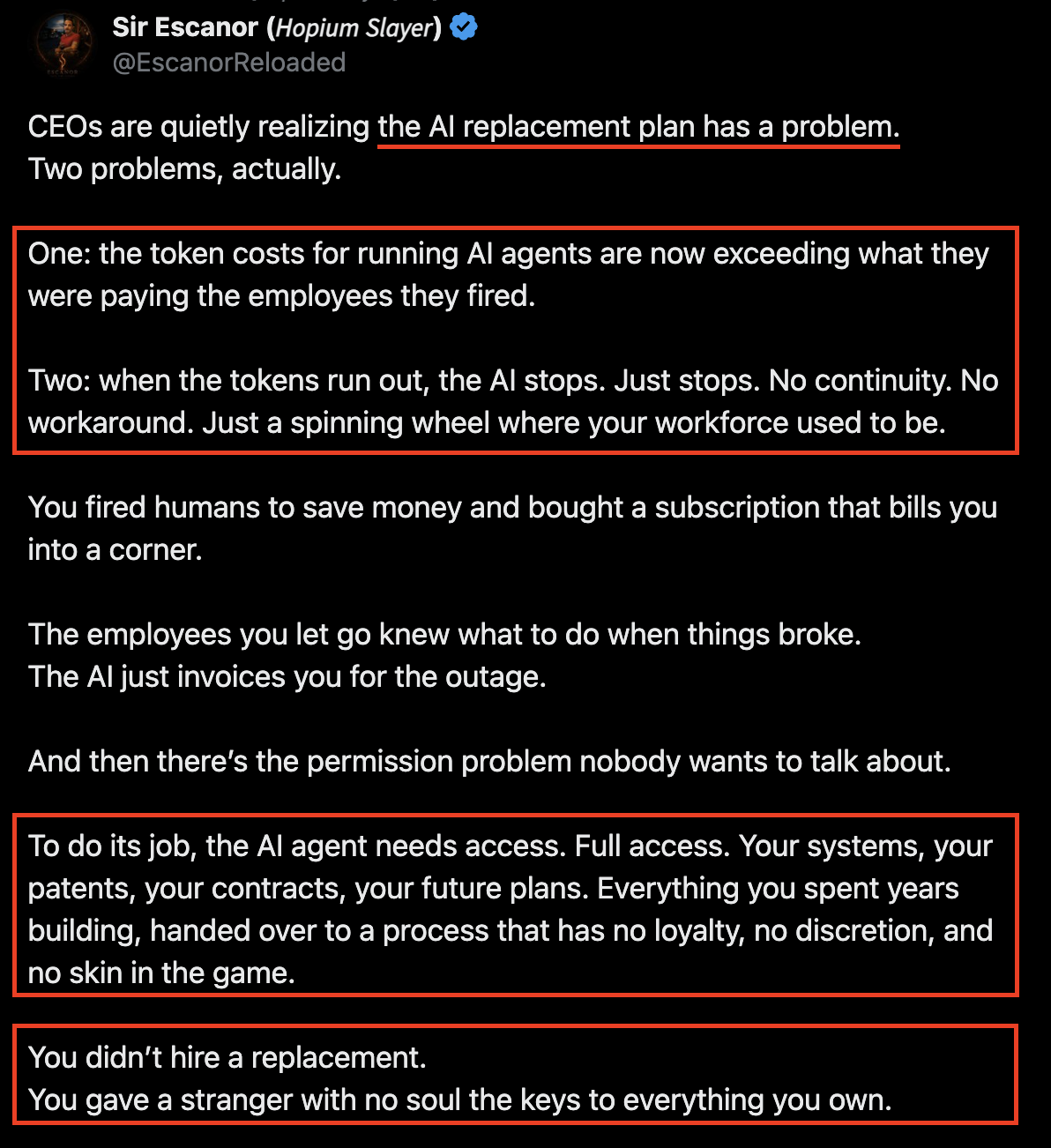
You gave a stranger with no soul and no skin in the game the keys to everything you own.
Nicola Romanò
boosted

The form asked my permission to share my health data. Then it wouldn’t let me say no. – The Markup
https://themarkup.org/privacy/2026/05/27/opt-out-dark-patterns
Nicola Romanò
boosted

The new CEO of the Wikimedia Foundation worked at J.P. Morgan and Lehman Brothers. The Foundation has now fired a longtime lead developer and disbanded the team whose job was to listen to volunteers. Most of the people they fired were union organizers. Wikipedia’s editors are now threatening to strike. To stand in solidarity with them, sign the petition:
https://en.wikipedia.org/wiki/Wikipedia:Wiki_Workers_United_solidarity
For more, read on!
(1/2)
Nicola Romanò
boosted

Nicola Romanò
boosted

Age restriction is not a solution for young kids addicted to social media
The solution is to put a wrecking ball to the exploiting algorithms that try to keep these kids on the platforms for as long as possible to show them as many ads as possible
Age verification is just another tool to keep taps on everyone
Start with the root of the problem and knock on doors from Meta to start with
Nicola Romanò
boosted

Make this makes sense: we train our medical students/residents/fellows/ourselves to avoid stereotyping and bias and yet we are embracing medical AI slopware which does the exact opposite?
https://pmc.ncbi.nlm.nih.gov/articles/PMC11908302/
(Congrats to my fried Girish Nadkarni who coauthored it)
In the past couple of years I have been in a lot of meetings centered about the topic of "OMG students are using genAI in assessments what do we doooo?"
After marking a lot of assessments of different type from different courses in different years of study and two different undergraduate programmes, here are my conclusions, some of which I have no way of proving, I know, but that's fine.
1. A lot of students use genAI. In many cases I cannot prove that, it's just a feeling (nobody writes like this, especially not Year 1 non-native speakers), but I had students telling me directly and I do believe them.
2. Looking at marks in the cases above where I have that feeling, I see a wide spread from fails to high A.
3. Following from 2, overall marks have not changed significantly and systematically in any of our courses from the past 5 years. There are of course year-to-year fluctuations, but that's cohort-dependent there seems to be no overall trend.
4. The conclusion you might draw from 2 is that we're rewarding students who are good at using genAI. Possibly, and I have not made up my mind up about this. My answer is that we should change our way of assessing and teaching, rather than trying to "catch" students using genAI. We're currently redesigning our Programmes and that's what we're trying to do. I am in the process of designing a new course and I have tried to do that assuming students will use genAI, but making it so that using it will not be an advantage, and might actually make it more cumbersome to do the assessments.
5. We looked at final year dissertations and plotted marks against %AI writing detected by our submission system. Taking this with a pinch of salt, given that AI detectors are biased and unreliable, there is only a small negative correlation but it's such a small effect size as to be essentially negligible. Again, the distribution of marks is the same as in previous years.
So in conclusion, just like anything else AI related, there's a lot of hype on how this is disruptive and it's terrible or game-changing depending on which side you're on. And yet, in practice...
Has anyone had similar observations? I'd love to hear your thoughts.
Nicola Romanò
boosted
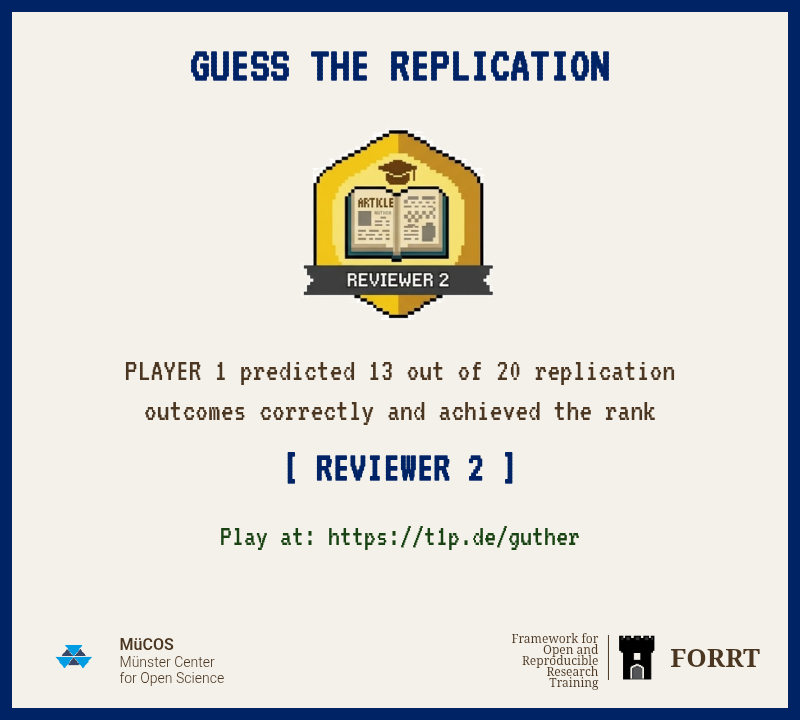
Guess the replication game
https://t1p.de/guther
I got much better at this once I stopped reading beyond the title.
#openscience #GuesstheReplication #openresearch #replication
Nicola Romanò
boosted

Don’t call it age verification. Call it centralised personal data collection. And understand that it serves surveillance, not safety for children.
Nicola Romanò
boosted

Nicola Romanò
boosted

In my experience when someone says "scientists don't want you to know" what they are really saying is "science doesn't support my crackpot theory"
Nicola Romanò
boosted

NHS Goes To War Against Open Source
https://shkspr.mobi/blog/2026/05/nhs-goes-to-war-against-open-source/The NHS is preparing to close nearly all of its Open Source repositories.
Throughout my time working for the UK Government - in GDS, NHSX, i.AI, and others - I championed Open Source. I spoke to dozens of departments about it, wrote guidance still in use today, and briefed Ministers on why it was so important.
That's why I'm beyond disappointed at recent moves from NHS England to backtrack on all the previous commitments they've made about the value of open source to the UK's health service.
It's rare that multiple people leak the same story to me, but that's what gives me confidence that lots of people within the NHS are aghast at this news.
A few days ago, I was sent this quote which was attributed to a senior technical person in NHS England.
We are obviously looking at things like Mythos, which is more sophisticated at finding vulnerabilities. In the next week or so, we will be changing our tack on coding the open and making our code public until we're on top of that risk.
Most of our repos, unless they're essential, will be removed for security reasons.
As I've written before, this is not the correct response to the purported threat by Mythos. Neither the AI Safety Institute nor the NCSC recommend this action. While there may be some increase in risk from AI security scanners, to shutter everything would be a gross overreaction.
Nevertheless, that's what the NHS is preparing to do.
On the 29th of April, guidance note SDLC-8 was sent out. Here's what it says:
The majority of code repos published by the NHS are not meaningfully affected by any advance in security scanning. They're mostly data sets, internal tools, guidance, research tools, front-end design and the like. There is nothing in them which could realistically lead to a security incident.
When I was working at NHSX during the pandemic, we were so confident of the safety and necessity of open source, we made sure the Covid Contact Tracing app was open sourced the minute it was available to the public. That was a nationally mandated app, installed on millions of phones, subject to intense scrutiny from hostile powers - and yet, despite publishing the code, architecture and documentation, the open source code caused zero security incidents.
Furthermore, this new guidance is in direct contradiction to the UK's Tech Code of Practice point 3 "Be open and use open source" which insists on code being open.
Similarly, the Service Standard says:
There are very few examples of code that must not be published in the open.
The main reason for code to be closed source is when it relates to policy that has not yet been announced. In this case, you must make the code open as soon as possible after the policy is published.
You may also need to keep some code closed for security reasons, for example code that protects against fraud. Follow the guidance on code you should keep closed and security considerations for open code.
There's also the DHSC policy "Data saves lives: reshaping health and social care with data":
Commitment 601 – completed May 2022
We will publish a digital playbook on how to open source your code for health and care organisations
And, here's NHS Digital's stance on open source in their Software Engineering Quality Framework:
The position of all three of these documents is that we should code in the open by default.
All of which is reflected in the NHS service standard:
Public services are built with public money. So unless there's a good reason not to, the code they're based should be made available for other people to reuse and build on.
All of which is to say - open source should be baked into the DNA of the NHS by now. There are thousands of NHS repositories on GitHub. The work undertaken to assess all of them and then close them will be massive. And for what?
Even if we ignore the impracticality of closing all the code - it is too late! All that code has already been slurped up. If Mythos really is the ultimate hacker, hiding the code now does nothing. It has likely already retained copies of the repositories.
And if it were both practical and effective to hide source code - that doesn't matter. These AI tools are just as effective against closed-source. They can analyse binaries and probe websites with ease.
There are tens of thousands of NHS website pages which refer to their GitHub repos - will they all need to be updated? What's the cost of that?
I've no idea what led to NHS England making this retrograde decision - so I've send a Freedom of Information request to find out.
I am convinced that closing all their excellent open source work is the wrong move for the NHS. I hope they see sense and reverse course.
Until then, I've helped make sure that every single NHS repository has been backed up and, because the software licence permits it, can be re-published if the original is closed.
In the meantime, you should email your MP and tell them that the NHS is wrong to shutter its world-leading open source repositories.
Don't let them take away your right to see the code which underpins our nation's healthcare.
Further Reading
I'm quoted in this article from The New Scientist.
Matt Hancock on the issue
Discussion by Jessica Morley, PhD
Free Software Foundation Europe press release
Further commentary from New Scientist
Petition - Keep Things Open
Update 2026-05-14: GDS have published their Guidance "AI, open code and vulnerability risk in the public sector " which explicitly says closing repos is the wrong approach.
Nicola Romanò
boosted

My only topical take for today is that “undoing a 600% increase is an 85.7% decrease” being arithmetically true does not stop it from being a great example of why to avoid percentages if you want to be understood.
Nicola Romanò
boosted

In "good news for my small annoyances in copying the same function across scripts", R 4.6.0 will (finally) have a %notin% built-in
https://www.jumpingrivers.com/blog/whats-new-r46/ and https://cran.r-project.org/doc/manuals/r-devel/NEWS.html
Nicola Romanò
boosted

i was quite surprised to discover that no one had registered deleteduser [dot] com, and was curious to see how many emails i'd get if i registered it, assuming many orgs 'delete' logic probably just overwrote the email address with blahblah@deleteduser.com or similar.
The answer, is at least 3 different orgs in the hour that I've owned that domain and been listening for email.
And yes, all of those emails contain the actual PII of the person who has been 'deleted' :-D
Nicola Romanò
boosted

so it cost anthropic $20k to find this openbsd crash bug which amounts to putting a negative integer in a tcp field where a negative integer was not expected by the c code which does some cavalier int cast bullshit, ie. a vuln which is totally fuzzable, and quite certainly would have been found by the fuzzers of the 2010s had anyone cared to burn that much compute on fuzzing openbsd.
The difference today is not that anybody suddenly cares about investing that much in openbsd (is the build server still a donated machine running in Theo's basement?), but that openbsd's reputation for security makes it really good marketing if you can find a bug, any bug, it doesn't matter; and that marketing value is what makes it worth spending $20k on fuzzing.
Nicola Romanò
boosted

Nicola Romanò
boosted

Lui et son équipe de douze salariés vont quitter les lieux. Motif ? Ce restaurateur bio et végane, dont la cuisine était accueillie à l’hôtel Babel à Paris, a refusé de retirer un sticker « Free Palestine ».
Lire l'article ➡️ https://l.reporterre.net/bt4
Nicola Romanò
boosted



Learned via the @R4DSCommunity Slack chat today that radian is no longer actively developed! @eitsupi's arf is recommended in the README now! https://github.com/randy3k/radian
NGL, while I greatly enjoy arf, I deeply appreciate radian and hate to see a good option disappear.
- Pronouns
- he/him
Senior lecturer at Edinburgh University and Zhejiang-Edinburgh Joint Institute (ZJE).
Undergraduate Programme Organiser, Biomedical Informatics at ZJE.
I teach #imageanalysis & #dataanalysis with #RStats & #python.
My research is focused on how #heterogeneous behaviour in #pituitary (and other) cells shapes their function as a population.
I'm also very interested in #reproducibility and #openscience.
Joined Oct 2022
