volkris @volkris@qoto.org
I think the most pressing and fundamental problem of the day is that people lack a practically effective means of sorting out questions of fact in the larger world. We can hardly begin to discuss ways of addressing reality if we can't agree what reality even is, after all.
The institutions that have served this role in the past have dropped the ball, so the next best solution is talking to each other, particularly to those who disagree, to sort out conflicting claims.
Unfortunately, far too many actively oppose this, leaving all opposing claims untested. It's very regressive.
So that's my hobby, striving to understanding the arguments of all sides at least because it's interesting to see how mythologies are formed but also because maybe through that process we can all have our beliefs tested.
But if nothing else, social media platforms like this are chances to vent frustrations that on so many issues both sides are obviously wrong ;)
Joined Dec 2022
@csgordon@zirk.us @Npars01 @stopgopfox@libretooth.gr
Under the FairTax proposal the wealthy would have to pay a lot more in taxes even as the poor would enjoy the explicit and actively progressive move of the check they would get to help pay for essentials!
The proposal was intentionally designed to help the poor. Whether it's good or not, we should not pretend it is something it's not, and ignore that.
No, the Constitution gives Congress the authority to authorize the minting of money without any requirements that it be associated with any loans.
So it's just outright just factually false that debt is required for the US to make money.
The federal government is free to make all the money at once out of thin air without any debt involved.
Trading goods and services for money is not robbery.
It's exactly the opposite.
Yeah except for the minor detail that Congress did not authorize the minting.
This is the problem with trying to subvert the democratic process.
It is up to Congress to authorize minting of money.
Really, all of these efforts to circumvent the democratic process are dangerous.
As usual NPR is so busy grinding its axes that it is getting the facts completely wrong.
No the Treasury brings in PLENTY of money to pay the US debt. It posts balance sheets daily for the public to read on its website so any of us can see that for ourselves. There is no risk of not being able to pay debts.
Yes, the president might have to make some choices as to where to spend money since Congress never passed legislation to fund all of the programs that congresspeople have been crowing about for the last year, but that's really why we should stop electing such jerks who make big promises that they can't keep.
But it needs to be very clear that the US is not legally at risk of defaulting. The administration threatening that is extremely irresponsible.
volkris
boosted

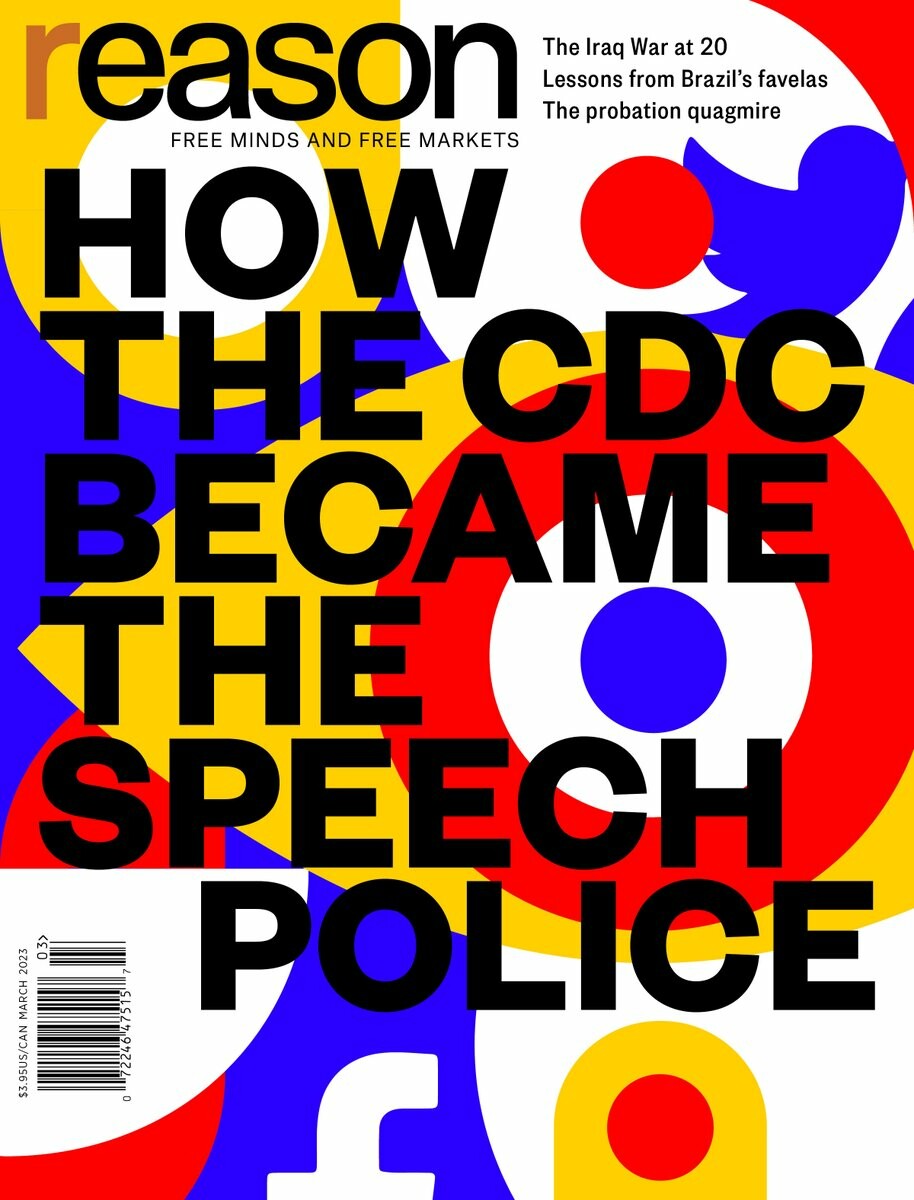
The new issue of Reason is available online now for subscribers: https://reason.com/issue/march-2023/
You really wouldn't accept $100 bill unless you thought there was debt attached to it?
No, people accept currency based on whether they believe other people will value it for future trade. When the government mints money there absolutely is no debt attached to it, and yet we still trade dollars.
@stopgopfox@libretooth.gr
Everything I've heard from FairTax proponents is that they do not propose any cuts to programs nationally. They aren't getting into the issue of spending restraint. They want to raise the same amount of money, just to do it a more effective, efficient, and fair way.
Today we have a ton of elements of the income tax that try to tax wealthy people more and poor people less. Poor people get everything from the standard deduction through earned income tax credit. So the FairTax plan wants to echo that sort of progressive policy, but just do it in a more effective way.
So the rich guy buying a Ferrari will pay more so that the poor person doesn't have to pay taxes on their food for the week.
@Npars01 @stopgopfox@libretooth.gr You know what else drops consumer spending and increases costs? Not having money in the first place, compliance with income taxes.
Taxes in any form have the effect you're talking about. There's no way around that. So long as government is needing to be funded it will take a bite out of private sector activity.
The FairTax has advantages over income taxes, and that's what it should be compared against. Not no taxes at all, because that's not an optional on the table.
The problem with the administration's spin is that the Treasury has plenty of income to cover its debt obligations, which is is legally required to prioritize.
Default is not legally on the table, period. Such a choice would be flat out unconstitutional.
For the administration to be even suggesting that it would not service debts as they come due represents a real violation of faithful execution of the law, and they need to be called out on it.
Treasury has plenty of money to avoid default, so it must not choose to go that route.
No, the Treasury mints money without a debt obligation.
Congress is free to authorize the minting of money whenever it wants without borrowing from anyone to fund that.
Such facts disprove the "all money is debt" claim.
As for the $5, Why do you care where it came from when I buy the hamburger from you? Heck, I could have even minted the $5 myself, and so long as my forgery was perfect it would have the same value to you.
And this perfectly illustrates the folly of going down those practically irrelevant rabbit holes.
On a related note, it doesn't matter how many books a person may write, if his argument is so clearly false then it's false no matter the messenger's history.
Here's another way to respond:
If I give you a million dollar check but with the stipulation that you cannot cash it, are you really rich?
Technically, accounting-wise, you have that money, but practically, no, you're no better off.
Graeber's graphs are counting exactly that situation, counting the private sector as richer based on money locked up in loans to the federal government.
If government paid off those loans instead of revolving it into new loans then the private sector would ACTUALLY be richer, able to use that capital to invest in machinery, hiring, and all sorts of other things.
His argument miscounts unspendable paper wealth and so is misleading.
> "The Supreme Court’s 2010 ruling in the Citizens United v. FEC case prohibited the government from restricting political campaign spending by companies, nonprofit organizations and unions."
Well, I appreciate that at least this article didn't portray CU as being just about rich people, pointing out that nonprofits and unions have their speech protected by the ruling as well.
FWIW, I happened to copy this quote for someone else and then saw this reply and figured I'd share it here too.
> "In contrast, the #FairTax dramatically improves economic growth and wage rates for all, but especially for lower-income families and individuals. In addition to receiving the monthly FairTax prebate, these taxpayers are freed from regressive payroll taxes, the federal income tax, and the compliance burdens associated with each. They pay no more business taxes hidden in the price of goods and services, and used goods are tax free."
Robert Reich really went off the deep end a few years back, to the point where he is not particularly reliable at all these days.
In this video he's saying a lot of thing that are flat out wrong compared to US law.
The US is legally barred from defaulting. Such a choice would run contrary to the Constitution, and any debtor would have the right to receive payment ahead of other expenditures.
What Reich says here is easily debunkable by reference to the laws of the country.
We really need to call out the guy more, since he's so consistently spreading false information these days.
@stopgopfox@libretooth.gr
I'd reference this website.
They literally wrote the book outlining the plan. I have a copy of the actual book around here somewhere. I probably picked it up decades ago.
For example:
> "In contrast, the FairTax dramatically improves economic growth and wage rates for all, but especially for lower-income families and individuals. In addition to receiving the monthly FairTax prebate, these taxpayers are freed from regressive payroll taxes, the federal income tax, and the compliance burdens associated with each. They pay no more business taxes hidden in the price of goods and services, and used goods are tax free."
The video is based on some accounting hoops that don't have real world meaning, and it also gets some of its facts wrong about what money is and how it works.
Mainly, if I trade $5 to you for a hamburger, it doesn't matter in the slightest whether I'm trading you $5 in $1 coins or a Federal Reserve Note even though those would be treated differently in his accounting.
Because his description of money is unrealistic, even if technically correct as for legal abstraction.
The "all money is debt!" argument is not only factually wrong, but also irrelevant to how money is used in the real world.
@stopgopfox@libretooth.gr
If this is a reference to the FairTax, since I see that popping up today, the plan would write the poor checks to offset the tax burdens.
The FairTax was specifically designed to be progressive, to make sure it this payment prevents it from hitting the economically vulnerable.
Not quite.
It's money that Congress *authorized* the Executive Branch to spend if possible, based on projections of tax collections vs project costs throughout the following year or so.
It was not money we agreed to spend as that's an executive branch action that happens over time.
It's really important to realize this difference as it's at the crux of the debt ceiling debate.
Congress authorized the spending of money that didn't exist, which constrains the budget. It didn't and couldn't have agreed to spend that money. Because, again, it didn't exist.
I think the most pressing and fundamental problem of the day is that people lack a practically effective means of sorting out questions of fact in the larger world. We can hardly begin to discuss ways of addressing reality if we can't agree what reality even is, after all.
The institutions that have served this role in the past have dropped the ball, so the next best solution is talking to each other, particularly to those who disagree, to sort out conflicting claims.
Unfortunately, far too many actively oppose this, leaving all opposing claims untested. It's very regressive.
So that's my hobby, striving to understanding the arguments of all sides at least because it's interesting to see how mythologies are formed but also because maybe through that process we can all have our beliefs tested.
But if nothing else, social media platforms like this are chances to vent frustrations that on so many issues both sides are obviously wrong ;)
Joined Dec 2022
volkris's choices: