volkris @volkris@qoto.org
I think the most pressing and fundamental problem of the day is that people lack a practically effective means of sorting out questions of fact in the larger world. We can hardly begin to discuss ways of addressing reality if we can't agree what reality even is, after all.
The institutions that have served this role in the past have dropped the ball, so the next best solution is talking to each other, particularly to those who disagree, to sort out conflicting claims.
Unfortunately, far too many actively oppose this, leaving all opposing claims untested. It's very regressive.
So that's my hobby, striving to understanding the arguments of all sides at least because it's interesting to see how mythologies are formed but also because maybe through that process we can all have our beliefs tested.
But if nothing else, social media platforms like this are chances to vent frustrations that on so many issues both sides are obviously wrong ;)
Joined Dec 2022
@holyramenempire @benda @mentallyalex
Again, go directly to the source, not to third party reporting that all too often get the story wrong.
Don't go for the game of telephone.
Below I'll paste the link again.
"The Higher Education Loan Authority of the State of Missouri (MOHELA)—a “public instrumentality” of the State, Mo. Rev. Stat. §173.360, and part of the Missouri Department of Higher Education and Workforce Development, §173.445—is one of those servicers."
Missouri established MOHELA by law as part of its state operation. I can link to the specific statute as well, below.
So MO by law operates this program and has it as a significant actor in its public policy. It seems pretty straightforwardly part of the state's operation, and the state would lose should the loans be prematurely canceled.
No. In the US system the onus is on the lawyers, generally the plaintiffs, to prove things, not on the court.
They are to prove it TO the court.
But that still doesn't change that modesty isn't part of the calculation.
The states that brought the suit point to financial damage as the reason they have any right to be heard at all. Otherwise they would have no access to the courts as they would have no stake in the issue.
@Huck@mstdn.party @carnage4life
Right, exactly. No significant changes in the period of recovery out of a hole where we threw huge numbers of people out of work is a bad thing!
So here is the BLS labor force participation rate graphed, showing not only that so many have dropped out, but that it hasn't done much lately to recover. Yes, this is the problem.
There have been few significant changes when we NEED to see significant recovery, with more people choosing to join the labor force.
Right, but all of that is already accounted for in the federal budget.
Federal and state governments have projections about how much will actually be collected as they figure out how much they have to spend on government programs.
For the president to just forgive that means the budgets our representatives voted on will be missing a huge chunk of funding.
If this was a question being put to Congress then that might be worth talking about, but because the president tried to end run around the legislative branch, even when Democrats were in charge, this ends up being a completely different question.
The question today isn't whether $30 billion should be invested. It's whether a president can unilaterally give up billions in federal funding that was to be used to pay for other programs.
Even people who are all for loan forgiveness should be uncomfortable with that, if they like to see government funded.
But what's the practical and sustainable solution going forward?
How do we figure out who is and isn't capable of deciding whether to take out a loan?
Do we block everyone from participating fully in the financial system for the sake of some, or how do we sell a program where someone (government?) will tell people they aren't allowed financing?
This is a really thorny issue.
@holyramenempire @benda @mentallyalex
You might find more answers from directly from the brief.
The lower court agreed that this is a state agency bringing in revenues from servicing those loans, that it would lose out on should the loans be forgiven prematurely.
Modesty isn't part of the legal calculation, though.
If the action is illegal, then it's illegal, no matter how small a violation it might be, and it's up to the court to point that out. Same for if it's legal.
It's because Congress set up the PPP loans specifically to be forgiven while these student loans were specifically written not to be forgiven.
Congress has been counting on the revenues from the student loans to pay for other programs.
Congress can change that at any point, but so far, it hasn't.
Even if that's right, which is an enormous assumption, they would only collect back a portion of the money being used to buy other things.
The argument is that the states will lose funding as they make money through tax policies and loan servicing operations. Should the loans be forgiven, they will lose those revenues and take a hit to their budgets.
The lower court agreed with this, finding that the budgetary harm would give them standing.
This isn't a new challenge, though.
Democrats held Congress for years and didn't get around to addressing it, which was a major disappointment. Most of those who failed were reelected.
We can't just blame the GOP for this. We keep choosing to reelect representatives who have failed us.
@SteveLemson@mindly.social
Keep in mind that other lower courts have already made their rulings.
It's not just up to a single court in the US system.
One way people look at it is that the revenues being given up through forgiveness will have to be made up by other taxpayers. That's a common way to think about this sort of thing in the US.
In that sense, yes, those who paid off their loans are losers as they'll have to pay more while not receiving the benefit of forgiveness.
FWIW, I don't believe CWs should be routine but instead should be exceptional. Routine political posts shouldn't have CWs, though politeness would suggest a hashtag.
The reason I have this opinion is for the sake of empowering end users.
We can control how our feeds look by filtering on hashtags, and we can even make that precise through filters based on combinations of hashtags.
But CWs are blunt, harder to filter effectively, and give some control over the feed to the author's idea of what we do and don't want to see.
Make sense?
@Huck@mstdn.party @carnage4life
The official BLS numbers show significant numbers of people having stopped looking for work, having dropped out of the labor force.
WHY people have stopped looking for work is separate from the observation that they have.
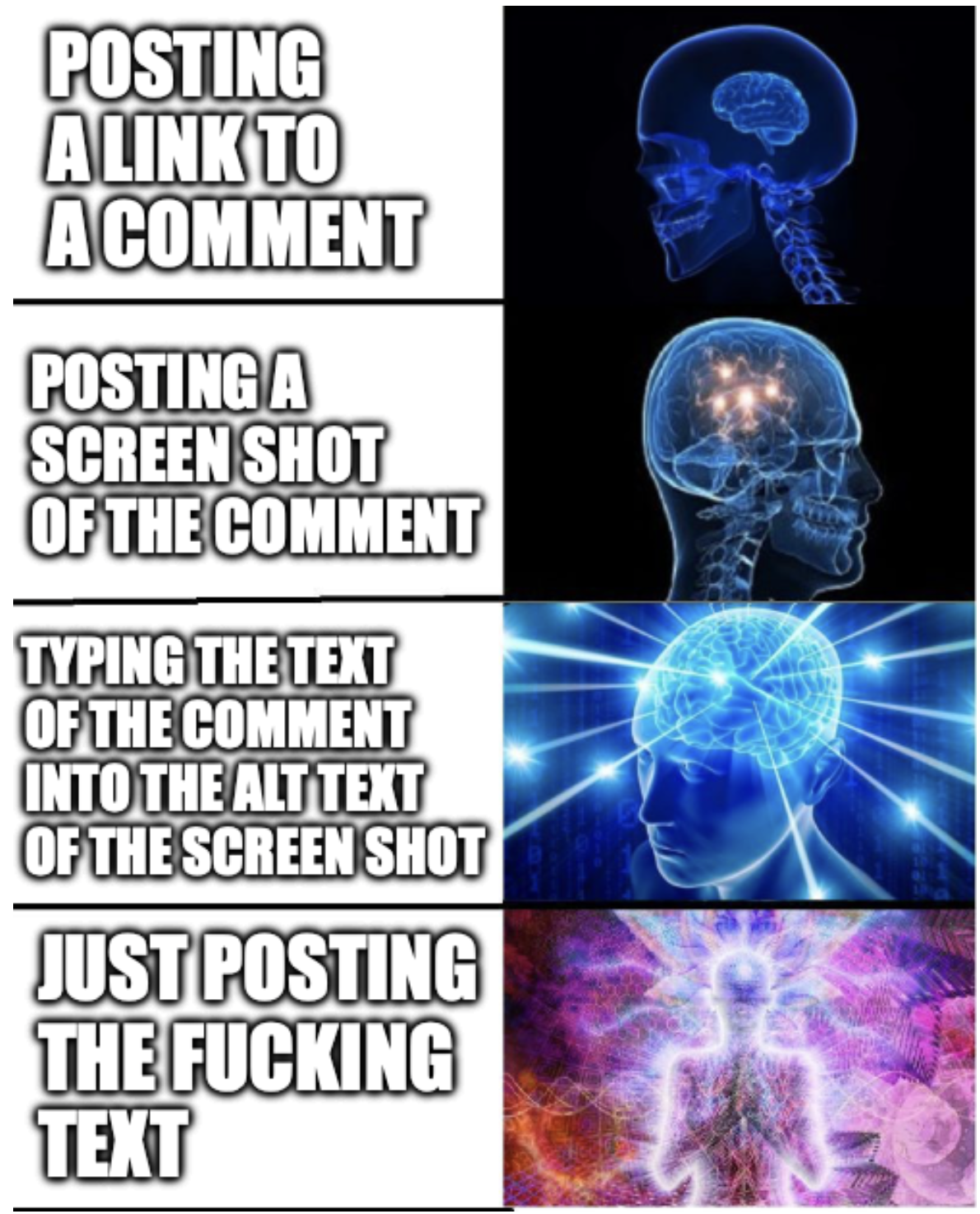
So we can read the text in the image?

The headline was about workers who were missing. Those that you cited are explained, not missing.
Articles like these, the legit ones anyway, have already factored in your points and note that there are still an awful lot of potential workers not in the labor force.
@Huck@mstdn.party @carnage4life
You're looking at the wrong statistic, though. The headline unemployment rate only counts people in the labor force, those who want to work, excluding those who've dropped out.
The more relevant statistic is the employment-population ratio, which does show fewer people in the laborforce than would be on-trend.
Basically, you were showing that people want to work by looking only at the people wanting to work and ignoring all of those who don't.
Also: that's not how inflation works.
I think the most pressing and fundamental problem of the day is that people lack a practically effective means of sorting out questions of fact in the larger world. We can hardly begin to discuss ways of addressing reality if we can't agree what reality even is, after all.
The institutions that have served this role in the past have dropped the ball, so the next best solution is talking to each other, particularly to those who disagree, to sort out conflicting claims.
Unfortunately, far too many actively oppose this, leaving all opposing claims untested. It's very regressive.
So that's my hobby, striving to understanding the arguments of all sides at least because it's interesting to see how mythologies are formed but also because maybe through that process we can all have our beliefs tested.
But if nothing else, social media platforms like this are chances to vent frustrations that on so many issues both sides are obviously wrong ;)
Joined Dec 2022
volkris's choices: