

🎓 Doc Freemo  🇳🇱
@freemo@qoto.org
🇳🇱
@freemo@qoto.org
- UFoI Member
- http://UFoI.org/u/freemo/
- Website
- http://JeffreyFreeman.me
- Gitlab
- https://git.qoto.org/freemo
Admin
Jeffrey Phillips Freeman
Innovator & Entrepreneur in Machine Learning, Evolutionary Computing & Big Data. Avid SCUBA diver, Open-source developer, HAM radio operator, astrophotographer, and anything nerdy.
Born and raised in Philadelphia, PA, USA, currently living in Utrecht, Netherlands, USA, and Thailand. Was also living in Israel, but left.
Pronouns: Sir / Mister
(Above pronouns are not intended to mock, i will respect any persons pronouns and only wish pronouns to show respect be used with me as well. These are called neopronouns, see an example of the word "frog" used as a neopronoun here: http://tinyurl.com/44hhej89 )
A proud member of the Penobscot Native American tribe, as well as a Mayflower passenger descendant. I sometimes post about my genealogical history.
My stance on various issues:
Education: Free to PhD, tax paid
Abortion: Protected, tax paid, limited time-frame
Welfare: Yes, no one should starve
UBI: No, use welfare
Racism: is real
Guns: Shall not be infringed
LGBT+/minorities: Support
Pronouns: Will respect
Trump: Moron, evil
Biden: Senile, racist
Police: ACAB
Drugs: Fully legal, no prescriptions needed
GPG/PGP Fingerprint: 8B23 64CD 2403 6DCB 7531 01D0 052D DA8E 0506 CBCE
Joined Jul 2018
🎓 Doc Freemo 🇳🇱
boosted
🇳🇱
boosted

@freemo If I'm understanding it right (not likely since I didn't understand your OP right) then it's just a matter of which scheme you choose and there's no reason to choose one or the other since they make the same predictions. I guess that's what you meant by "In fact it may very well be impossible to test the one-way speed of light due to the very consequences of relativity itself"
🎓 Doc Freemo 🇳🇱
boosted
🇳🇱
boosted
Now your hitting on the crux of the problem. The problem comes from the inehrent fact that clock synchronization is not about actually synchronizing clocks in any reality... it is about creating a convention which when applied to clocks will give you consistent experimental results. Thats the key in all this. When we synchronize clocks in the typical einstein convention for it the result is such that experiments will give consistent results regardless of if c is symmetric or asymmetric, so the problem becomes moot.
🎓 Doc Freemo 🇳🇱
boosted
🇳🇱
boosted
@seroom to me slow moving clocks dilating makes a lot of sense.. the slower you move a clock the less it dilates, but the longer it needs to stay in motion. So it will in the end dilate the same regardless of how fast you move it for the same distance.
That said if we are just talking about preference in terms of what we assume with our equations, then constant c should be prefered for no other reason than it produces the simplest model and gives the same results as more complex models where c is not one-way constant. The simplest model that gives correct results should always be preferred. But just because its preferred doesnt mean it dictates reality :)
🎓 Doc Freemo 🇳🇱
boosted
🇳🇱
boosted
@freemo yes, I think I've got a grasp on it now. I really do appreciate your responses. I do want to point out that ε-synchronization indicates that slow separated clocks time dilate. I think the counterintuitiveness of this is a legitimate reason to prefer constant c.
🎓 Doc Freemo 🇳🇱
boosted
🇳🇱
boosted
@freemo @Science I continue to believe you are mistaken. From Wikipedia "the speed of light is isotropic, meaning that it has the same value regardless of the direction in which it is measured. Observations of the emissions from nuclear energy levels as a function of the orientation of the emitting nuclei in a magnetic field (see Hughes–Drever experiment), and of rotating optical resonators (see Resonator experiments) have put stringent limits on the possible two-way anisotropy."
🎓 Doc Freemo 🇳🇱
boosted
🇳🇱
boosted
I am not mistaken, this is well established cannon in the scientific community regarding the speed of light, this isnt something I made up. There is a whole wikipedia article on it. To quote the wikipedia article linked below:
When using the term 'the speed of light' it is sometimes necessary to make the distinction between its one-way speed and its two-way speed. The "one-way" speed of light, from a source to a detector, cannot be measured independently of a convention as to how to synchronize the clocks at the source and the detector. What can however be experimentally measured is the round-trip speed (or "two-way" speed of light) from the source to the detector and back again. Albert Einstein chose a synchronization convention (see Einstein synchronization) that made the one-way speed equal to the two-way speed. The constancy of the one-way speed in any given inertial frame is the basis of his special theory of relativity, although all experimentally verifiable predictions of this theory do not depend on that convention.[1][2]
https://en.wikipedia.org/wiki/One-way_speed_of_light
@3ammo By the way the above quote from wikipedia reinforces/agrees with what ive been saying, that the one-way speed of light as a constant is a mere convention and not a postulate or theory about any reality, as one-way speed of light is not measurable.
🎓 Doc Freemo 🇳🇱
boosted
🇳🇱
boosted
> qoto.org/@3ammo/105963064680177147, the "isotropy" of the speed of light is also directly related to our notions of space symmetry (among other things). This a statement about the world.
two problems with this.
1. space symmetry holds true for many things, but none of them in any way rely on a symmetry of speed of light. If light is antisymmetric then space can still be isotropic in all the ways we have observed it to be. you are referring to the cosmological principle and all it states is "When viewed at a large enough scale the universe will look the same to all observers"... this principle holds true even if c is asymmetric.
2. we never defined how c is asymmetric, nor did I state it is just some arbitrary direction in space, the asymmetry could arise through all sorts of rules (none of which is testable mind you). For example it could be that light travels faster in the direction you are moving than the opposite. In relativity fashion therefore the direction of the asymmetry is opposite for each of the observers in a clock synchronization experiment, yet due to the reasons mentioned before once this is resolved by a full round trip to compare clocks the asymmetry cancels out and you get what looks like symmetric results. In fact this example is very much in line with what we see with time dilation and special relativity how the act of making a round trip resolves the twin paradox as the acceleration to reverse direction resolves the paradox.
The point your missing (I think) and that is so important to this is that if an asymmetry exists it can not be distinguished from a symmetry in part to the impossibility of measuring light one-way. It is of a similar nature as trying to know two complimentary properties in QM, not only is it impossible, that impossibility is fundamental.
🎓 Doc Freemo 🇳🇱
boosted
🇳🇱
boosted
@3ammo By the way even einstein said that the idea that C is symmetric in both directions is **by definition** (convention) and not as a postulate. Here is his own words on the matter in one of his published papers.
First he says:
> "But it is not possible without further assumption to compare, in respect of time, an event at A with an event at B."
In this sentence he points out that we can not experimentally or otherwise theoretically conclude anything about these individual times without making an assumption, which implies it is arbitrary. He goes on to say (he put by definition in italics not me):
> "We have not defined a common 'time' for A and B, for the latter cannot be defined at all unless we establish **by definition** that the 'time' required by light to travel from A to B equals the 'time' it requires from B to A"
In other words the symmetry of light is by definition, and not an assertion as to **what is**, namely, a convention.. he never says "we assume light to be".. he says "establish by definition", which is exactly what a convention is.
🎓 Doc Freemo 🇳🇱
boosted
🇳🇱
boosted
@3ammo the problem with that logic is that we already can experementally prove that relativity is correct so any conventional measurement is moot going in.
Moreover the idea that speed of light is a constant is not what is the issue. The speed of light **is** a constant when measured round-trip, that is experimentally provable. What is not a postulate and the part we cant prove is that the speed of light is a constant one-way regardless of orientation. We take that to be the case in relativity as a matter of **convention** not as a postulate. The reason we do so is because even if it is not symmetric it wont change any of the results, therefore any arbitrary convention works, so we pick the easiest one.
Regardless you still cant actually measure it one way, if you do so conventionally you wont account for time dilation at all and get an incorrect answer where using the relativity approach you will get a more accurate answer but it will be interently a two-way measure.
🎓 Doc Freemo 🇳🇱
boosted
🇳🇱
boosted
@3ammo So here is why its a convention and not a postulate... simply speaking if you pick some other convention that ensures the round-trip is unchanged but it is asymmetrical, all the math we do will give the same final results. Thus its a convention because it doesnt really matter since everything is eventually a round-trip anyway, so we just pick the easiest way to get the answer.
As an example imagine a world at the most extreme asymmetry where light travels at c/2 in one direction and instantaneous in the other. If you use this convention and then apply the new form of lorentz transformations to any thought experiment that could be carried out as a literal experiment, you get the same result as you would get if c was symetrical. What happens is the error is just enough that it cancels out and produces the same results.
Consider communicating with a distant astronaut and how we perform the very simple lorentz transformation there to synchronize time. Lets assume we know the real time (I will abbreviate it RT) and lets assume there is a meassured time, ill call this MT.. here is how it works out assuming C is symetrical.
1. Astronaut flys 1 light hour away, experiment starts, RT 0:00
2. Earth sends light signal to astronaut saying "The time here is 0:00" (RT)
3. Astronaut receives message claiming time is 0:00, he knows he is one light hour away so he now sets his clock to 1:00 (MT), he then replies "message received, I have now set my clock to 1:00" and sends this back home.
4. Home base gets the message saying the astronauts MT is 1:00, knows again it is one light hour away so concludes after lorentz transformation that the MT is now 2:00. Looks up at his clock, the RT, and sees it says 2:00. Concludes the astronaut clock and home clock are set to the same time.
But now lets look at the same scenario where the speed of light is c/2 in one direction and instantanious in the other, but the scientist dont know this so use the **convention** that c is symmetric. Being just a convention it should all work out (if it were a postulate then it would be meaningful and thus effect results and things would break here).
1. Astronaut flys 1 light hour away, experiment starts RT 0:00
2. Earth sends light signal "The time here is 0:00" (RT)
3. Astronaut receives signal, assumes c is symetric, therefore performs the same lorentz transformation as before and determines that the time must be 1:00 (MT), in reality because c/2 the RT is 2:00, so the astronauts clock is technically off by an hour. Astronaut replies "I have now set my clock to 1:00".
4. Home base again gets the message of the astronaut claiming the time being 1:00, home base again assumes time is symmetric so gets the same result he did in the earlier experiment assuming that the astronauts clock must be 2:00 by the time they hear the return message (which took an hour to get to them).. sure enough they look up at the wall and it matches RT of 2:00... but in reality the signal was not symmetric and the return time for the light signal was instantaneous instead. That means by the time homebase heard "my clock is set to 1:00" and they assumed it was RT 2:00 by the time they heard it this was wrong, the reply was instantaneous and in reality the astronauts clock was 1:00 by the time they got their response and their transformation was wrong, and the clock is still slow by 1 hour. However it appears to them everything is correct, the full round trip time was still c, they got all the same answers at all the same times they would have if it was symmetrical. So even though it is technically wrong, the results work just as well
In fact you can pick any arbitrary asymetrical convention you want, so long as the round-trip results in a average speed of c, and you will get the exact same results and both sides of the communication would be unable to tell any difference at all.
This is why its a convention, you can pick any asymmetry you want and none of the results will ever change, therefore a convention is picked arbitrarily to be easy. No one needs to say "this is how it is" because nothing changes whether it is that way or not
“In fact he was incurably insane and hallucinated more or less continuously, but by a remarkable stroke of lateral thinking his fellow wizards had reasoned that, in that case, the whole business could be sorted out if only they could find a formula that caused him to hallucinate that he was completely sane.*
*This is a very common hallucination, shared by most people.”
― Terry Pratchett, The Truth
If you think alot about why inequality happens, or how much of inequality is laziness vs circumstance, this is an excellent video that explains that but without the guilt or virtue signaling. Great math and statistical explanation of the dynamic.
Really everyone should watch this:



🎓 Doc Freemo 🇳🇱
boosted
🇳🇱
boosted

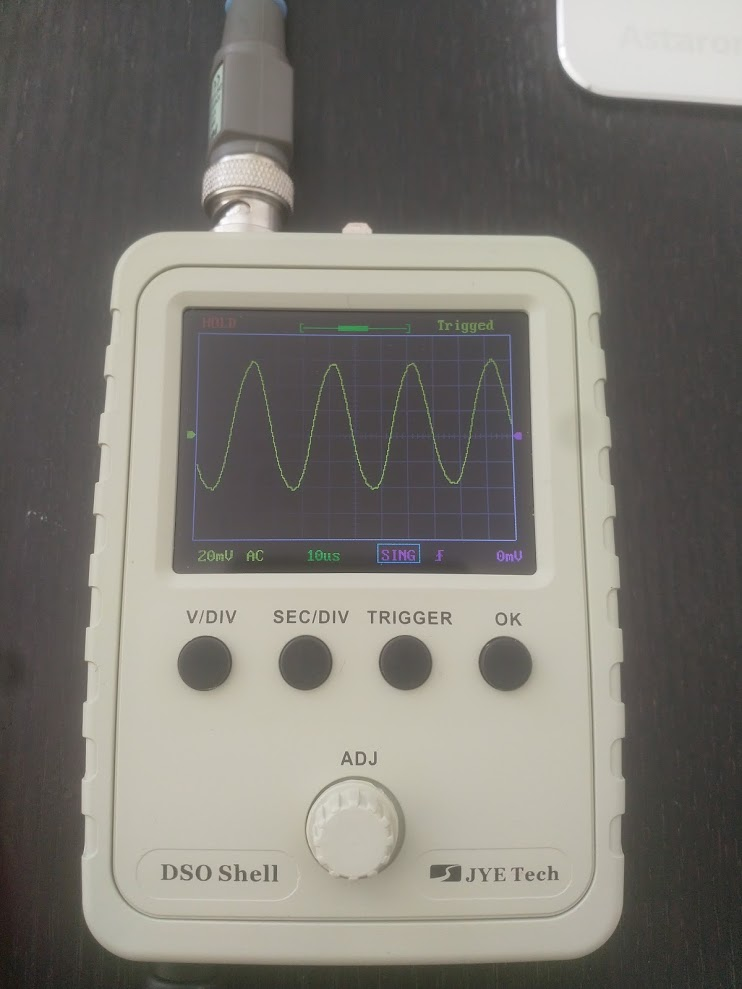
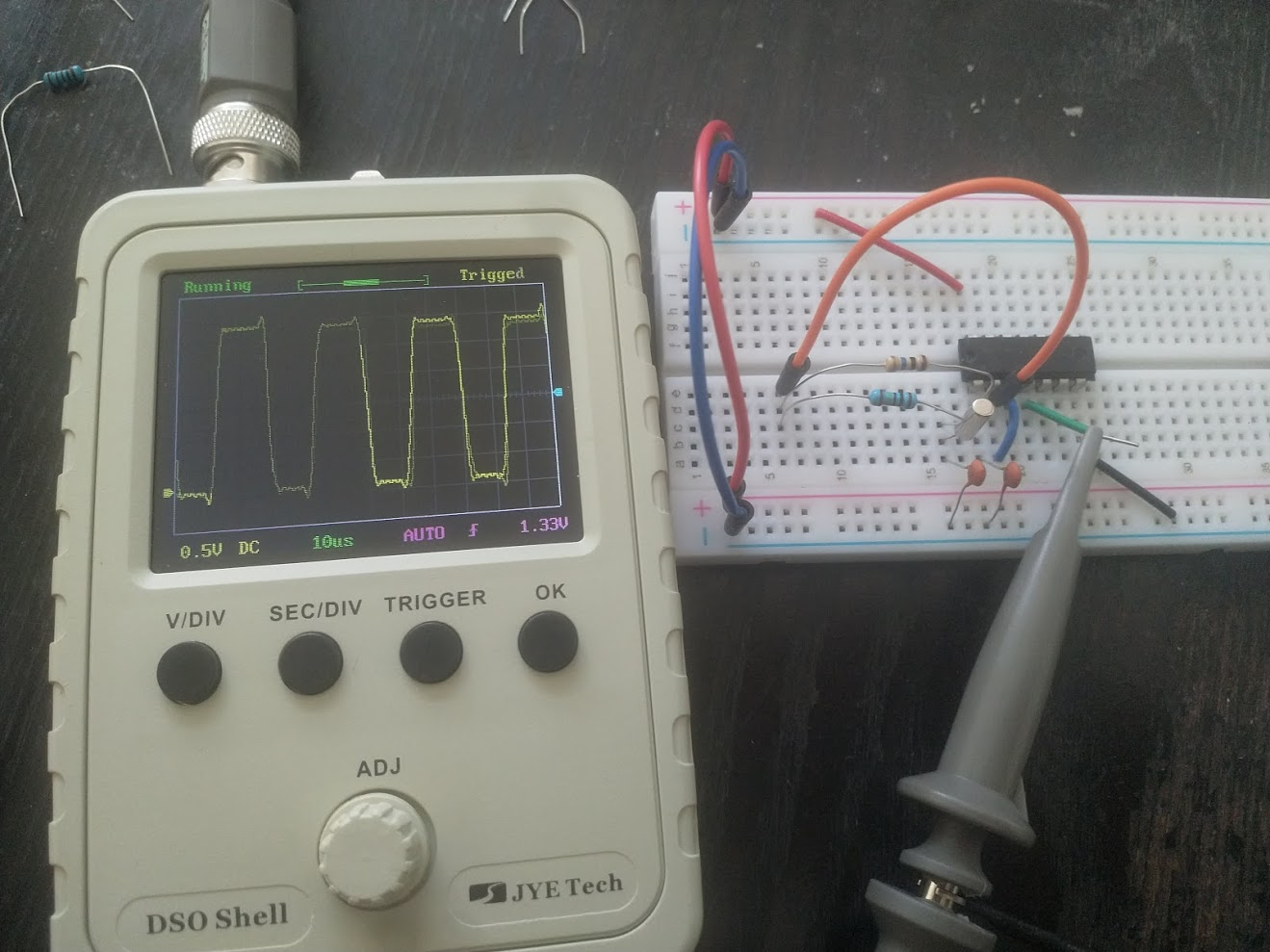
I'm implementing a 32kHz crystal oscillator. Finally got it to actually work, right now! Using a logic inverter (7404 IC), and the Pierce circuit, with 10M and 1M resistors, and two 68pF capacitors and a 3V supply.
In my first tests I saw a wave, but only later realized it was actually caused by 50Hz interference. In these pictures we can now see it's actually a wave with 30us period, or 33kHz.
The voltage at the crystal looks like a nice and smooth 0.1V sine wave, and at the inverter output (going through a second inverter here), we have a pretty nice square wave.
I will now use this to modulate a lower frequency signal.
🎓 Doc Freemo 🇳🇱
boosted
🇳🇱
boosted
In the second stage of this circuit we use the square wave (and the negated one) to control an analog switch. At each cycle we charge a capacitor, connecting it straight to Vcc, and then discharge it through a resistor. This is a small variable capacitor, that goes from 0 to 100pF. As we increase the capacitance, the discharge gets slower. Effectively, we are modulating this sort-of-sawtooth wave by changing the capacitance value. In other words, we are "transducing" the variable capacitance into a modulated voltage signal.
The wave looks a little distorted, no idea if this is a circuit imperfection or just my cheap oscilloscope. Although we can observe anyways that the amplitude changes as we move the screwdriver.
By our best estimates there is a 1 in 500 chance betelgeuse will go supernova in my life time. I really hope I beat the odds on this one!
🎓 Doc Freemo 🇳🇱
boosted
🇳🇱
boosted

@freemo Would the Iron Curtain of Duality also imply the existence of a Chiffon Curtain of Duality?
**Another interesting fact of the day**: If I handed you a device with just a single knob and told you that by twisting the knob you would change the speed of light in a vacuum to a new value for all of time and space from the beginning of time, and then you set off to prove if the device did what I claimed. There would be no way to actually verify or disprove it.
The reason for this is by changing the speed of light you'd effect the apparent size of the universe and everything in it. If you slow down the speed of light to half its normal speed then you also shrink the space between everything to half, so the light takes the same time to move between two objects. Basically any change to the speed of light would cause an equivalent change to your "ruler" and thus would appear to be unchanged.


🎓 Doc Freemo 🇳🇱
boosted
🇳🇱
boosted
Yup you are still missing something.
When you synchronize the clocks and then separate them the act of separating them causes time dilation to occur on the clocks and thus desynchronizes them. Time dilation itself is dependent on the speed of light so if the speed of light is different in different directions then so too will be the effects of time dilation.
So if you synchronize the clocks first and separate them they will be out of sync and you will be unable to compensate for how much out sync they are at any one moment without knowing the extent of the speed of light asymmetry int he first place..
So with your proposed solution of synching the clocks first you haven't, as you can see, avoided the problem at all since the act of moving them breaks synchronization. And your lorentz transformation depends and requires symmetric values of C or to know the specific asymmetry up front to do the synchronization. So you are still shit out of luck :)
- UFoI Member
- http://UFoI.org/u/freemo/
- Website
- http://JeffreyFreeman.me
- Gitlab
- https://git.qoto.org/freemo
Admin
Jeffrey Phillips Freeman
Innovator & Entrepreneur in Machine Learning, Evolutionary Computing & Big Data. Avid SCUBA diver, Open-source developer, HAM radio operator, astrophotographer, and anything nerdy.
Born and raised in Philadelphia, PA, USA, currently living in Utrecht, Netherlands, USA, and Thailand. Was also living in Israel, but left.
Pronouns: Sir / Mister
(Above pronouns are not intended to mock, i will respect any persons pronouns and only wish pronouns to show respect be used with me as well. These are called neopronouns, see an example of the word "frog" used as a neopronoun here: http://tinyurl.com/44hhej89 )
A proud member of the Penobscot Native American tribe, as well as a Mayflower passenger descendant. I sometimes post about my genealogical history.
My stance on various issues:
Education: Free to PhD, tax paid
Abortion: Protected, tax paid, limited time-frame
Welfare: Yes, no one should starve
UBI: No, use welfare
Racism: is real
Guns: Shall not be infringed
LGBT+/minorities: Support
Pronouns: Will respect
Trump: Moron, evil
Biden: Senile, racist
Police: ACAB
Drugs: Fully legal, no prescriptions needed
GPG/PGP Fingerprint: 8B23 64CD 2403 6DCB 7531 01D0 052D DA8E 0506 CBCE
Joined Jul 2018
