
Nicola Romanò @nicolaromano@qoto.org
- Pronouns
- he/him
Senior lecturer at Edinburgh University and Zhejiang-Edinburgh Joint Institute (ZJE).
Undergraduate Programme Coordinator, Biomedical Informatics at ZJE.
I teach #imageanalysis & #dataanalysis with #RStats & #python.
My research is focused on how #heterogeneous behaviour in #pituitary (and other) cells shapes their function as a population.
I'm also very interested in #reproducibility and #openscience.
Joined Oct 2022
Nicola Romanò
boosted

Twitter; abuse
Shout out to the pro-science folks here and on twitter who admonished me for leaving and told me (1) I was letting down the cause and (2) by leaving I was playing politics instead of doing science.
No. A bully runs that house, and I'm walking out the door. You have no right to tell anyone to stay with an abuser and put up with threats to their own safety.
Unless you've weathered three years of death threats for your public health advocacy, keep it to yourself.
Nicola Romanò
boosted

#introduction Hi, first toot! I'm a scientist and secular humanist. I love reading (fantasy and sci-fi but anything really), clouds, timekeeping, moose, the 80s, and classic rock music. Causes include the planet, human trafficking, and US blue wave 🌊
@gringene @wdecoster @nanopore Good idea! I'll try that tomorrow (and I'll post the header when back at work!)
@wdecoster @gringene @nanopore That was my first thought as well, but I see the same when importing the reference I used in IGV. Also, I used the same reference to align directly on the MinION and that one looks fine... Good suggestion, though, I will double-check again tomorrow just in case I have selected the wrong file somewhere.
@gringene @nanopore Yes, absolutely. I am using Mus_musculus.GRCm39.dna.primary_assembly.fa as a reference, from https://ftp.ensembl.org/pub/release-108/fasta/mus_musculus/dna/
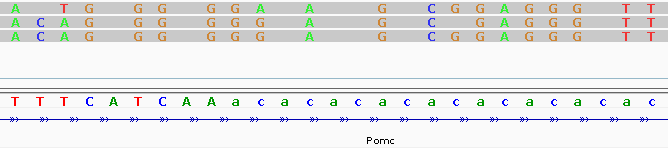
Note that this is not limited to the region I showed in that post, you can essentially pick any gene and see a similar picture.
As an example, here is a zoom of one of the alignments I get... there is obviously something odd going on...
Nicola Romanò
boosted

Tis the season to be marking
Falalalalaaaa la la la laaa
@mcaleerp and I collected together all our ideas for making feedback and engaging students in using that feedback to make some tools that we and others can use go make better and useful feedback, but also tools to help student to use that feedback.
Access our article here:
https://osotl.org/index.php/osotl/article/view/42
Is there any one familiar with analysis of #nanopore #longreads ?
I'm having some bizarre issues when using #minimap2 to align them and I'm almost out of ideas of what to try next...
Here's an explanation of my issue
Nicola Romanò
boosted

Wow, this paper on #scRNAseq and differential expression methods is an eye opener. https://www.nature.com/articles/s41467-021-25960-2
Nice overview of methods and relatively easy to understand explanation of what is wrong with certain, especially single-cell-specific, methods.
Of great help in my own scRNA-seq efforts. Should probably have read this earlier. Now, back to R I go. 😅
@scullingmonkey I was not thinking about the absolute numbers, rather the fact that they're not keeping an account of the numbers. Even if legal (it wouldn't be in the UK or in Europe) it's definitely bad scientific practice
@scullingmonkey "the company does not keep precise records on the number of animals tested". I am not familiar with US law... but is that even legal?
@CharlesO wondering if this is a scam to get you to pay publishing fees? Is this person an actual professor at that uni?
Nicola Romanò
boosted

As a blind individual, I have to say that #Caturday on #Mastodon is far far more enjoyable then at #Twitter, where the vast majority of cat photos are not described.
It is also been fascinating for me to hear descriptions written by those who sent the image, immediately followed by Apple image recognition’s attempts to describe the same image. Only rarely does that add anything to the ALT, & often directly contradicts it.
There is no auto magical solution to image description. It is something best done by a human, for only that human can explain the “why” of the image: the reason that image was chosen to speak so eloquently without words for those who can see it. ALT allows you to provide those words.
Nicola Romanò
boosted

Pride in history can be detrimental to progress. It can make people delusional that they’re special relating to times they didn’t exist in. The reality of those times is often translated to them as one-sided stories where they imagine themselves to be the heroes. They get stuck.
Nicola Romanò
boosted

"More than our rank".
This is an initiative that every university would do well to join, regardless of its ranking.
Indeed, each institution, for various reasons, many of which are its own, is worth much more than the rank assigned to it by a limited, indigent and ideologically connoted system of indicators.
https://inorms.net/more-than-our-rank/
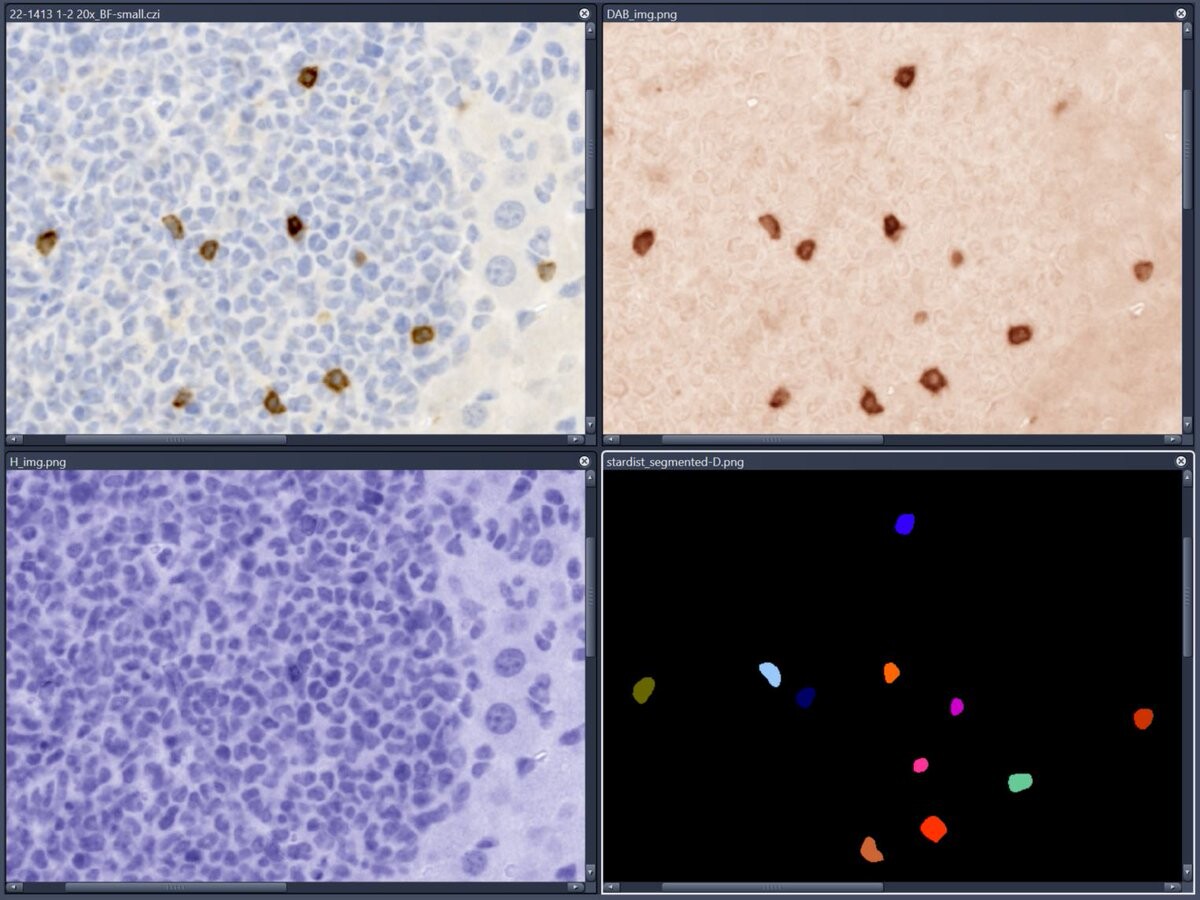
@joshburnett @digitalsreeni That looks like a thresholded version of the top right, followed by detection of connected areas of pixels. scikit-image is a great tool to use for these things.
Nicola Romanò
boosted

It only takes a few lines of #python code to gain insights from scientific images.
They are just a click away if you are not into coding - ask me about it.
#deeplearning #bioimageanalysis #microscopy
@DavidKnuffke That is cool, but I would not rely 100% on it; indeed, I tried on a few outputs, and while some are detected as <1% real, others are considered >90% real. I haven't, however, found a piece of text written by a student that was classified as AI-generated (however, I have only tried a few).
I would be extremely careful about relying on such a tool as "proof" of academic misconduct.
Most of all, I think that discussing these tools with students is extremely important.
@gerard_mazza@kolektiva.social Only partially agree. I had ChatGPT give answers to questions that required some critical understanding of fairly complex experimental design, which is very much a real-life skill that students need to learn in my field...
Nicola Romanò
boosted


Why? I really started believing in federated platforms (again). That’s what the internet was and should be. I must take the sacrifice for this belief, despite loving the Twitter community.
Nicola Romanò
boosted

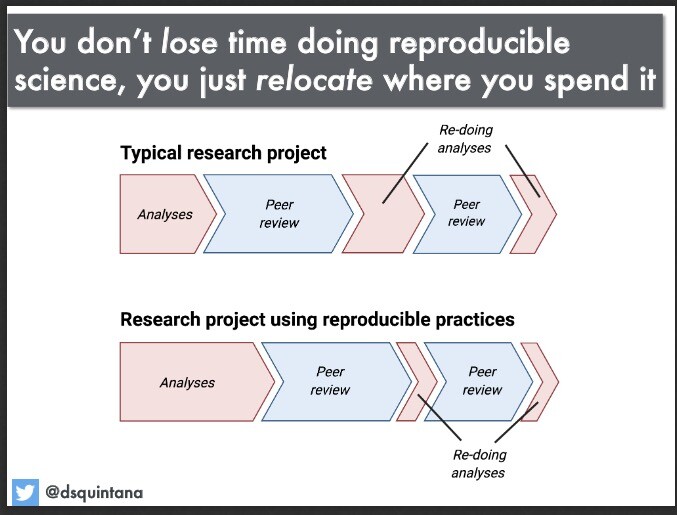
The slides for my recent intro to open science (OS) talk, including 5 things about OS that everyone should know
➡️ https://osf.io/zy2pc ⬅️
1. OS practices accelerate scientific discovery
2. Adopting OS practices can make you a more competitive job/grant applicant
3. Data sharing is on a continuum (it doesn’t have to be either fully open or fully closed)
4. Take it one step at a time, you don’t have to learn every skill at once
5. Your future self will thank you for adopting OS practices
- Pronouns
- he/him
Senior lecturer at Edinburgh University and Zhejiang-Edinburgh Joint Institute (ZJE).
Undergraduate Programme Coordinator, Biomedical Informatics at ZJE.
I teach #imageanalysis & #dataanalysis with #RStats & #python.
My research is focused on how #heterogeneous behaviour in #pituitary (and other) cells shapes their function as a population.
I'm also very interested in #reproducibility and #openscience.
Joined Oct 2022
