
tripu
boosted

RT @ceolinwill@twitter.com
Open-source alternatives to popular products:
- Figma: @penpotapp@twitter.com
- Google Analytics: @PlausibleHQ@twitter.com
- Notion: @appflowy@twitter.com @Boostnoteapp@twitter.com
- Slack: @Mattermost@twitter.com @RocketChat@twitter.com @element_hq@twitter.com
- Zoom: @jitsinews@twitter.com
- Airtable: @baserow@twitter.com @nocodb@twitter.com
- Calendly: @calcom@twitter.com
- Mailchimp: listmonk
🐦🔗: https://twitter.com/ceolinwill/status/1546622473193537537
I answered to that very quote [here](https://qoto.org/@tripu/108601123340223313) and [here](https://qoto.org/@tripu/108605903537015769). I have the impression you keep on throwing quotes instead of engaging with arguments.
I think I have presented a nuanced view, an opinion that is far from any extreme (_“quantifying and modelling more often **may lead to confidence bias, overconfidence, Dunning-Kruger, or problems of the sort**”_; _“probability […] is appropriate […] in **almost all** circumstances”_; _“I never denied the usefulness of system 1 thinking, social norms, or heuristics; of course **all that has value**”_). I still don't understand where you disagree, specifically.
tripu
boosted
RT @NASA@twitter.com
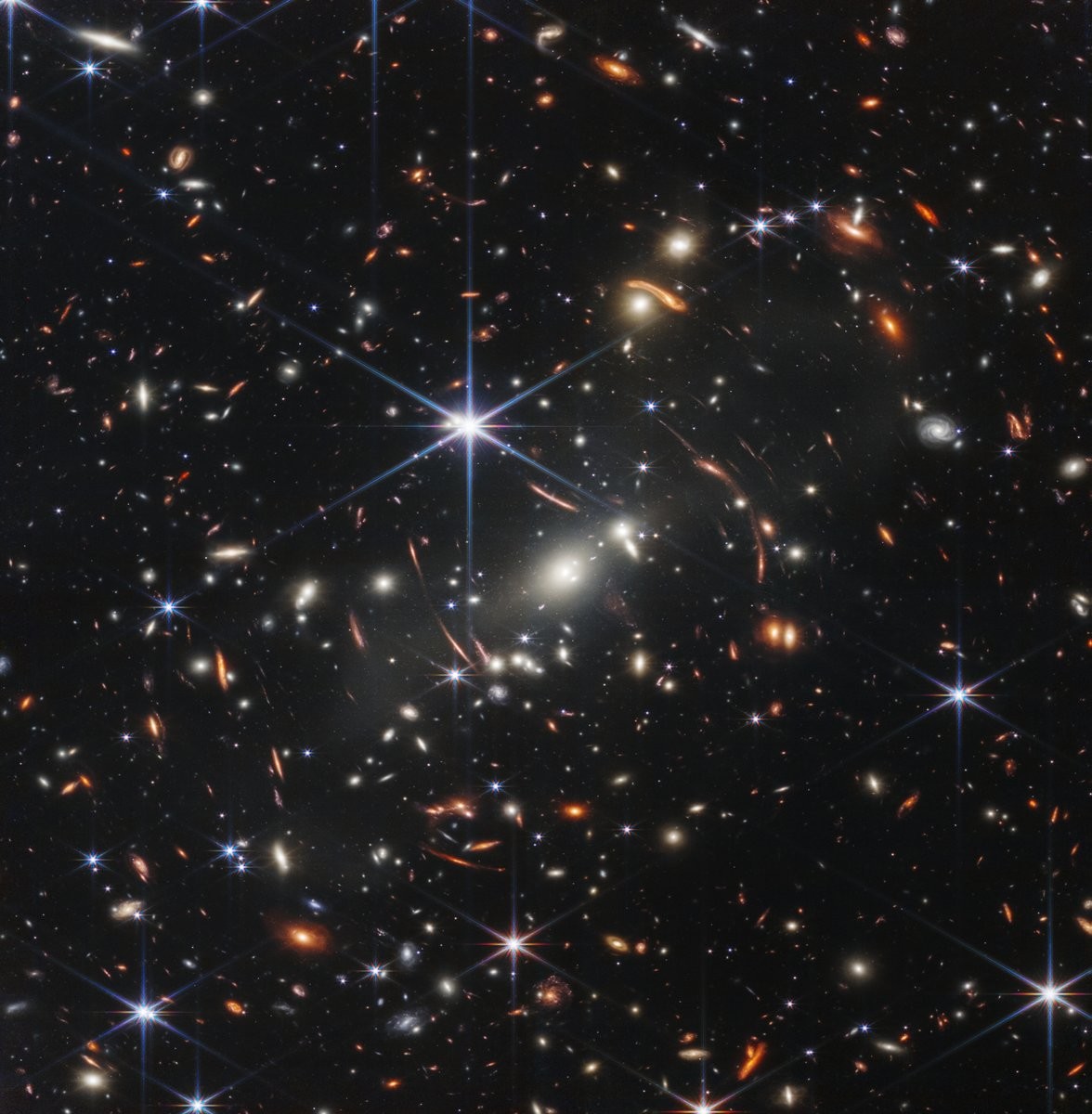
It's here–the deepest, sharpest infrared view of the universe to date: Webb's First Deep Field.
Previewed by @POTUS@twitter.com on July 11, it shows galaxies once invisible to us. The full set of @NASAWebb@twitter.com's first full-color images & data will be revealed July 12: http://nasa.gov/webbfirstimages
tripu
boosted

La vergüenza del #decretoley, que siempre fue una vergüenza, es una vergüenza aberrante y miserable con este #gobierno:
https://civio.es/el-boe-nuestro-de-cada-dia/2022/07/07/decretos-ley-desde-1996/
tripu
boosted

Dear Linux desktop apps, you have full authorization to create a folder in my ~/.config directory, you are even invited to stuff your data in my ~/.local/share directory, and let's not forget about that ~/.cache y'all! Wunderbar! Much freedom!
So, now, please repeat after me:
👏 I 👏 SHALL 👏 NOT 👏 MAKE 👏 A 👏 FOLDER 👏 IN 👏 YOUR 👏 HOME 👏 DIRECTORY 👏
Thank you kindly
tripu
boosted

I needed to shave my beard in order for the stupid AI of my bank app to realize I'm the same person as the one on my ID card.
This is why we need crypto and self-custody. Not your keys 🔑, not your beard 🧔♂️ !!!
Our claim is that probability (math, numbers) is appropriate (useful, valuable) in almost all circumstances.
You just swapped surreptitiously “[irrational] religious fundamentalism” with “historical cultural & religious practices”. There are huge differences.
Math is better at describing reality with accuracy, communicating unambiguous information, and predicting the future than less rigorous systems — and _everything_ is less rigorous than math.
Math (science, in general) can (and does) incorporate insights from other areas of life. You can quantify or estimate almost anything, crunch the data, find patterns and correlations, and model aspects of reality. There are studies modelling religious experience, subjective well-being, inflection points in History, whatever. The opposite is not true: Islam can't evaluate a new method to improve the reproduction rates of fish in captivity, Danish culture can't provide an estimation of the future impact of a certain monetary policy, Western tradition can't know how to reduce heat dissipation in electric batteries, etc.
I never denied the usefulness of system 1 thinking, social norms, or heuristics. Of course all that has value. I'm saying that putting numbers on things and manipulating those numbers with the tools of mathematics almost always _adds_ value and helps in understanding and decision-making.
No solo esa confusión que mencionas. Es también que la «noticia» sea que alguien advierte de «los riesgos de confiar ciegamente en [cualquier cosa]». ¿No es evidente, no aplica a todo? Y además: espero que El País mencione que aproximadamente la mitad de «sus colegas» tienen una opinión distinta, e incluso opuesta (o sea, que #blockchain y #BTC son grandes avances).
#Periodismo 🤦♂️
> _“There's no religious fundamentalism that's more irrational than an atheist's primitive use of probability.”_
This is hyperbolic, unfounded, and obviously false.
So: you take a random atheist with a basic knowledge of probability (myself, for instance) and the way they (I) use probability is _less rational_ than the worst religious fundamentalism imaginable (eg the Aghori, Aum Shinrikyo, Children of God, or Jihadism).
I honestly don't know how to argue against — or in favour of — this ridiculous idea, obviously wrong as it is.
Most rationalists I respect (and I) disagree.
> _“I generally support applying made-up models to pretty much any problem possible, just to notice where our intuitions are going wrong and to get a second opinion from a process that has no common sense but […] also lacks systematic bias (or else has unpredictable, different systematic bias).”_
A meta idea to further illustrate my point:
I made a bold claim there (that people would understand things better and make better decisions using numbers more often). You seem to disagree. How could we resolve that question?
One way would be to use data and maths. For example we could design lab experiments and surveys where we try to assess whether participants understand something better, or choose better alternatives, with and without numbers. We could prime participants to rely on different systems (guts, tradition, peers, stats) and see how they perform. We could test them for the same thing in slightly different scenarios. We could look for natural experiments where certain institutions or individuals made decisions under comparable circumstances, except for the availability or absence of mathematical models or estimations. And so on. We would then collate results, control for spurious variables, average and weigh, and arrive at an (always imperfect and always temporary) conclusion, and then settle the question for the time being.
Another way to test my bold claim would be… _anything else_: personal experience, anecdotes, opinions.
If you agree with me that the first method would be more useful or reliable than the second one, you kind of agree with my initial claim already.
I agree that quantifying and modelling more often _may_ lead to confidence bias, overconfidence, Dunning-Kruger, or problems of the sort, sometimes.
But that is very weak criticism of my proposal, since _every_ system or tool you use (or lack thereof) could potentially give you a false sense of confidence. Don't people with religious convictions have overconfidence? Don't people who rely mostly on tradition, social norms or intuition have biases (eg, desirability bias) and poor understanding of issues ?
The question for me (and other rationalists) is **whether people and institutions would be better off, in general, using maths more often**, in the form of stats, estimates, cost-benefit analyses, decision matrices, etc.
My impression is that the vast majority of people would benefit from putting numbers on things more often.
It feels great to stumble upon an #ACX post validating your own idea:
> _“I’m disappointed that no one has ever tried expanding the #QALY concept to things outside health care before. It’s not that I think it will work. It’s that I think it will fail to work in a different way than our naive opinions fail to work, and we might learn something from it.”_
https://slatestarcodex.com/2013/05/02/if-its-worth-doing-its-worth-doing-with-made-up-statistics/

Since our goal in #life is maximising {well-being, quality of life, happiness, flourishing, utility} both for us and in the universe as a whole (no...
tripu
boosted



Saved to read when I have the time. Thanks!
I completely agree. Measuring isn't the same as shaping or controlling. I don't have the time to read that post, so I'm not sure what's the connection to my quote.
Even better:
> _“You can put a #number on anything if you try hard enough (number quality not guaranteed, see store for details).
Once you put a number on something, you improve your understanding and decision making (even if the number isn’t of prime quality). At the core of this belief is the idea that the world we live in is made of #math, however literally you decide to take that statement. Whenever a field of #science achieves any useful knowledge of that world, it is usually in form of precise mathematical equations or careful #statistics. Every science is an exact science, or trying to be.”_
Everything is quantifiable, and should be quantified. Everything is a #measure or can be measured. #Science can study anything, and #mathematics i...
Real-life example of my point:
> _“Here’s the Economist’s 1843 cover story on how I used spreadsheets to make sense of dating and polyamory. Here’s the New York Times article on how my wife and I used spreadsheets to pick our apartment. Somehow **the simple idea (not remotely original to me) of taking the simple tool of decision matrices out of the office and into life choices is enough for worldwide fame**.”_
https://putanumonit.com/2020/03/18/media-roundup-and-book-club/
Everything is quantifiable, and should be quantified. Everything is a #measure or can be measured. #Science can study anything, and #mathematics i...
