

Nicola Romanò @nicolaromano@qoto.org
- Pronouns
- he/him
Senior lecturer at Edinburgh University and Zhejiang-Edinburgh Joint Institute (ZJE).
Undergraduate Programme Organiser, Biomedical Informatics at ZJE.
I teach #imageanalysis & #dataanalysis with #RStats & #python.
My research is focused on how #heterogeneous behaviour in #pituitary (and other) cells shapes their function as a population.
I'm also very interested in #reproducibility and #openscience.
Joined Oct 2022
Nicola Romanò
boosted

dplyr 1.2.0 is out now and we are SO excited!
- `filter_out()` for dropping rows
- `recode_values()`, `replace_values()`, and `replace_when()` that join `case_when()` as a complete family of recoding/replacing tools
These are huge quality of life wins for #rstats!
Nicola Romanò
boosted

 What's the most common complaint I've heard about Linux?
Not the installation process.
Not finding a distro.
Not getting programs to work.
Not troubleshooting.
Not hardware compatibility.
The most common complaint about Linux I've seen is this:
For a normal computer user, asking for help is just about impossible.
They ask a simple question and:
People respond "Did you Google it?"
People complain that the question wasn't asked "correctly".
People respond "RTFM"
People get mad??? at them for making an easy mistake.
We can't expect normal people to know to, or even know how to deal with any of that stuff.
Search engines these days are awful, manuals are hard to read for most people (especially stuff like ArchWiki), and normal people make mistakes we think are easily avoidable.
The solution to making Linux more popular is not ruthless promotion. The solution is to actually help the people who are trying to use it. 
@futurebird Don't know if it's something appropriate to your teaching, but last year I saw an excellent talk by Felienne Hermans, the creator of the Hedy programming language https://hedy.org/ . This guides young students through different levels of complexity onto full fledged Python.
You can watch her talk here, as she obviously explains it much better than me (it's video 15 in the playlist, you might enjoy the other talks as well!) https://pairprogramming.ed.ac.uk/winter-school-25/
I also recommend her article "A Case for Feminism in Programming Language Design" https://dl.acm.org/doi/10.1145/3689492.3689809
Nicola Romanò
boosted

"Getting over ANOVA: Estimation graphics for multi-group comparisons", Lu et al. 2026 (Claridge-Chang's lab)
https://www.biorxiv.org/content/10.64898/2026.01.26.701654v1
"Data analysis in experimental science mainly relies on null-hypothesis significance testing, despite its well-known limitations. A powerful alternative is estimation statistics, which focuses on effect-size quantification. However, current estimation tools struggle with the complex, multi-group comparisons common in biological research. Here we introduce DABEST 2.0, an estimation framework for complex experimental designs, including shared-control, repeated-measures, two-way factorial experiments, and meta-analysis of replicates."
Grateful to Adam Claridge-Chang for leading and pushing on this. There's institutional-wide need for change in the biological sciences when it comes to statistical handling of data. And quite the memorable acronym, #DABEST ...
Nicola Romanò
boosted

AI deepfakes affect people even if they know the videos are fake: nice media coverage here of https://phys.org/news/2026-01-people-swayed-ai-generated-videos.html one of our recent studies. 1/2
1/2
Nicola Romanò
boosted

My book, Accessibility For Everyone, is now free and online as a website.
https://accessibilityforeveryone.site
The book was first published by A Book Apart in 2017 but it holds up! It covers web accessibility for designers, developers, content folks, and really everyone who works in tech.
Nicola Romanò
boosted

ArXiv "now requires first-time posters to be endorsed by an established arXiv author in their own field. People who have previously posted in the same disciplinary section of arXiv do not need an endorsement. The move is an attempt to clamp down on a rising tide of fraudulent submissions, says University of Amsterdam astronomer Ralph Wijers, chair of the arXiv editorial council. A large fraction, he says, are generated with artificial intelligence (AI)."
https://www.science.org/content/article/arxiv-preprint-server-clamps-down-ai-slop
@steveroyle Doesn't sound promising
Nicola Romanò
boosted

Our new pre‑print is out!
scReady – an automated and accessible pipeline for single‑cell RNA‑Seq preprocessing: Empowering novice bioinformaticians
https://wellcomeopenresearch.org/articles/11-43
@haessar.bsky.social @fionan-a.bsky.social @yiyicheng
@steveroyle Is there any hint of why and if it's only MRC or wider UKRI?
@doctormo "You're dead to me" by Greg Jenner. Funny and interesting.
@sponce1 That's very interesting! Would you mind if I used this as an example in a lecture?
Nicola Romanò
boosted

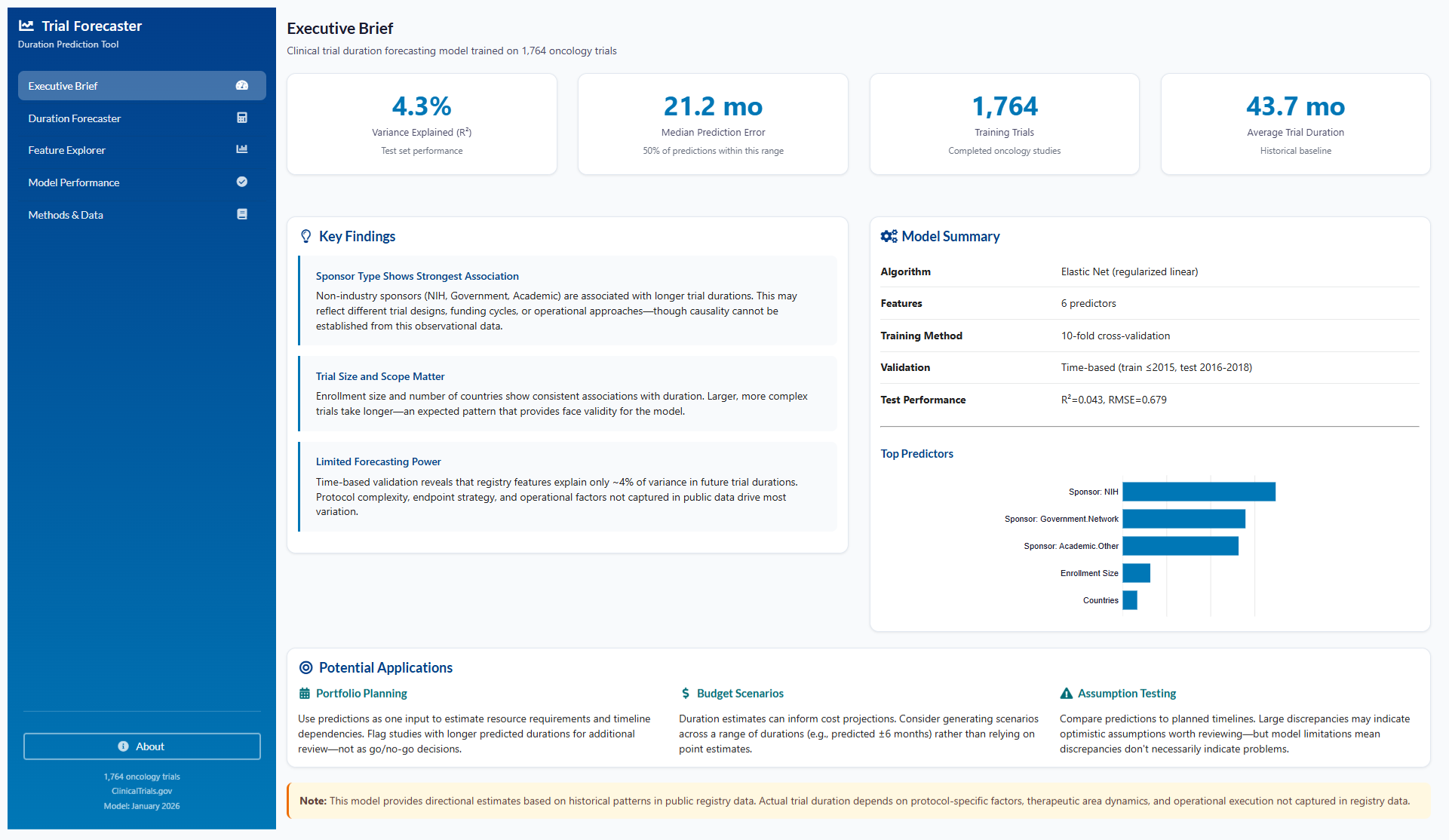
Built an oncology trial duration forecaster. The honest finding? R² dropped from 0.84 to 0.04 under proper validation. Validation strategy > model selection.
.
🔗 stevenponce.netlify.app/projects/standalone_visualizations/sa_2026-01-19.html
.
#rstats | #shiny | #pharma | #clinicaltrials | #machinelearning
@skewray @rperezrosario or a better way of solving it is teaching people they can, and how to do that? I never realised until now that I could!
@karthikganapathy @svat Or Eddie Izzard's take on it https://youtu.be/TjC3R6jOtUo?si=wlpODLzANqR3Rq9Y
Nicola Romanò
boosted

I think I now know where to draw the line between "good" and "bad" #GenAI, and possibly (or rather obviously) the same for #machineLearning. It's simply whether the input data has been constructed rigorously. Put this way it's the most obvious statement ever, but somehow #BigTech have convinced us all that they advance research by recklessly scraping #twitter, #4chan and who knows what else (they keep their training data secret).
What is good science in computational linguistics? Well, open data is a step towards it. But open and crap is not a solution. We need to actually _know_ and manage the data. And nobody in their right mind would want to plough through toxic data to clean it. We've all heard the horrors of Kenyan data workers who do it for money and still suffer doing it.
But better (yes, also smaller) corpora are of interest to scholars in the humanities and the social sciences. Think of https://textcreationpartnership.org or https://mlat.uzh.ch. Yes, they are too big for individual researchers or even teams to handle, but we have the organisational and technological infrastructure to work on them collectively. We've been doing it for ages and we will continue doing it. We just need to do it together.
And this is the goal of the European Research Council project proposal I'm submitting in this very moment.
Nicola Romanò
boosted

The Mathematical Center of the Venezuelan Institute for Scientific Research was destroyed in the military operation conducted last week. This is unbelievably sad. The IVIC is among the top research centres in the world and has been a major hub for mathematics in Latin America since at least the 1970s.
https://venezuela-news.com/ministra-jimenez-denuncia-destruccion-ivic-ataque-militar-eeuu-venezuela/
Solidaridad con los y las colegas de Venezuela y Latino América. Gracias por seguir luchando para desarrollar y transmitir el conocimiento matemático.
@ricci @ricci We have regular meetings with our admin team, and they are involved in decision making together with faculty. Mostly anything that admin does for me means that there is something I do not have to do myself, which is, by default, great.
As always *communication* is key and recognising admin work is absolutely necessary because if you want people to work well with you, treating them as second class citizens doesn't really help in the long term to create a good working environment.
@irene @ricci Please, do not use that counterpoint. Research and teaching are in no way superior to the admin work.
I've worked and I do work with some amazing people in admin, who do jobs I would never want to do but that it is critical for what I do.
Sure, I've been in situations where my job has been hindered by university policies or by admin, but I've also been in situations where that has come from fellow researchers/lecturers (case in point, people doing shabby work when marking).
Nicola Romanò
boosted


I am a Gen X man. And I want to tell you how I realised and learned to identify the “survival laugh.”
First, I noticed it in a social setting. I saw a woman laugh at a dangerously unpredictable man, not from joy, but to disarm him. Then I slowly recognised it everywhere: the forced chuckle in a professional meeting, the charming smile in media. This was never joy. This was a survival tactic. She doesn’t enjoy herself. She is deflecting a blow. She is surviving.
So I started asking myself in all sorts of different situations “Would I be laughing right now?”. The answer was almost always no. I can’t help but wonder how other men don’t see it? But the answer is simple: patriarchy.
I do see genuine, unforced laughter or enjoyment as well. But when I see it, I see it more often than not in queer communities, where we all can feel free from those heteronormative pressures. That contrast makes the truth of the “survival laugh” all the more heartbreaking. To everyone who has had to laugh to stay safe, all I can say: I see you, and I’m sorry.
#randomthoughts #society #patriarchy #safeplace #queer #misogyny #survival
- Pronouns
- he/him
Senior lecturer at Edinburgh University and Zhejiang-Edinburgh Joint Institute (ZJE).
Undergraduate Programme Organiser, Biomedical Informatics at ZJE.
I teach #imageanalysis & #dataanalysis with #RStats & #python.
My research is focused on how #heterogeneous behaviour in #pituitary (and other) cells shapes their function as a population.
I'm also very interested in #reproducibility and #openscience.
Joined Oct 2022
