

rastinza @rastinza@qoto.org
Italian, MSc in chemistry specialized in cheminformatics and QSAR.
I'm interested in cooking and building stuff.
I love traveling, I lived in India, China, Slovenia, Poland and Spain.
Currently working in Spain in the field of genomics; and doing a PhD in Drug Development using Quantum Mechanics and Artificial Intelligence.
Don't take what I say as an insult, I have no bad intentions and I'm open to talk about it.
Don't star my toots, I find that often useless: if you liked it send a reply.
Consider boosting the toots, it's the only real way in which stuff is propagated through mastodon.
Joined Feb 2022
@12ax7 @malerbabomba@mastodon.bida.im @samba @statussquatter @NicholasLaney@nebbia.fail
Mi immagino che se sei a questi livelli di organizzazione il materiale incendiario sia l'ultimo dei problemi. Però si, chiaramente ti possono accusare di varie cose. Un'alternativa meno efficace ma comunque valida sarebbe acqua e sapone.
A quanto ho visto credo che CS sia il gas standard in dotazione in Italia. Dubito vi siano studi estensivi sulla mutagenicità.
Con i solventi citati non dovrebbero esserci rischi di reazioni. Il migliore dovrebbe essere la benzina. L'unico rischio è che se ci sono fiamme in giro possono prendere fuoco.
@12ax7
Direi che siete fortunati ad averci un chimico nella comunità, possiamo analizzare il problema fino a trovare le soluzioni più adatte.
Ho cercato qualche articolo a riguardo, a quanto ho capito in Italia il gas lacrimogeno usato è il CS.
Qui c'è un articolo liberamente accessibile che parla di tre gas: CS, CN ed OC: https://militaryhealth.bmj.com/content/161/2/94.info
I tre composti non presentano gruppi fortemente acidi o basici e dunque non possono essere neutralizzati attraverso le normali reazioni acido-base. Può darsi che reagiscano con sostanze acide o basiche: il CS contiene due gruppi cianuro e l'articolo riporta che in acqua idrolizza a malononitrile, questa reazione verrebbe velocizzata in presenza di acidi o basi ma dubito fortemente che questa reazione proceda abbastanza rapidamente da avere alcuna utilità nella cura dei sintomi.
Una cosa molto interessante che non sapevo è che non si tratta di gas: sono composti solidi o liquidi a temperatura ambiente. Per essere usati vengono dispersi in un aerosol, dunque hanno particelle abbastanza grosse che si dovrebbero poter fermare abbastanza bene con una buona maschera antiparticolato. Anche il panno con sapone dovrebbe funzionare bene.
Il rimedio consigliato ed efficace è lavare gli occhi con acqua o soluzione salina.
Queste molecole sono sostanzialmente insolubili in acqua, quindi non le scioglierete via. L'acqua deve essere spruzzata in un getto abbastanza forte e per un tempo prolungato in modo da rimuovere meccanicamente le particelle sull'occhio.
Tutte e tre le molecole sono solubili in sostanze apolari, tuttavia non è il genere di cose che vuoi metterti negli occhi.
Un'altra cosa che consigliano è muoversi verso posizioni più elevate. Le particelle eventualmente cadranno verso il basso, mi immagino tuttavia che questo richieda abbastanza tempo.
Il metodo del cono stradale mi sembra abbastanza buono. Dato che questi composti sono solubili in sostanze apolari, sarebbe meglio utilizzare queste invece di acqua per disattivare la granata.
Acetone, alcol, benzina; questi hanno inoltre il vantaggio che possono essere incendiati. Bruciare questi gas dovrebbe distruggerli.
A questo punto si potrebbe migliorare l'idea del barattolo. Si può usare un contenitore pieno di un solvente in cui chiudere la granata in modo che il gas gorgogli attraverso il liquido. Sarebbe meglio chiudere il contenitore del tutto, se non fosse possibile per evitare esplosioni, si può aggiungere una valvola al tappo in modo che il gas resti comunque a contatto con il liquido per più tempo per via della pressione.
@malerbabomba@mastodon.bida.im @samba @statussquatter @NicholasLaney@nebbia.fail
@admitsWrongIfProven As far as I remember Arch comes with systemd and indeed it does start services; you wouldn't expect internet connectivity otherwise.
Anyways, you have the same amount of control in ubuntu: you can remove stuff and you can disable services. The difference is pretty much in the package repositories.
Don't know exactly about the video encoders, but packages are more or less the same as the ones in ubuntu. Probably you have to enable non free software packages.
Arch has non free software packages by default.
If I must say, the biggest advantage of Arch is the availability of the AUR, which makes niche software easier to install.
If this is a computer you need to work on, I strongly advise any Linux distribution but Arch. Troubles sometimes arise with Arch, and you don't want to be troubleshooting for a couple of hours on a friday afternoon because you have to complete a presentation.
@torq "See, you did it again!"
@admitsWrongIfProven You don't get any more nor less control with arch or ubuntu.
The main difference is the updates: arch has the latest versions of software while ubuntu does not.
Unless you like to experiment all new features of stuff, you don't need arch and I'd rather stay away since often these can misbehave being less tested.
When you install Arch you're forced to set up a system since very little comes pre installed. It really doesn't take more time than installing a list of packages you wish.
When you install ubuntu you have a good ecosystem of packages preinstalled, but nothing prevents you from removing them and installing what you'd have installed on Arch.
Me, I prefer debian to ubuntu; frankly I see little added value on ubuntu now.
Arch will force you to learn some things. If you're in for a learning experience, that may be interesting. It doesn't necessarily require a lot of time, I guess you could probably just search for a list of things to install on the internet and choose from there.
All in all, it really doesn't matter all that much which linux distribution you decide to use.
@alexcc I rather like not having the limit. I'll try to be shorter.
Do you know any alternative? I'd be interested. I have tried iris.ai some time ago and it didn't perform great. There's connected papers which is nice, but requires field knowledge.
I'm not really sure how you'd make the distinction between useful for society and only on a personal level.
This appears to me as a legitimate and good use for researchers.
@alexcc I do think it has legitimate uses. The careful reading critique can disqualify anything.
For example I believe publication search engines to be a better way to search through literature rather than going to the library and reading all the publications, but you may argue that reading through the journals trains your critical and careful thinking.
Of course, chatGPT is not a search engine, the stuff it spits out cannot be trusted at all and definitely you cannot rely on it to provide you with information to write in your articles.
Despite this, I believe it has its uses in research as well.
I have written about one of these uses a little time ago: provide an overview of a topic you know little about in order to pick up a list of keywords to search for.
I have used this method the other week and within 5 minutes I was reading a technical article about the exact technique I was searching for. 5 minutes prior I knew nothing about this technique and very little about this field in general. My search was rather naive and going through the normal route I probably would have had to take a quick look at a couple papers, then find some kind of review about all the methodologies in the field and from that find the article I was interested in. Doing all this, would likely have required me at least one hour.
@drsimevans Sorry, I saw now all the other things you posted. Great stuff!
rastinza
boosted

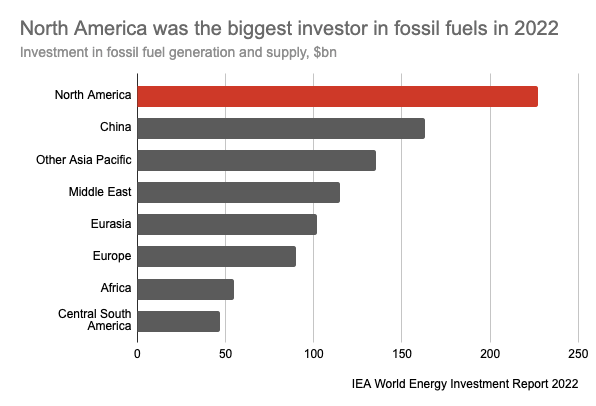
Guess who's investing the most money in fossil fuels?
Source: https://www.iea.org/data-and-statistics/data-product/world-energy-investment-2022-datafile
@drsimevans This figure is not normalized over the overall amount of investment.
While it shows that north America definitely is foraging fossil fuel, the comparison doesn't appear too fair.
To make it clear, I'm just complaining about the data in the graph, not about the analysis or the conclusions.
I don't know the actual figures, but I'll give an example to explain how this graph might fail to depict the situation, to make it simple I'll assume fossil fuel is only used in power production.
If North America was the largest power producer in the world and other countries imported energy from them, it would be normal to expect their investment in fossil fuel to be higher. Now, would it be fair to imply that they are the consumers of such fossil fuel? Indeed the consumers are the importers of such electricity and this would not appear in such a graph.
Now, let's say this is not the case and no significant export exists. This graph still fails to describe who is investing money in alternatives to fossil fuels. If North America was the lead country in renewable energies this would not appear in the graph. They might have a 70% renewable production and being very near to full conversion, however their production might be so high that the investment in fossil fuel would still appear huge.
Indeed this is a very simple and naive example, there are many sectors of economy at play. North America is a large economy and they do export a lot, so I believe this problems to be present in the analysis and probably with a major effect on the conclusions.
This doesn't mean I think north America is doing great, they're doing basically nothing of value in this area as far as I know. They could and they should do much more.
@Tappello Si, però infatti non è che le cose funzionino molto bene nel mondo reale.
La realtà è che la maggior parte di quelle cose vengono fatte da persone frustrate e non appagate dal proprio lavoro, poco rispettate dai datori di lavoro e che cercano semplicemente di fare sembrare di avere lavorato molto facendo il minimo possibile.
All'università non insegnano come si lavora, tuttavia insegnano cose che quelli che lavorano dovrebbero usare.
@statussquatter @malerbabomba@mastodon.bida.im Dubito, l'ultima volta che sono stato a contatto di lacrimogeni ero in Slovenia, a Ljubljana durante una grande manifestazione contro le misure per il covid a cui non ho preso parte.
Il gas è andato in tutta la città, anche a un paio di chilometri di distanza si sentivano gli effetti, io mi rifugiai in casa a circa 500 metri dal punto in cui erano stati sparati e per oltre un'ora non si riuscì a respirare bene.
Inoltre avere un ombrello in manifestazione può essere additato come arma impropria senza fornirti effettivamente alcun vantaggio reale.
Con un ombrello impedisci che la granata ti cada sotto i piedi e la fai cadere magari una decina di metri più in là, però il gas si diffonde rapidamente, soprattutto nelle vie chiuse di una città.
@malerbabomba@mastodon.bida.im Opinione da chimico senza alcuna conoscenza specifica sui gas lacrimogeni: dubito che l'utilizzo di bicarbonato abbia effetti lenitivi; potrebbe anzi infiammare l'occhio ulteriormente in elevate concentrazioni.
Qui riporta un solo esempio di lacrimogeno e non è acido https://en.m.wikipedia.org/wiki/Tear_gas non so effettivamente quali siano i lacrimogeni più diffusi, ma dubito che si tratti di acidi.
Immagino che le azioni migliori da prendere siano lavare gli occhi copiosamente con acqua o con una soluzione salina e lavarsi la faccia con sapone.
Inoltre, il Maalox non contiene bicarbonato come eccipiente: https://www.torrinomedica.it/schede-farmaci/maalox_tc/
Riguardo invece alla respirazione la cosa migliore sono ovviamente le maschere antigas. Dubito che le mascherine per i virus abbiano un qualunque potere bloccante, l'unica cosa che mi viene in mente è avvolgersi la faccia in un panno imbevuto di acqua e sapone, questo potrebbe diminuire la quantità di composto inalato.
La soluzione migliore per non venire danneggiati dal gas è ovviamente non venirne a contatto, pertanto spostarsi rapidamente quando vengono sparati e disattivare le granate cadute. Dubito che durante una manifestazione esistano maniere efficaci per impedire chimicamente la diffusione del gas, dunque l'opzione migliore è quella fisica: chiudere la granata all'interno di un barattolo di vetro spesso dovrebbe essere una buona opzione per impedirne la diffusione nell'area. C'è il problema che qualcuno deve sacrificarsi avvicinandosi molto rapidamente, la cosa più efficace sarebbe un gruppo di persone attrezzate con maschere antigas che ricoprano specificamente questo ruolo, ma qui ovviamente stiamo parlando di un livello di organizzazione parecchio elevato.
@amberxorluci I'd love to boost them again, unfortunately after a week or so they're lost forever...
@chsjuniper @jschauma What is the better alternative right now?
@GustavinoBevilacqua wetransfer.com
@TheStrugglingScientists 11/05 - I did an experiment, results are interesting
22/05 - The methodology I tried with the last three results didn't work out
12/10 - Results were incorrect
rastinza
boosted

Whauw, A Capella Science is back!
🔗 https://youtu.be/RFE8HQKpPlI
😻
/cc [ #acapellascience | #science × #acapella | #music ]
🔗 https://youtu.be/RFE8HQKpPlI
😻
/cc [ #acapellascience | #science × #acapella | #music ]
@hackernews@die-partei.social Depends, if they made the company lose money then I don't really care what should happen to them, stock holders will decide.
If the company made something highly immoral or illegal then no, they should not be held accountable or fired, they should be trialed and arrested.
rastinza
boosted


How the Dunning-Kruger effect is just sugar for the ego (but mathematically wrong):
https://economicsfromthetopdown.com/2022/04/08/the-dunning-kruger-effect-is-autocorrelation/
Italian, MSc in chemistry specialized in cheminformatics and QSAR.
I'm interested in cooking and building stuff.
I love traveling, I lived in India, China, Slovenia, Poland and Spain.
Currently working in Spain in the field of genomics; and doing a PhD in Drug Development using Quantum Mechanics and Artificial Intelligence.
Don't take what I say as an insult, I have no bad intentions and I'm open to talk about it.
Don't star my toots, I find that often useless: if you liked it send a reply.
Consider boosting the toots, it's the only real way in which stuff is propagated through mastodon.
Joined Feb 2022
