
🙄
OK, you win. By exhaustion of the opponent. 😆
Please know that, from now on, wherever I use the loose word “science” I'm actually referring to “‘science’ plus ‘applications of scientific knowledge’ plus ‘engineering’”.
I don't even remind why we were splitting hairs like this.
Ah, yes. Let me rewrite once again:
> What else do you need to work on this problem and come to a solution, other than _science plus applications of scientific knowledge plus engineering_?
Coming back to my initial claim, my point is that:
* All those fields are quantitative, they rely heavily on math; and they at the very least _try_ to be evidence-based, to use reason, and to aim for objectivity.
* Wherever one draws the boundaries of “science”, all those fields are parsecs away from entirely different sets of tools that people often use for decision-making, both at the individual level and as a society (once again: religion, tradition, intuition, authority, etc).
* With the possible exception of moral philosophy, no extra ingredient is necessary, or even desirable, to improve the world or to aid in individual decision-making.
tripu
boosted

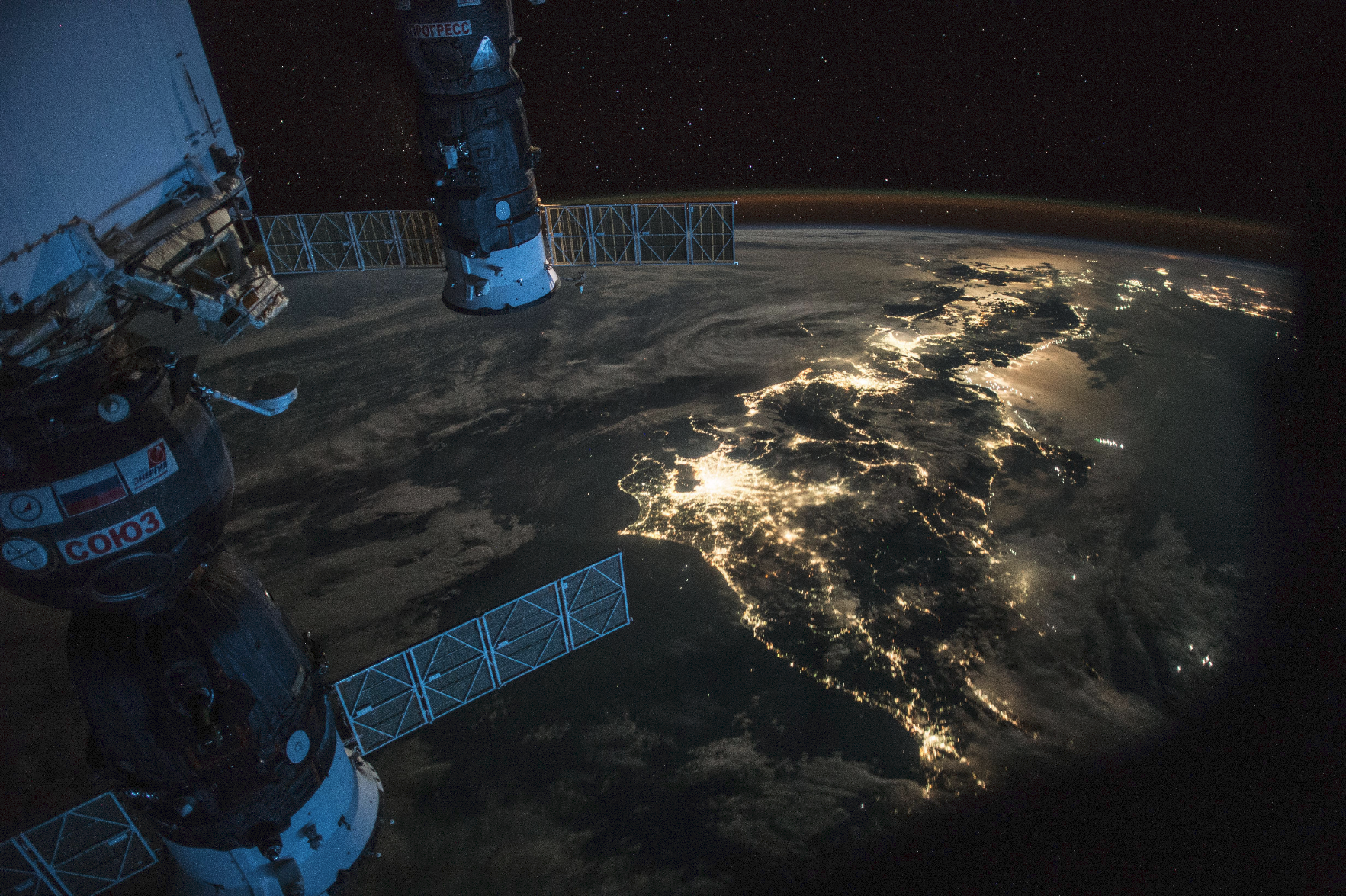
Looking at Tokyo in the night - View from ISS [Image credit: Scott Kelly]
#science #space #Earth #ISS #SpaceStation #Tokyo #Japan #photography
> _“Scientists can (and sometimes should) work on solutions for specific real world problems, but their work is no longer the textbook definition of science; that falls under engineering.”_
If a physicist working on evaluating the impact of different interventions to tackle climate change, a psychologist proposing improvements to an existing type of therapy and a biologist manipulating genes to make a certain crop more nutritious are _not doing science_ according to that “textbook definition” of “science”, I'd say that definition is useless in practice.
> _“Your example of cake cutting problems falls under mathematical optimization, which although has a lot of real world applications, can be studied on its own.”_
I have the impression you are doing all kinds of contortions to avoid acknowledging the common-sense meaning of “science” that the vast majority of us have in our minds, especially when contrasted with other areas of knowledge or epistemic systems that are obviously _outside_ the purview of even the most loose concept of “science” imaginable (religion, tradition, intuition, authority, etc).
Definitely the words “science” and “scientific” are not helping in this debate.
I suspect each of us thought the meaning of those words was clear, and that everybody else would agree with those definitions. Unfortunately, it's clear that they mean different things to different people and that we draw the boundaries in different places.
Let's try to move forward without relying on that specific word.
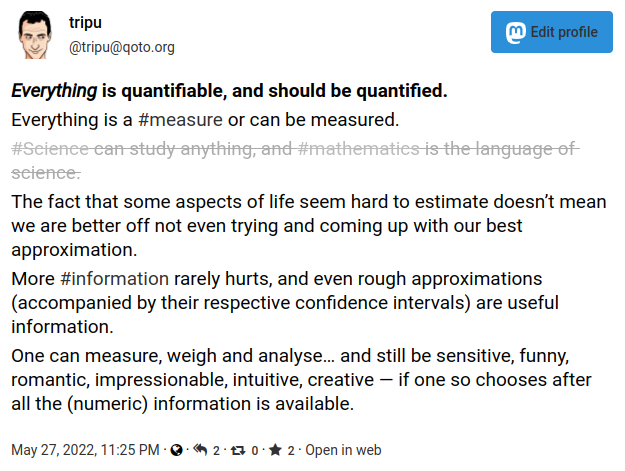
I stand by [my initial claim](https://qoto.org/@tripu/108376014503251403) slightly edited as so:
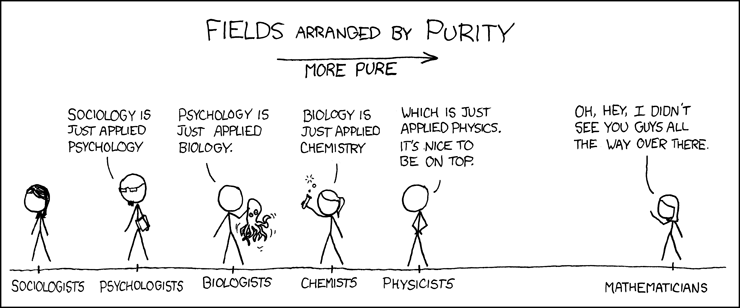
Come on, we are talking degrees here. We all know [there is only one pure science](https://xkcd.com/435/), and everything else is more or less a farse :)
> _“The purpose of science […] is to understand nature, not come up with solutions.”_
Uh?
If vaccines are not a “solution”, what is?
Does a researcher stop “doing science” the moment they complete their postdoc and focus on making a pacemaker slightly easier to maintain? Pacemakers are solutions, too. And more reliable, safer, smaller pacemakers are solutions to whatever shortcomings the previous solutions had.
Even a mathematician working on a better cake-cutting algorithm is working on a solution to something very specific and of human interest — and not so much in understanding natural phenomena.
_Of course_ #science is concerned with modifying reality (for the better!) as well as with understanding reality.
Human well-being is the ultimate magnitude of the natural world that anyone would want to optimise for, and science is the main tool we have for that.
> _“Computer science is not a science.”_
I happen to be a “computer scientist” (and also a “software engineer”).
It's debatable, and I understand your reasons for saying so. I myself have struggled with that question often.
At the same time, if computer scientists aren't scientists, _physicists and chemists aren't scientists either_:
> _“**Computer science has, by tradition, been more closely related to mathematics than physics, chemistry and biology.** This is because mathematical logic, the theorems of Turing and Godel, Boolean algebra for circuit design, and algorithms for solving equations and other classes of problems in mathematics played strong roles in the early development of the field. Conversely, computer science has strongly influenced mathematics, many branches of which have become concerned with demonstrating algorithms for constructing or identifying a mathematical structure or carrying out a function. […] For these reasons, some observers like to say that **computing is a mathematical science**.”_
— Peter Denning, “Computer Science: The Discipline” (2000).
> _“Literature is most definitely not.”_
I know, I know… I was applying the concept in a lax way…
When I was a #teenager my dream #job was to direct and host a night #radio show in @radio3_rne where I would play great music and speak in an enigmatic voice about unusual ideas.
Now that I'm 41, my #dreamjob is to read important #books, write regular opinion pieces, attend cultural events, and perhaps and host a #podcast about it all.
I still love #tech, though.
That's debatable: (good modern) moral philosophy tries to derive statements rationally from a parsimonious set of axioms (yes, there are axioms at the root of it, but as we said that's true of _any_ discipline).
But I'm willing to drop that one for the sake of making progress in the debate.
My question stands: what else do you need to work on this problem and come to a solution, other than #science?
/cc @ImperfectIdea
> _“You cannot however use science alone to take it.”_
Challenge accepted!
> _“You must first of all decide whether wealth transfer or social intervention are things that should be done, that is, if you think it is a moral and acceptable thing.”_
**Economics**: a (social) science. It studies the allocation of scarce resources (in this case, money), and in doing so provides answers to the eternal conflict between _efficiency_ (economic growth) and _equity_ (redistribution) — which is at the root of my hypothetical scenario. Necessary here.
**Moral philosophy**: a (soft) science. The study of ethics. Definitely helpful for this example too, to help disentangle questions of “is vs ought” that Economics alone can't resolve.
**Political science** (it's in the name): concerned with systems of governance and power (redistribution is implemented within those systems).
**History**: a (soft) science studying the past, and change. Because redistribution measures have been proposed or implemented before. (How did they work, what happened?)
**Medicine** (focused on physical health) and **psychology** (because individuals react to the status quo, and to proposed policies). We're trying to optimise human well-being here, after all. **Sociology** too, because _societies_ as a whole react to the status quo and to proposed policies also.
Underpinning it all: **mathematics** (especially **statistics**). **Chaos theory** to better understand market dynamics under the proposed changes.
Throw into the mix also **computer science** (to run simulations of public policies and changes in incentives). Heck, even the systematic study of **literature** [would provide useful inputs here](https://en.wikipedia.org/wiki/Project_Cassandra_(literature)).
These are all “sciences” (admittedly, under a lax definition of “science”) — in any case, definitely closer to the realm of science than to any of the other epistemic systems we've mentioned (tradition, intuition, religion, etc).
There you are. What else do you need to work on this problem and come to a solution, other than #science?

@tripu I already agreed with you that science is an useful tool, I don't see why you want to discuss that further. I never said the opposite. 1. S...
@rastinza, let me try to reset the conversation, with a couple hypothetical scenarios:
👉 We are discussing some wealth transfer program or social intervention. I present you with a number of specific individuals, in order to decide who should pay, or start paying more, or be asked to help the community somehow — and who should benefit from subsidies, grants or other kind of social assistance. How do you proceed?
👉 You're pondering whether to have kids at all, or have another kid, or have kids now or ten years from now. Your friends advise you in one direction, your religion tends to recommend something else (but your own pastor seems to disagree), your parents have their own piece of advice, social norms push you in one direction, and your gut seems to disagree with them all. How do you make up your mind?
👉 You could invest what little spare time you have in studying a new degree, working extra time at a side gig, tackling the pile of books you've been meaning to read for years, or starting to work out. What tools do you use to move forward?
/cc @ImperfectIdea
Last week I donated 10% of my gross income of 2021 to [_Ayuda Efectiva_](https://ayudaefectiva.org/) as part of my commitment to the [“Giving What We Can” Pledge](https://www.givingwhatwecan.org/pledge/).
❤️
#EffectiveAltruism #AltruismoEficaz #GWWC #philanthropy #AyudaEfectiva

This is more or less how I spend the #money I earn #finance #economics #EffectiveAltruism #EA #philanthropy

> _“Religion provides clear answers to the questions ‘why are we here’, ‘what is the purpose of life’ and so on”_
Sure. But it's not about providing answers; it's about providing _good_ answers. My 2-year-old can provide a clear answer to the thorniest of questions, too.
I sense you're stuck in binary thinking: either a theory is absolutely comprehensive, or it fails; either an epistemic system can answer any conceivable question, or it doesn't work as stated. I'm more interested in what works best.
Yes, you can reject any axiom, define “works best” to mean anything, and even deny that there could be a way to know what “works best”. But then you're trapped in an epistemic void of nihilism.
Almost everything we use for decision-making would fail at the quantum level, near a black hole, or when the Big Crunch is nigh. Again, I'm happy to rephrase my claim to restrict it to a human-scale scope. As I said, that's still an awful lot of areas that are commonly assigned to the realm of intuition, opinion, the ineffable, or the subjective — and I maintain they're not.
> _“You can use all the measurements you like, but you won't get a scientific answer.”_
I think science is the best tool we have to get closer to know whether the question is valid in the first place, and if so to learn the answer. There have been astonishing discoveries and progress, and it's continuing.
How are evolution by natural selection, the Big Bang, multiverses, computation, quantum physics, black holes, chemistry, mathematics, space probes, genetic engineering, etc _not_ getting us closer to the mystery? Project that trend one millennium (or a billion years) into the future, and tell me that math in particular, and science in general, are not helping us, by far more than anything else we have, in answering that question (and _any_ question).
> _“One edge case is enough to falsify a whole theory.”_
I'm happy for my claim that “math is everywhere and numbers are useful to us humans in all domains of life” to be limited by the Uncertainty Principle. There's still an awful lot of useful applications outside of that. After all, when was the last time you felt the UP was constraining your options in life?
> _“Making predictions does not equate to explaining something: neural networks for example make very good predictions about stuff, however provide no explanation.”_
Agreed. Still, science and math do tend to make predictions _and_ explain far more than anything else we know. Even when science or engineering can't “explain” but just “predict accurately”, they're terribly useful, and better than anything else. Don't you agree?
> _“You cannot consider religion and tradition as alternatives to science since these do not work in the same field.
How can you evaluate which works better if they provide answers to different questions?”_
What questions do religion or tradition answer better than science?
> _“The scientific method is based on several axioms, thus one might simply disregard it completely if he disagrees with one of those.”_
Agreed. But that's true of _any_ epistemic system. That's not a weakness of science. (And I would claim that science needs fewer and simpler axioms than, say, Christianity.)
🇪🇸 #Spain #university #education #gender #feminism
Sources: _Ministerio de Universidades_ ([1](https://public.tableau.com/views/Academica20_EEU/InfografiaEEU?%3AshowVizHome=no&%3Aembed=true#7); [2](https://www.universidades.gob.es/stfls/universidades/Estadisticas/ficheros/DyC_2021_22.pdf))


I think you only need a few axioms, eg “suffering is bad”. There doesn't need be a big apparatus of ideology.
Your example is simple: losing friends is trivially easy; making and maintaining friendship is costly and for some people may be difficult. Your hermit who has “too many friends” can “solve” the situation in a day or two, alienating or ignoring people as needed. The opposite is not true.
Also: necessarily, when we approximate the ingredients of well-being, there'll be outliers and exceptions. That's to be expected, and doesn't mean numbers don't work.
You can always refine the model, and measure instead no. of friends _in relation to desired no. of friends_: 1 means perfect; anything above or below is worse.
Ultimately, everything is quantifiable.
> Position and momentum of an electron
Yes, I think you hit on a valid edge case: singularities (in the physics sense). At quantum level and black hole level my claim might well fail 😅
> [Science] cannot answer the question "is science a good way to explain the world?"
Yes, it can. Put science to compete against alternatives (intuition, religion, tradition, randomness, etc) to make predictions about a specific phenomenon. See which does better. Rinse and repeat. Science comes ahead in the aggregate.
