

**1.** Many other moral rules that I (and I think most human beings) hold true do not have clear, objective cut-off measures or thresholds — but that does not utterly invalidate them.
I (and most people) believe that interrupting procreation by force one minute after intercourse is OK, but that doing so one day before the due date of the child is wrong. There might not be an instant in time where the act switches from morally acceptable to morally wrong. So what.
I (and most people) believe that an adult having sex with a newborn is wrong, but that sex with some who is 30 or older is OK. There might not be an age where the act switches from monstrous to normal. So what.
etc.
The impossibility of _“objectively [demonstrating] the ‘universal threshold for human well-being’”_ does not destroy my reasoning, I think.
Two arguments:
tripu
boosted

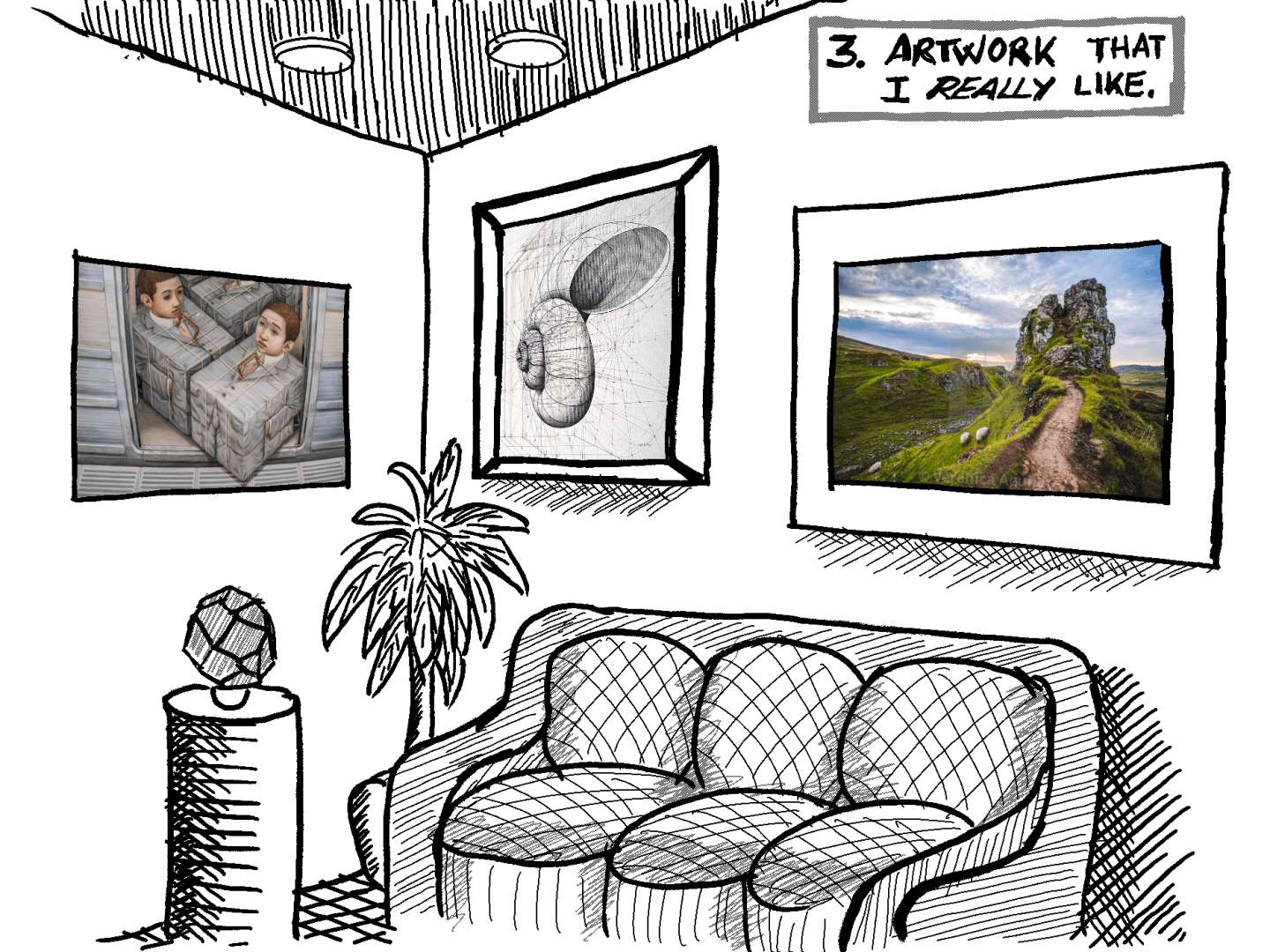
Things I want in my #house (if/when I have one), #3: #artwork that I really like.
#sketch #cartoon #drawing #reMarkable #reMarkable2 #homeSweetHome
• Tetsuya Ishida: “Self-Portrait of Other” https://brooklynrail.org/2019/11/artseen/Tetsuya-Ishida-Self-Portrait-of-Other
• Rafael Araujo: “Semi-flat Shell” https://www.rafael-araujo.com/product-page/semi-flat-shell
• Verónica Aguilar: “Fairy Glen, Isle of Skye” https://veronicaaguilarphotography.picfair.com/pics/013236649-fairy-glen-isle-of-skye
#sketch #cartoon #drawing #reMarkable #reMarkable2 #homeSweetHome
• Tetsuya Ishida: “Self-Portrait of Other” https://brooklynrail.org/2019/11/artseen/Tetsuya-Ishida-Self-Portrait-of-Other
• Rafael Araujo: “Semi-flat Shell” https://www.rafael-araujo.com/product-page/semi-flat-shell
• Verónica Aguilar: “Fairy Glen, Isle of Skye” https://veronicaaguilarphotography.picfair.com/pics/013236649-fairy-glen-isle-of-skye
tripu
boosted


 🌿
🌿  :ignucius:
Addendum (lest I should be accused of utopian over-simplification):
Yes, **chance** plays a huge role in life outcomes. Yes, **the past**, which we can't control (heritage, inheritance, the womb, childhood) is decisive, too. Yes, even conscious life decisions are strongly constrained by circumstances and by the information available at the time.
Yes, **free will** might be but an illusion.
I just want to stress that all the above holds true in our current welfare systems, too.
I realise many cases won't be easy to adjudicate. But that's a problem with our current welfare laws, too.
It shouldn't be too difficult for the State to collate all the relevant data they hold for each person and feed it to an algorithm which in many cases would produce a fairly confident result. Think work history, tax returns, residency, health indicators, race, education, reports from social workers, property owned, investments, criminal record, etc. A good chunk of the population are clearly “privileged” or “dispossessed” by looking at these metrics.
Expressed this way, it sounds eerie and inhumane. I'm just describing the logic of it here. Of course, there still would be judges, social workers, recourse, and exceptions involved — just as in the current system. But I feel this general guidance would deliver as well if not better than the current system, while decreasing rent-seeking and public expenditure (taxes).
Thoughts?
🧵 5/5
**A single parent who finds themselves struggling to raise their offspring while at the same time enjoying themselves the small luxuries of modern life** (tourism, Netflix, eating out, a new car, a gym membership). If they are a single parent because their spouse died or left, leaving them with precarious income, they should get some benefits to help them make ends meet. If, on the other hand, they decided to raise kids without a partner in the first place, they are not morally entitled to anyone else's money.
**A new retiree who suddenly can't afford more than the basics and has to lead a monastic life until death**. If that person had miserable jobs all their life and still managed to be frugal and save a bit for retirement, society owes them a chunk now, since their misfortune was not their fault and they made responsible use of the bad cards they were dealt. If, on the other hand, that person used to be well-off and had the resources to invest on their own retirement plan, but was reckless enough to live hand to mouth instead, then a monastic life is all they get, in all fairness (no assistance from the rest of society).
**Someone who is unemployed.** If they are unemployed because they are handicapped, belong to a marginalised group, suffered an important workplace accident, have a very low IQ, etc, then society should fund a reasonable life for them (ie, above the minimum threshold). If, on the other hand, that person is lazy or unconscientious, or too picky when offered a job, then food, clothing and shelter is all they are entitled to get from the rest of society.
🧵 4/5
What about **needs up and beyond that basic threshold**? To give a few examples: predictable, regular cash flows from retirement until death (public pensions); subsidies for IVF or child care; public study grants; tokens for public transport; subsidised campsites or holidays; everything having to do with “culture” or sports (coupons for book shops, concerts, museums, sport centres, sport clubs).
For those, I draw a line between situations of necessity that are **caused by events mostly outside the control of the person**, and those **for which the person is much to “blame”**. I am all for taxes to fund the former, and zero for the latter.
So: individual responsibility, and the predictability of the (bad) outcome, are my deciding criteria.
Here go a few examples:
🧵 3/5
First of all, I establish
* a **universal, absolute threshold for human well-being** (enough food, reasonable shelter, basic medical treatment, physical safety), and
* the moral obligation of society as a whole to help those who find themselves below that threshold, _for whatever reason_,
* for as many people as necessary, for as long as necessary, and regardless of the cost in taxes.
It doesn't matter whether you are a long-time beneficiary of social benefits already, a former billionaire who recklessly burned all their cash, a chronic tax-evader, or an unrepentant serial killer: if you are starving, have no roof, or suffer from illness or violence — and you do _not_ have the resources to remedy your situation — and you have _not_ unequivocally rejected the assistance of society — then it is not only moral but _mandatory_ that our taxes be directed towards lifting you out of that dire state and back into human dignity.
That's the unconditioned baseline for welfare benefits.
🧵 2/5
More about me slowly coming to (always temporary) conclusions in #politics:
#welfare, social #safetynet
For a long time, I failed to define a clear line between **fair, necessary, humane benefits** on the one hand, and **greedy, opportunistic, unjustified rent-seeking** on the other.
More recently I settled on a heuristic that I find just, and that is fairly simple to apply:
🧵 1/5
This is the kind of #cityscapes that I dig 🏙️
https://www.reddit.com/r/CityPorn/comments/onbxp5/shanghai_at_night_china/
#urban #punk #dystopia #BladeRunner
@shironeko
I consider quite a few more variables: licence, source code, protocol, jurisdiction, governance, discoverability, feature set, usability…
/cc @eff
@shironeko
Fair enough. We enter the territory of trade-offs and individual preferences.
/cc @eff
@icedquinn
It depends on your definition of #libertarianism, doesn't it? I was discarding radical libertarianism (ie, #anarchism).
Even if all monopolies are cancelled, as long as there _is_ a State, there is central authority exerting _some_ coercion, limiting _some_ freedoms. What I meant to say is that I'm fine with that. ie, I think I agree with you in that even a libertarian society ought to have some restrictions.
@shironeko
_Every_ tool has its drawbacks (usability, if nothing else). Isn't #Signal, in practice, among the very few “least bad” options we have? If your recommendation is encrypted e-mail or something like that, we have very different use cases in mind.
/cc @eff
When I was younger, I thought that the defining distinction between #theLeft and #theRight was **solidarity** — as in, the former necessarily _has_ to have way more of it than the latter.
Gradually I came to realise that characterisation is problematic for three reasons:
1. #Leftists want to _impose_ #solidarity, which is an oxymoron (by definition, you can't mandate voluntary inclinations, such as affection or desire, on people).
1. In practice, and at least in my own country (#Spain), the Left has become pro-independence and sympathetic towards secessionists (but more solidarity would require larger unions, stronger federations — not the richest regions going their own way).
1. Sometimes the Right puts in practice _more_ solidarity towards certain groups or causes (eg, non-elites, non-conformists, disadvantaged people who reject the orthodoxy) than the Left itself.
I now think that the **ratio _personal freedom_ vs _economic freedom_** better categorises Left vs. Right (cf #NolanChart). I like to think of those two dimensions as “#freedom to do what you please with your **body**” (food, drugs, euthanasia, suicide, sex, read, speech, thought, association, religion) and “freedom to do what you please with your **property**” (save, invest, buy, sell, donate, build, trade, settle).
This is not a defence of #anarchism or #libertarianism, by the way — I do believe _certain_ restrictions on both kinds of liberties are necessary for any society to function at all.
tripu
boosted



"En su juego solo ganan ellos". ¡El meme más currado de nogafam hasta ahora!
Ojalá llegue hasta el final del mundo, esta imagen dice mucho por si sola.
Ojalá llegue hasta el final del mundo, esta imagen dice mucho por si sola.


 🇳🇱
@freemo@qoto.org
🇳🇱
@freemo@qoto.org
@tripu FYI did you know QOTO has its own Matrix server now? Open registration for all: https://element.qoto.org @eff
Here I am talking (in 🇪🇸 #Spanish) about curious and useful 🇯🇵 #Japanese words in the latest #episode of #BolaDeCristal #podcast:
👉 [**_“La magia del vocabulario japonés”_**](https://www.boladecristal.es/blog/2021/07/08/ep40-la-magia-del-vocabulario-japones/)
* [MP3 file](https://podcastcdn-26.ivoox.com/audio/1/4/2/3/ep40lamagiadelvocabulariojaponesco-bolacristalpodcast-ivoox72543241.mp3?secure=PcIBOkWi9rl3hxXOK0hEPQ==,1626621100))
* [On Spotify](https://open.spotify.com/episode/6TsOrvD32wu46qPcpgfQwB?go=1&utm_source=embed_v3&t=0&nd=1)
