

(webdev Tory)  @worldsendless@qoto.org
Full Stack Clojure web app engineer
Joined Jul 2021
@souldessin Google, for instance, does NOT use the slash in its searches
Whoa! TIL that it's actually okay to have a slash before your query strings, and that some servers require it!
myexample.com?an-arg vs myexample.com/?an-arg
https://stackoverflow.com/questions/1617058/ok-to-skip-slash-before-query-string
Small ongoing issues remain after changing my OS to Guix from a backup. I didn't realize how much I relied on symlinks until finding they were all broken in the backup.
(webdev Tory)
boosted
boosted

*Escape to Freedom* is a new animated video from the Free Software Foundation (FSF), giving an introduction to the concepts behind software freedom: both what we gain by having it, and what rights are at stake. #UserFreedom #EscapetoFreedom https://u.fsf.org/escape-to-freedom
Apparently, my way of just using twitter through certain browser profiles doesn't save me from nonfree Javascript. https://www.fsf.org/twitter
(webdev Tory)
boosted
boosted

Had a SUPER productive weekend! Finally finished Half-Life 2 and can't wait for the sequel.
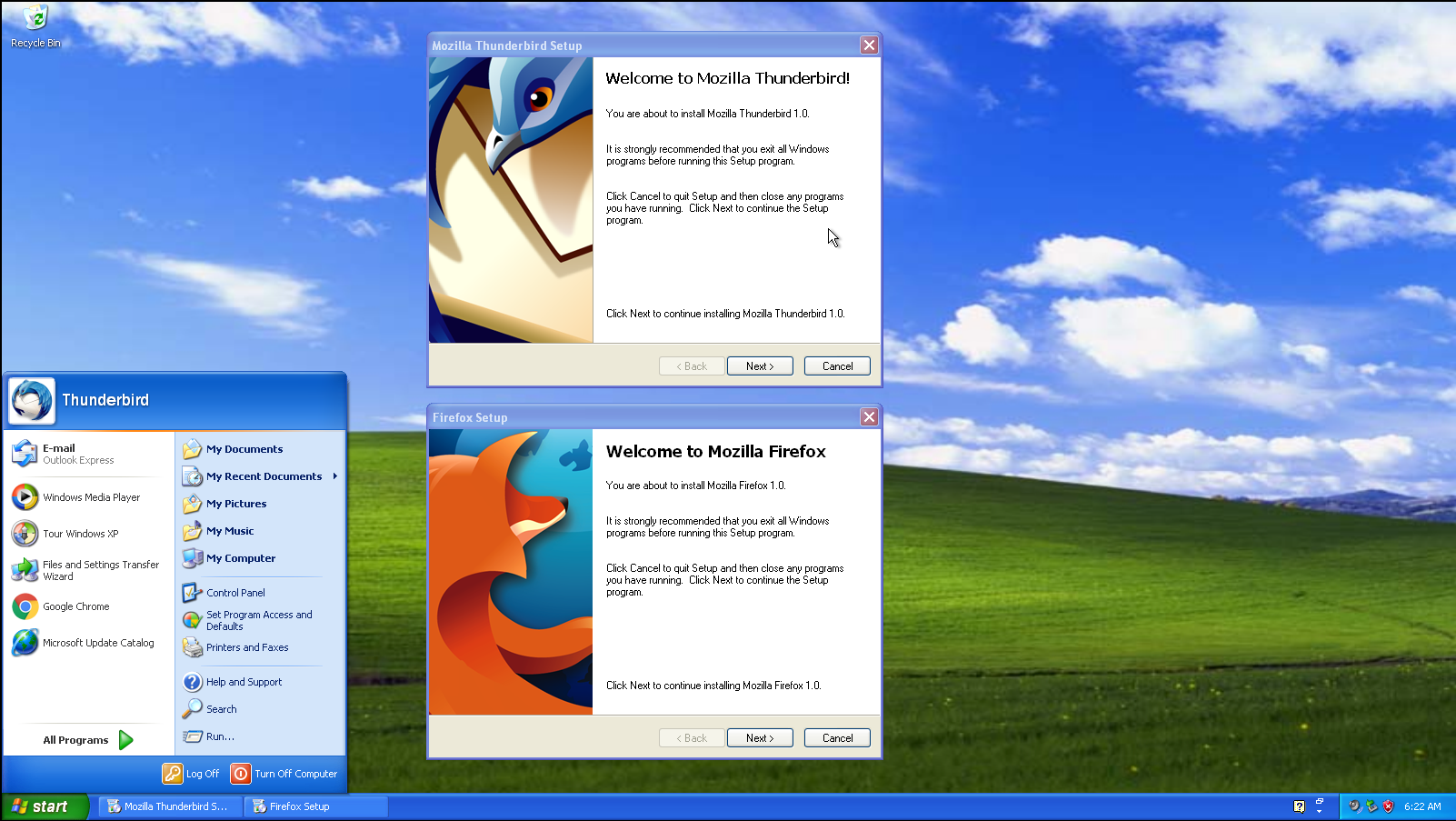
We also upgraded our Dell Inspiron 7000 from Windows 98 to Windows XP and it's time to install Mozilla Firefox 1.0 and Thunderbird 1.0
Looking forward to trying these new apps!
(What year is it?)
@yoshuawuyts Do you think that is a sign of stability concerns, or the mark of active community?
Look what I found! https://www.gnu.org/software/librejs/
As a Clojure webdev, I love open source, but our excellent CLJS infrastructure is often powered by React.js, which falls an the wrong side of The Javascript Trap. What to do? https://www.gnu.org/philosophy/javascript-trap.html
(webdev Tory)
boosted
boosted

@worldsendless quora doesn't show anything without requiring nonfree JavaScript and blocks Tor, so I wouldn't recommend using it: https://www.gnu.org/philosophy/javascript-trap.html
@icedquinn >linux foundation consists primarily of big tech vultures
Yes, the "Linux foundation" is a bunch of proprietary software companies working together on their proprietary malware.
>maybe valve who is pushing some stuff for the desktop
valve is pushing nothing for the GNU/Linux desktop - rather corrupting it with their proprietary filth.
Their steam client still uses 32bit libraries(!) on a 64bit processor in 2022 and the only contribution I'm aware of from valve is to; WINE+DVXK+esync (Proton).
So many people seem to love claiming that valve is doing "so much for Linux", but as far as I am aware, valve hasn't made a single commit to Linux.
Yes, Linux is dead - as it contains proprietary malware, but GNU Linux-libre is a revival of it: https://www.fsfla.org/ikiwiki/selibre/linux-libre/
@icedquinn >linux foundation consists primarily of big tech vultures
Yes, the "Linux foundation" is a bunch of proprietary software companies working together on their proprietary malware.
>maybe valve who is pushing some stuff for the desktop
valve is pushing nothing for the GNU/Linux desktop - rather corrupting it with their proprietary filth.
Their steam client still uses 32bit libraries(!) on a 64bit processor in 2022 and the only contribution I'm aware of from valve is to; WINE+DVXK+esync (Proton).
So many people seem to love claiming that valve is doing "so much for Linux", but as far as I am aware, valve hasn't made a single commit to Linux.
Yes, Linux is dead - as it contains proprietary malware, but GNU Linux-libre is a revival of it: https://www.fsfla.org/ikiwiki/selibre/linux-libre/
Quora sent me an "interesting question."
"Is Linux dead? Why?"
I'm not even bothering to read that clickbait. Are some questions stupid? Actually, yes. Clickbait questions are stupid.
But when you still maintain that old code, the cringe becomes a cold sweat
---
RT @catalinmpit
Looking back at my old code and content makes me cringe.
Sometimes it's good to look back and see how far you've come.
https://twitter.com/catalinmpit/status/1548299178618417154
RT @programmerjoke9
but it's easy#100Daysofcode #javascript #programming #dev #linux #java #programming #CodeNewbie #python #reactjs #bugbounty #DataScience #infosec #gamedev #BigData @programmerjoke9

At this point I'm too far down the rabbit hole to imagine switching from emacs (far more than code usage). But I'm haunted by the possibility of specialized editors, even though webdev is intrinsically polyglot. Cross-pollination, though, rules my philosophy, and emacs triumphs.
---
RT @stylewarning
With that said, please build more language-specific IDEs. I get a lot of work done in Emacs, and it's the least bad option for me, but I'…
https://twitter.com/stylewarning/status/1548577956024307712
RT @stylewarning
I switched to Emacs after about 12 years of coding. Prior, I was a huge fan of slick, glossy, command & control IDEs. (I probably still would be if they actually continued to innovate.)
Haven't switched since changing to Emacs. It's trusty and dependable, whilst being advanced. https://twitter.com/bluespacecanary/status/1548499233661075458
@abbienormal @veer66 it makes no assumptions about the shape of the migration/db you are at right now; it only reads the sql files, and keeps track of which ones have been run yet.
Migratus takes care of loading specified sql files in a particular order, and provides Clojure bindings to run/create said files. It takes an init file, run at the start to set up your schemas, then runs all the up and down migrations in numerical-sort order, where the recommended numeral is something like the Unix timestamp.
So it runs any number of SQL things on your database, and does it in the right order. It also supports knowing which ones have already been run, and being able to back-track them. So it's all about batching and ordering, with some features (which, I'm ashamed to admit I've never used) for versioning your database.

The distinction here is whether it helps right queries as you access the db in business logic (HoneySQL does this, so you never need to actually type SQL), or whether it reads SQL code and implements it as migrations (Migratus does this)
@abbienormal @veer66 I think the comparison is to other tools. I didn't know Django did that, but I believe Scala also has a nifty migration-updater tool. For Clojure, I actually want to make something that will create migrations based on my current data. Right now, though, I just use Migratus plain.
@veer66 @abbienormal Oh. For writing SQL statements I love HoneySQL
Full Stack Clojure web app engineer
Joined Jul 2021
