

@yangwenli That's a likely explanation, yes.
One may be tempted to brush aside any positive correlation between conservatism and health and happiness as a side-effect of some strong positive correlation between conservatism and income/wealth (“well, no wonder conservatives are happier and healthier and start more families: they just have more money!”).
Except… there is no such strong correlation. Today, in countries like the US and Spain, income [“has for all practical purposes zero discernible effect” in voting attitudes](https://www.cspicenter.com/p/the-national-populist-illusion-why-culture-not-economics-drives-american-politics), or the effect [is very weak](https://qoto.org/@tripu/106788318030499881).
So there has to be something else going on.
WDYT?
⑤ Mutual understanding:
> _“We tested how well liberals and conservatives could understand each other. We asked more than two thousand American visitors to fill out the Moral Foundations Questionnaire. […] One-third of the time they were asked to fill it out as they think a ‘typical liberal’ would respond. One-third of the time they were asked to fill it out as a ‘typical conservative’ would respond. […] The results were clear and consistent. **Moderates and conservatives were most accurate in their predictions**, whether they were pretending to be liberals or conservatives. **Liberals were the least accurate, especially those who described themselves as ‘very liberal’**.”_
④ #Tolerance:
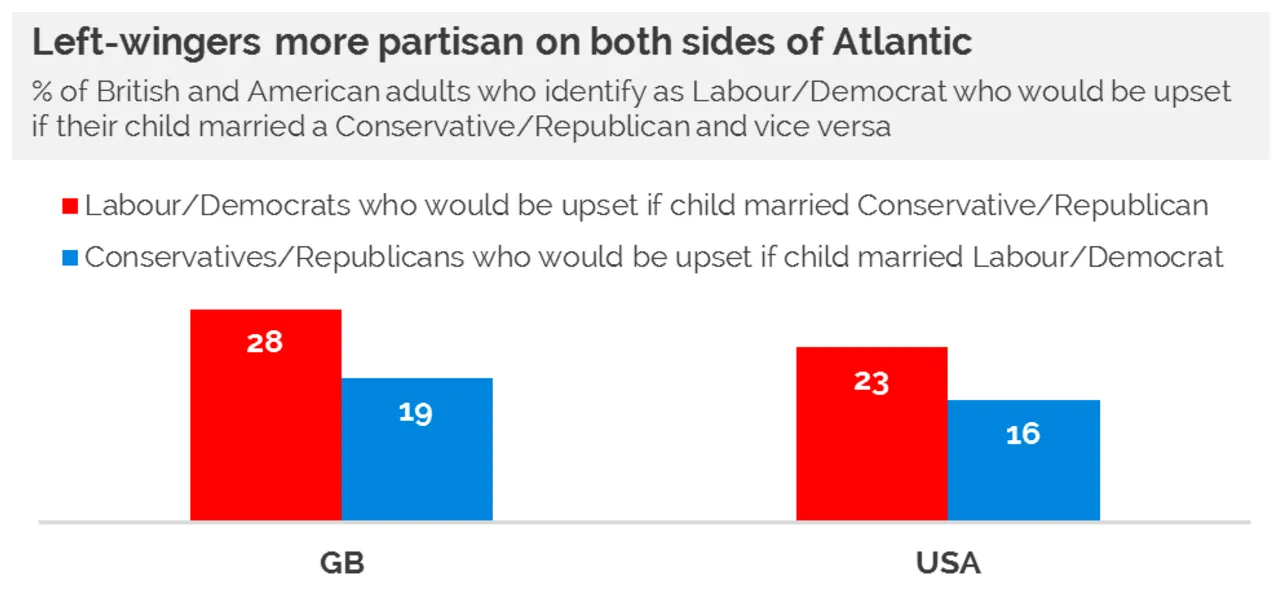
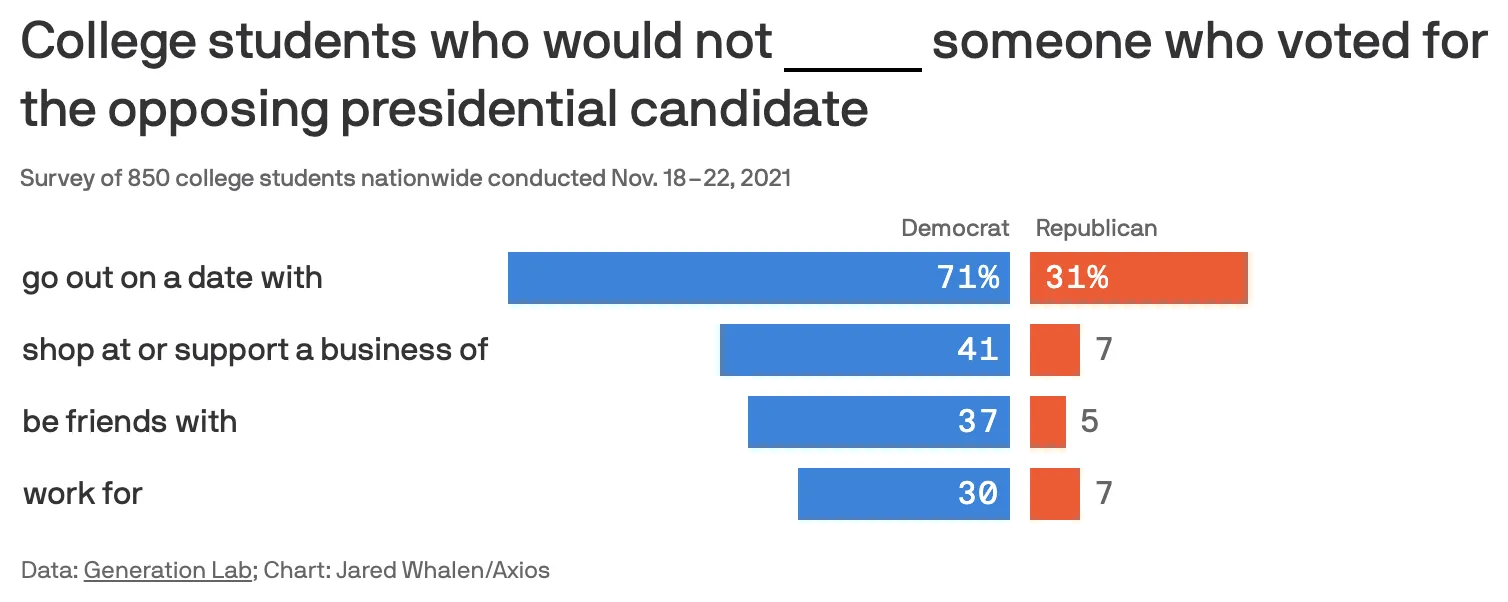
> _“**Liberals are in their personal lives more intolerant of conservatives than vice versa** across numerous dimensions in the US and the UK. Those on the left are more likely to block someone on social media over their views, be upset if their child marries someone from the other side, and find it hard to be friends with or date someone they disagree with politically.”_
— https://richardhanania.substack.com/p/why-is-everything-liberal
Sources here, with lots of interesting surveys and charts: https://noahcarl.medium.com/who-doesnt-want-to-hear-the-other-side-s-view-9a7cdf3ad702
③ #Happiness (and mental health again):
> _“**Political conservatives are happier than liberals**. We proposed that this happiness gap is accounted for by specific attitude and personality differences associated with positive adjustment and mental health. […] In four studies, […] differences accounted for the happiness gap. These patterns are consistent with the positive adjustment explanation.”_
— https://www.sciencedirect.com/science/article/abs/pii/S009265661100170X
Possible flaw: “conservatives, who are described as fearful, defensive, and low in self-esteem, will rationalize away social inequalities in order to justify the status quo (system justification)” (same source).
② Mental #health:
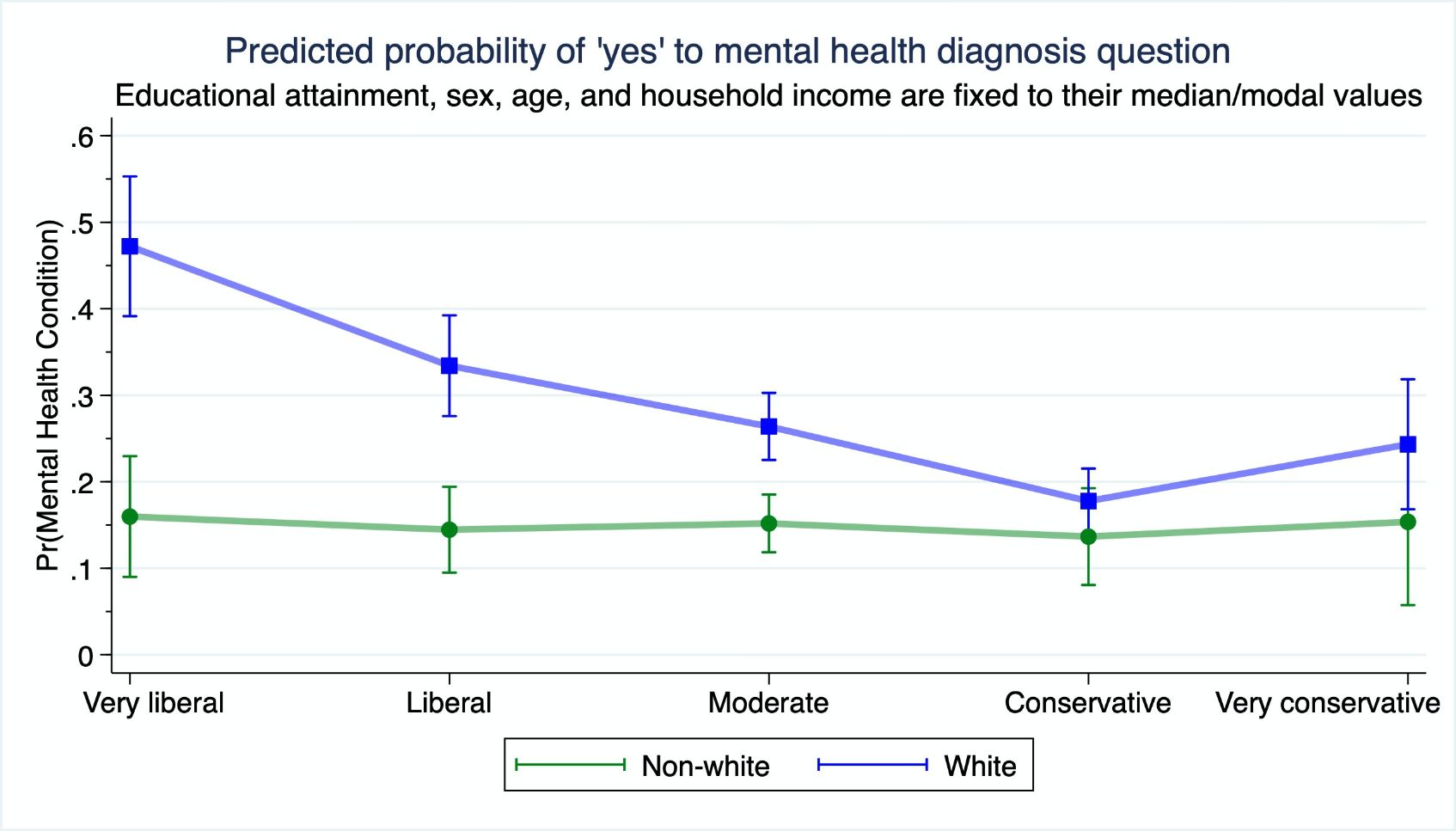
> _“**White (and especially ‘very’) liberals are far more likely than all other ideological-racial subgroups to report being diagnosed with a mental health condition**.”_
— https://twitter.com/ZachG932/status/1248823825317363714
Possible flaw: [“it's possible that the disparities in self-reported diagnosis are simply or partly a function of white liberals being more likely to seek mental health evaluations”](https://twitter.com/ZachG932/status/1248826478432858112).
① #Marriage and family life:
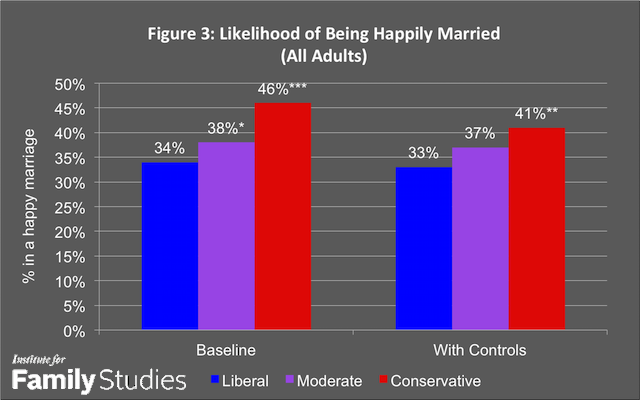
> _“**Conservatives are more likely than liberals to be happily married**, simply because they're more likely to be married in the first place. […] Ideology predicts marital status among Americans about as well as income or education.”_
— https://ifstudies.org/blog/more-than-money-the-liberal-conservative-divide-in-marriage/
Possible flaw: I suspect age correlates with both probability of being married and with probability of leaning right, so when you look at who's married _today_, some of those (happily) married who declare to be conservatives would have been singles who identified as liberals two or three decades earlier. In other words: perhaps it's not that being a liberal makes you less likely to marry, but that being married and having children moves you closer to conservatism!
Recently I have stumbled upon several studies that seem to suggest that (at least in the US) #conservatives are happier and healthier than #liberals, that they are more tolerant of different points of view, and that they understand the ideas of their adversaries better than they are understood.
👇 Putting it all here, plus some comments where I think results may be biased or distorted.
Michel de #Montaigne on #rationality (#Essays):
> _“Since it has pleased God to endue us with some capacity of #reason, to the end we may not, like brutes, be servilely subject and enslaved to the laws common to both, but that we should by judgment and a voluntary liberty apply ourselves to them, we ought, indeed, something to yield to the simple authority of nature, but not suffer ourselves to be tyrannically hurried away and transported by her; reason alone should have the conduct of our inclinations. I, for my part, have a strange disgust for those propensions that are started in us without the mediation and direction of the judgment.”_
https://www.gutenberg.org/cache/epub/3600/pg3600-images.html#link2HCH0065
@rastinza Except those keep (or even increase) their value after years or decades, don't they? I'm more sympathetic to that: they're status and fashion, but also an investment.
I see people nowadays buying ~€1,000 #smartphones, and replacing them every year or two — especially techies and teenagers.
Hear me out: I bought my current smartphone… four years and five months ago. I paid exactly €144,74 for it. It was (and still is) free and unlocked. It is still in good working condition (although getting a bit too slow now).
I am a professional technologist.
_What the hell do you need a $1K cell phone every couple of years for?_
I will just say that there is nothing in #rationality that “ignores human aspects”. “lived experience” or “feelings”. That's a false antagonism you are drawing there, Amy.
My claim is that reason and evidence are the best tools we have for dialogue and progress, and that the scientific method and rational argumentation are useful even to discuss human well-being and cultural issues.
https://www.merriam-webster.com/dictionary/rationality


I agree. Expecting feelings from victims and reason from those in power (or vice versa) is simplistic. That was my point.
I was answering to this:
> _"‘Removing feelings from political matters’ is a age-old attitude […] which neatly maintains unequal status quos. It prioritizes the advantage of those who already benefit […] by dismissing complaints or advocacy for change (‘feelings’) to make them neither heard or valued.”_
You are saying that “removing feelings from political matters” benefits “those in power”, or at least that on average it tends to benefit “those in power” more.
But I think that “removing feelings from political matters” benefits… _those who have better rational arguments_. And that is a good thing. Sometimes a club of millionaires has the best argument, sometimes a prosecuted minority has the best argument.
I discount the value of feelings as valid currency in public debates _for all participants_ (not just minorities).
And I'm sure you do, too:
Nationalists lamenting the arrival of immigrants, nativists longing for the “pure blood” of their race, people against abortion who weep when they think of a 6-week fetus that won't be born, people who experience profound disgust at the idea of two men getting married… those are feelings, very specific and strong feelings. Why don't we (you and I) give credence to those strong emotions? Because their arguments are flawed.
tripu
boosted


Southern view of Jupiter taken by the Juno spacecraft as it departed from Perijove 48. The camera, which is already well beyond it's expected lifetime, experienced some sort of temperature anomaly which resulted in most of the images not having been taken on PJ48. Hopefully the camera engineers find a solution before the closer Io passes!
NASA/JPL-Caltech/SwRI/MSSS/Kevin M. Gill
#Jupiter #Perijove48 #NASAJuno #Juno #JunoCam #Space #Science

That's true. I don't have that information.
But note that we can't assume that land reclaimed from animals would have _lower_ caloric output, either.
What we _do_ know is that one unit of land used for crops produces 16.3× as many calories and 6.8× as many proteins than one unit of land used for animals, on average.
Since we currently use more than three times as much land for animals than for plants, even assuming very conservative decreases in production, it seems the switch would be for better (less suffering, less land, less water, fewer antibiotics, less pollution, less CO₂).
I agree that if the vast majority of land used for animals now were pastures that are mostly useless for anything else, then the switch wouldn't be feasible. But is that the case?
/cc @bonifartius
OK, I'll think about that!
Right now, I don't see that I feel personally uncomfortable or threatened by any of this. It may be a blind spot.
Of course, to the extent that some rights are a zero-sum game, I have something to lose when public attitude or the law change to favour any of my outgroups, even if it's a small push at the margin. But then, that's true for everyone.
(Many rights and advances seem purely good for everyone; I'm sure we would be eye to eye about those.)
I don't understand that, Amy. Since when are feelings “progressive” and reason “conservative”?
Is there any evidence that social progress happened more often in History when society gave more weight to the _feelings_ and _emotions_ of minorities, thinkers or philanthropists — as opposed to paying more attention to _better rational arguments_ from their part?
> _“The madness starts when good meadows are plowed and used for crops. […] I've seen this being done to plan corn for bio-gas.”_
Agreed. I was referring to food only.
> _“It may certainly not ‘optimal’ to have ruminants on green land, but they create food from plants humans never could consume.”_
But we don't _need_ to raise ruminants to transform inedible plants into meat and dairy. We can grow edible plants in the first place, using far less resources and polluting less, and still feed everyone with that. That is why the current situation is not optimal (as you admit).
> _“It also doesn't make sense to drop one of the most important local protein and fat sources in cold and moderate climates, instead transporting stuff around the globe.”_
It makes total sense if the net impact of growing elsewhere + transporting is smaller than growing locally — and that seems to be the case very often.
(Only disadvantage I can think of: food sovereignty, resilience against geopolitical turmoil.)
/cc @freemo
> _“It is quite often the case animals are raised on land explicitly not suitable for crops.”_
If 23% of agricultural land currently dedicated to crops provides 83% of necessary calories worldwide, we would need to “reclaim” only an additional 4.7% of land from livestock usage in order to feed everyone only with plants. Even looking at protein sources, only 11.3% of land would have to be reallocated from “animals” to “plants”.
So even if it were “often the case” that land used for animals can't be used for plants, it looks like we could still do the switch.
/cc @bonifartius
